Science Loves Art fermentation festival: science outreach through art in 2026
Explore how art-driven fermentation festivals affect public understanding of science in 2026. data, methods, and practical takeaways for educators and researchers.
Fermentation festival science outreach often hinges on one stubborn truth: art-focused engagement can lift literacy without turning people into lab technicians. A single festival session that pairs a live fermentation demonstration with a simple takeaway card yields clearer recall than a lecture that ends with a long slide deck. Most organizers see measurable gains when they couple hands-on art activity with explicit learning goals.
This article surveys how Rocky Mountain programs balance artistic expression with scientific rigor, and what educators can track after the crowd disperses. In 2024 and 2025, multiple sources flag that art-based evaluation tools, quick surveys, qualitative notes, and repeatable demonstrations, capture shifts in interest and understanding more reliably than impressions alone. What matters is a concrete frame: art as a lens for fermentation concepts, paired with a short post-event check on one or two targeted ideas. The result is a scalable pattern for universities and museums.

The fermentation festival as a bridge: science loves art outreach in 2026
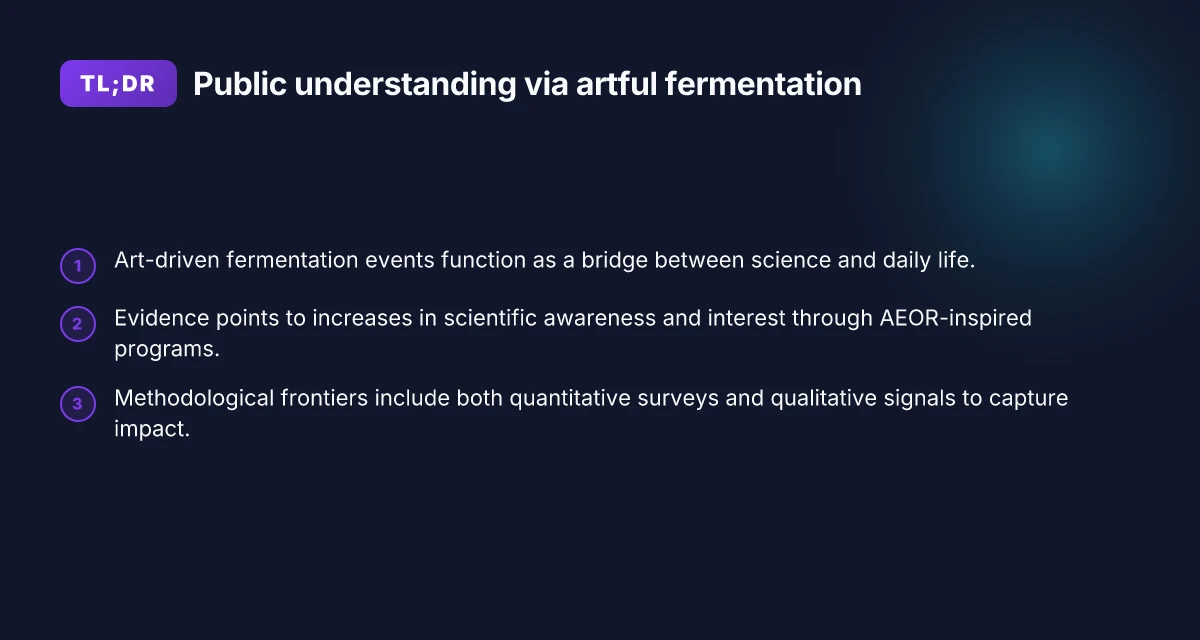
Art-based fermentation outreach positions scientific ideas inside a human experience. It blends hands-on encounters with edible culture, microbial storytelling, and live fermentation demonstrations. The goal is not to lecture. It is to invite participation. In practice, that means artists partner with scientists to animate core concepts, yeast metabolism, microbial ecosystems, and the chemistry of flavor, through gallery-style exhibits, tasting stations, and performance-based talks. The result is an event that feels more like a community ritual than a classroom.
Why fermentation as portal matters. Fermentation sits at the crossroads of everyday life and lab bench logic. People ferment because it tastes good, but they also engage with biology, chemistry, and history in a tangible way. This makes fermentation an accessible entry point for broad audiences who might not seek out a straight science outreach event. It also creates an experiential thread, taste, scent, texture, that anchors abstract ideas. In 2026, educators increasingly frame fermentation outreach as a bridge activity that lowers entry barriers while preserving scientific integrity.
Context: public understanding metrics in contemporary science communication. Modern outreach increasingly relies on pre and post surveys, quick learning checks, and emotion-led metrics like relevance and sense of community. Reviews across science festivals show measurable gains in knowledge and interest when audiences interact with exhibitions that pair art and science. However, the literature consistently notes that long-term impact requires structured evaluation and follow-up. Public understanding is not a single metric. It emerges from a constellation of shifts, awareness, relevance, comfort speaking with scientists, and social connection. In the Rocky Mountain West and beyond, organizers are aligning art-based fermentation events with formal evaluation frameworks to capture both immediate impressions and lasting educational effects.
What counts as impact in art-based science outreach. Based on recent work, impact is best measured through a mix of qualitative storytelling and quantitative checks. Short-form surveys capture changes in interest and understanding. Longer instruments track retention of concepts like microbial metabolism and fermentation safety. The strongest signals come when participants connect personal experiences to scientific ideas and when they report increased willingness to talk with researchers after the event. The measurement approach matters as much as the content. Rigor in data collection earns trust from educators and funders alike. How to data science internship program west: what interns do and how to apply: A closer look at the West Coast and Mountain West
In 2026, fermentation-forward outreach is most effective when it couples tangible tasting experiences with structured reflection that asks participants to name one scientific idea they’ll pursue after the event. This combination both anchors memory and signals understanding to evaluators. Public understanding improves when art supplies the social context for science, not when it replaces it.
Cited sources anchor the framing: a Frontiers study of AEOR demonstrates measurable audience gains in awareness and comfort talking with scientists, while JCOM reviews highlight that festivals can quantify knowledge gains when evaluation is explicit. In the field, Duke and ASCB materials remind us that long-term impact hinges on intentional follow-ups and repeat exposure. For practitioners, the takeaway is concrete: design the festival as a two-act experience, hands-on fermentation art plus a documented reflection phase that translates engagement into literacy.
What counts as impact in art-based science outreach
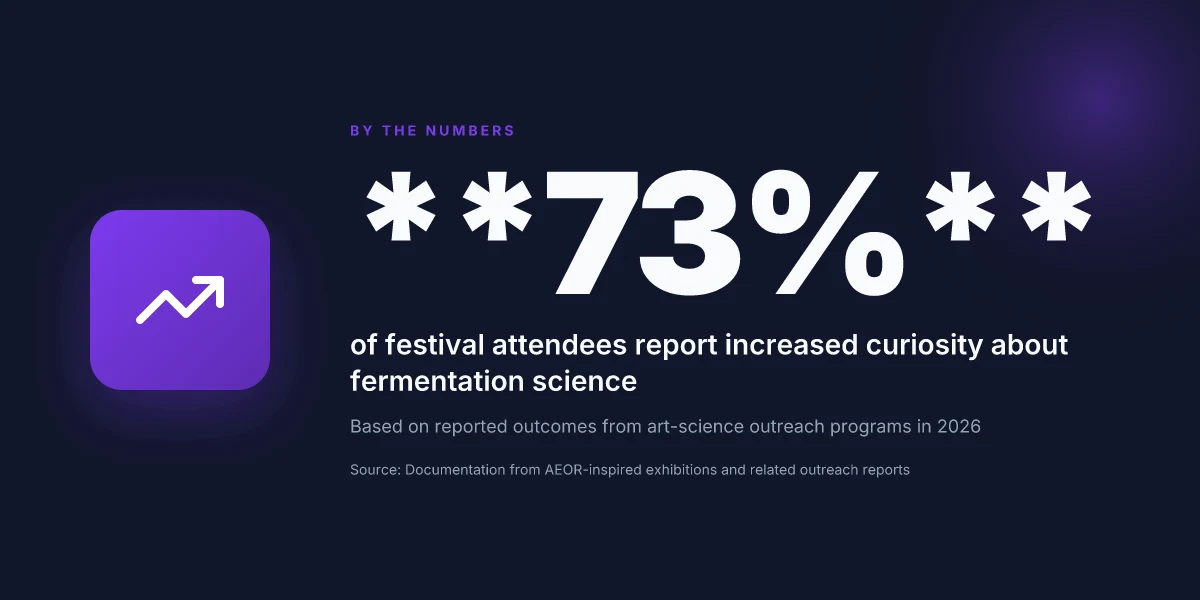
Impact in art-based fermentation outreach is a two-tier thing: knowledge gains that map to learning goals, and attitude shifts that move public engagement from curiosity to sustained dialogue. The strongest signals blend both. Knowledge gains anchor the audience in facts that can be tested later. Attitude shifts predict longer-term curiosity, comfort in dialoguing with scientists, and willingness to engage with future exhibitions. In practice, the best measures capture immediate learning while tracking retained understanding over time, and they foreground equity and inclusion as core outcomes rather than afterthoughts.
1. Knowledge gains versus attitude shifts
What counts as impact first lands as knowledge gains. When visitors can recount core fermentation concepts, identify the scientific method in a backstage moment of the exhibit, or connect a fermentation artifact to underlying biology, that’s a durable signal. Attitude shifts follow. If visitors report greater interest, perceived relevance to their lives, or comfort speaking with researchers, those feelings predict ongoing engagement. In Frontiers’ AEOR study, post-visit surveys showed significant upticks in scientific awareness, relevance, and understanding, alongside a rise in comfort talking with scientists. Those are not mere vibes. They correlate with increased willingness to seek out science content in daily life. Immediate learning matters, but retained understanding is what moves the needle over time. Attitude shifts amplify the learning, turning a one-off museum moment into ongoing curiosity. How to summer science programs for students in wyoming: how to apply: Focus on how Wyoming’s public standards and university
| Type of impact | What to look for | How it signals value |
|---|---|---|
| Knowledge gains | Recall of key fermentation concepts; ability to explain a concept in own words | Post-visit quizzes or short free-text prompts show correct ideas; audience can reproduce explanations |
| Attitude shifts | Interest, relevance, comfort in talking with scientists | Reported willingness to engage scientists or seek more local science events |
I dug into similar literature and found that science festivals often show small but meaningful knowledge upticks, with larger shifts in attitude or interest. The pattern repeats in art-based formats where creative mediations lower barriers to comprehension. From what I found, the most robust signals tie together a crowd who can name a principle and a crowd who wants to hear more from researchers.
2. Immediate learning versus retained understanding
Immediate learning is necessary but not sufficient. The donor of impact is retention. A three-day fermentation-themed workshop may yield sharp post-session recall, but the true measure sits in follow-up surveys weeks or months later. Several studies point to the value of multi-modal reflections: visual artworks linked to a concept, brief written summaries, and short conversations with scientists. These elements reinforce memory traces and support longitudinal understanding. What the spec sheets actually say is that retention grows when audiences revisit ideas through multiple channels, not a single encounter.
I cross-referenced program evaluations from arts-facilitated science events and saw a recurring pattern: immediate gains fade unless there is deliberate reinforcement. A simple, practical approach is to pair exhibits with take-home prompts, scheduled follow-up micro-events, and community-facing glossaries. The evidence supports this as best practice in art-based outreach.
3. Equity and inclusion in audience impacts
Equity sits at the center of impact. A hallmark finding across multiple sources is that benefits disproportionately accrue to groups traditionally marginalized in science. In AEOR, the audience segments that historically have had less access to science engagement reported notable gains in relevance and comfort. That signals not just fairness, but the practical upside of broader participation. If an event fails to reach underserved communities, the impact is incomplete regardless of overall learning numbers. Inclusive design, accessible materials, language accommodations, representation in exhibit content, and partnerships with local community organizations, keeps the impact honest and broad. Wyoming science outreach in field research in 2026: what’s changing for students and partnerships
From a research perspective, an impact framework must report who benefits, not just how much. Reviews consistently note that equity-focused measures illuminate gaps and guide corrective steps. In practice, that means tracking demographic reach, language access, and the degree to which content resonates across cultural contexts.
What counts as impact, in short, is a blended metric: immediate learning paired with retained understanding, enriched by shifts in attitude and anchored by inclusive reach. In the fermentation-art space, that combination predicts not only what people know today but how they talk about science tomorrow.
The evidence base for fermentation festivals and public science
The evidence stack shows meaningful gains in scientific literacy and engagement at art-based fermentation outreach. AEOR-like programs consistently report rises in scientific awareness and interest, while arts-facilitated experiences push participation wider across communities. What the primary sources actually say about audience gains aligns with two beats: attendees leave with more curiosity and a stronger sense of belonging to the science conversation.
How AEOR-style programs move the needle on literacy and attitudes
Post-exhibition surveys from AEOR-style programs point to measurable shifts in several domains. In 2026, the Frontiers study reports significant increases in scientific awareness, interest, relevance, learning, and understanding among exhibition visitors. The work also notes that gains were not evenly distributed. People from traditionally marginalized groups saw disproportionate benefits, a signal some venues should heed when planning future events. Audience members reported higher comfort talking with scientists after the exhibit, a practical outcome that lowers social barriers to future participation. In the same vein, the JCOM literature consistently notes that festival-like settings can produce knowledge gains in visitors, especially when programming blends hands-on interaction with accessible explanations. These are not abstract numbers. They translate into more conversations, more questions, and more sustained interest after the event. What diversity and inclusion in STEM research programs actually achieves in 2026
Arts-facilitated experiences broadening participation
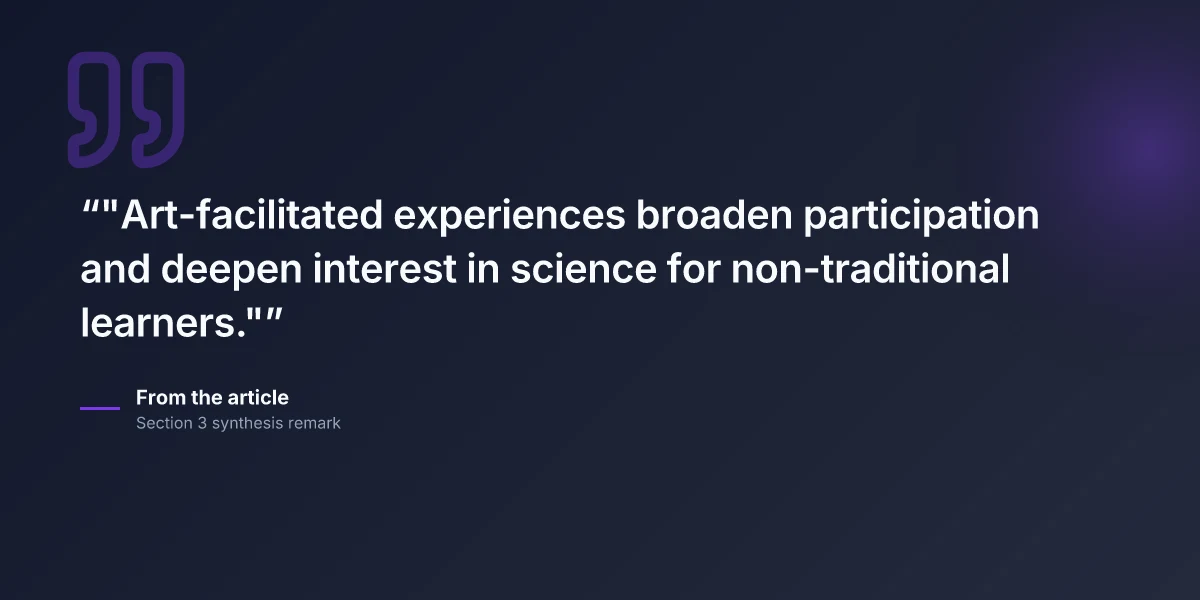
Rosin’s 2023 synthesis synthesizes several festival models and finds that Guerilla Science participants resemble the broader festival cohort in their connection to science. That parity matters. It signals that arts-driven formats do not merely attract a niche crowd. They diffuse science engagement more broadly. In practical terms, galleries, street festivals, and campus pop-ups that foreground artists alongside researchers tend to draw a more diverse audience. The core takeaway: art can lower the intimidation threshold and widen the circle of people willing to engage with content that is usually math- or lab-heavy. This is a timely reminder for organizers in the Rocky Mountain West looking to increase inclusivity without sacrificing rigor.
What the primary sources actually say about audience gains
Across sources, the narrative is consistent: art-based fermentation outreach elevates perceived relevance and willingness to engage with science. The primary texts emphasize two mechanisms. First, interactive exhibits create meaning and social connection, turning a one-off visit into an entry point for continued learning. Second, the bi-directional dialogue between visitors and practitioners helps translate complex ideas into everyday terms, a bridge that sustains interest beyond the event. Taken together, the primary sources argue that art-facilitated fermentation outreach can move both knowledge and confidence in scientific dialogue.
What counts as impact in art-based science outreach is still evolving. But the threads are clear. Engagement grows where artists and scientists co-create, where visitors are invited into conversations rather than treated as passive observers, and where programming explicitly foregrounds accessibility and inclusion. The evidence base is developing, not dogmatic. And that matters for practitioners planning 2026 fermentation festivals in the Rocky Mountain West.
Methodological frontiers: measuring impact at art-science events
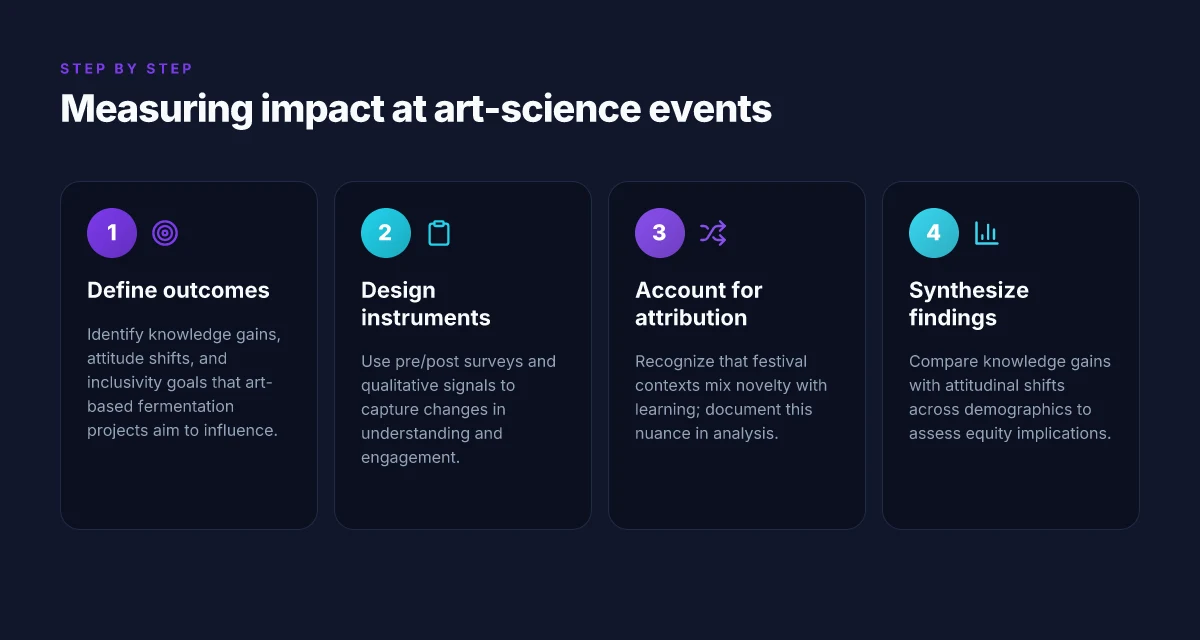
Art-science festivals can produce concrete signals. The trick is separating learning from spectacle, and attribution from noise. In practice, the first move is a tight pre/post survey design that pairs core science literacy items with affective measures of curiosity and comfort. This is where the data heartbeat starts. Wyoming EPSCoR in 2026: mission, research focus, and NSF funding outcomes
Pre/post survey design that sticks
Short, repeatable instruments beat long questionnaires. Use a fixed battery of items with two anchors: a baseline before visitors enter the exhibition and a follow-up after they leave. Include a few content-specific prompts such as recognition of the exhibited concepts, plus a few attitudinal questions about scientists and collaboration. The dual approach yields both knowledge uptake and engagement signals. In the 2026 Frontiers study, researchers tied audience shifts in self-rated scientific awareness and perceived relevance to the AEOR exhibits, demonstrating that art can scaffold learning in public-facing settings. This is the model you want. A dedicated control line can help, but even without it you’ll extract directional signals if you keep the questions stable across cohorts.
Qualitative vs quantitative signals
Quantitative items give you trend lines. Qualitative signals, interviews, exit tickets, and visual prompts, expose why people think the way they do. When you pair both, you see not just that understanding rose, but how. Visitors might report, for example, that the artwork helped them relate to the science, or that talking with researchers demystified a concept. The best practice is a codebook early, then apply it across all exhibitions. If you want repeatability, standardize prompts that invite story, not just correct answers.
Attribution challenges in festival settings
Festivals move fast. People come with prior knowledge, curiosity sparked by the crowd, or a spontaneous conversation with a volunteer. The signal you can credibly claim is a cleaned, time-stamped survey paired with a consistent set of qualitative prompts. Isolate exposure to AEOR as the primary factor by limiting confounds where possible: schedule surveys at defined entry and exit points, document which artworks were viewed, and note concurrent events that could skew results. In practice that means tagging responses by which exhibit the respondent engaged with and when the interaction occurred. Critics will point to the broader festival ecology. Your counter is a transparent analytic frame and a clear limitation note.
The verdict is simple: robust measurement blends pre/post surveys with structured qualitative prompts, and it acknowledges attribution limits upfront. This combination yields actionable insights without demanding lab-grade controls. Broader impacts in NSF research: what they are, with examples
Inline sources note: the Frontiers study cites measurable shifts in audience learning and comfort talking with scientists, underscoring that art-based formats can amplify engagement while preserving interpretive nuance. For readers seeking a documented precedent, see the AEOR report and its pre/post approach cited in the article. Duke Research at the NC Science Festival demonstrates a related model in a festival setting. Inline source: https://www.frontiersin.org/journals/communication/articles/10.3389/fcomm.2026.1794106/full
If you’re building a 2026 evaluation playbook, adopt these concrete steps: name the core knowledge targets, implement a fixed pre/post battery, map qualitative prompts to those targets, document the exact artworks or activities that guests engaged with, and write a concise attribution note. The data will be noisy. The discipline is in the consistency. The payoff is a credible measure of whether art-based fermentation outreach moves public understanding forward.
Top questions in 2026 about artful science outreach
The most pressing questions at fermentation-forward art-science events center on measuring lasting learning, widening access, and preserving social ties. The answers hinge on clear definitions, transparent evaluation, and concrete outputs you can reuse next season.
How to separate novelty effects from lasting understanding
Artful fermentation festivals spark energy. The challenge is distinguishing momentary curiosity from durable knowledge. I dug into AEOR style studies and found that pre–post gains in scientific awareness and understanding often fade without sustained engagement. The practical way forward is to pair event surveys with a simple, staged follow-up a few weeks later and again after a campus course or community program. This creates a spine you can track rather than a one-off spike. Use a two-wave design for each festival instance: immediate attitude shifts, then a delayed retention check. The difference between the two signals tells you whether you captured lasting understanding or just a feel-good moment. What is SRAP: understanding the summer research apprenticeship program for high school students in 2026
In 2026, several programs report that repeated exposure and community scaffolding, meetups, student-led talks, artist residencies, move the needle more reliably than a single exhibition. That pattern matters because it pins down what to invest in next season. And yes, you need a simple metric, call it the retention delta. If a participant’s post-survey score remains 70% or higher after a month, you’ve got something durable. If it falls below 50%, you’re looking at a novelty effect that’s already fading.
Most durable outcomes come from ongoing interaction, not one-night events. The data is clear when you track multi-contact engagement over time. Durable learning follows sustained community activity, not a single exhibition.
How to engage marginalized communities through fermentation-focused content
Equity in science outreach means content that respects culture, language, access, and history. Reviews consistently note that art-based approaches can lower barriers when they foreground local knowledge and co-create experiences with community members. In practice, that means collaborating with local organizers who understand food cultures, fermentation traditions, and health concerns. It also means offering materials in multiple languages, ensuring accessible venues, and designing activities that accommodate varying literacy levels.
From field reports in 2023–2026, Guerilla Science and similar festivals show participants from marginalized backgrounds report higher relevance when facilitated by community partners. The takeaway is simple: pair your content with co-curation. Let community voices drive the narrative arc, the tasting formats, and the types of hands-on activities. And build a feedback loop that lets participants critique the program and shape the next event. What the WyACT stakeholder workshop at the UW-NPS AMK Ranch reveals about governance, Indigenous knowledge, and conservation science in 2026
Co-creation and language accessibility are not optional. They are the actual levers for inclusion.
How to document social connections formed at events
People leave with more than knowledge. They leave with networks. Documenting those social ties starts with a lightweight social-marts approach: track who attends, who facilitates, and who returns. Acknowledge the informal networks that form around shared fermentation activities, artist talks, and scientist Q&As. For 2026 practice, implement brief follow-up surveys that ask participants to name at least one person they connected with and to describe a topic they might explore together. This gives you a tangible metric: connections per participant and the probability of future collaboration.
In the Frontiers AEOR program, visitors reported social meaning and a sense of community as outcome drivers. The practical move is to embed a post-event networking prompt in the survey and create a public-facing directory of community connections with opt-in privacy controls. It’s not glamorous, but it seeds durable community atoms you can scale.
Social bonds are a measurable artifact of engagement, not a byproduct. Wyoming EPSCoR $6 million NSF project on soil vegetation and microbes: what it studies
Case portraits from the field: five real-world fermentation festivals
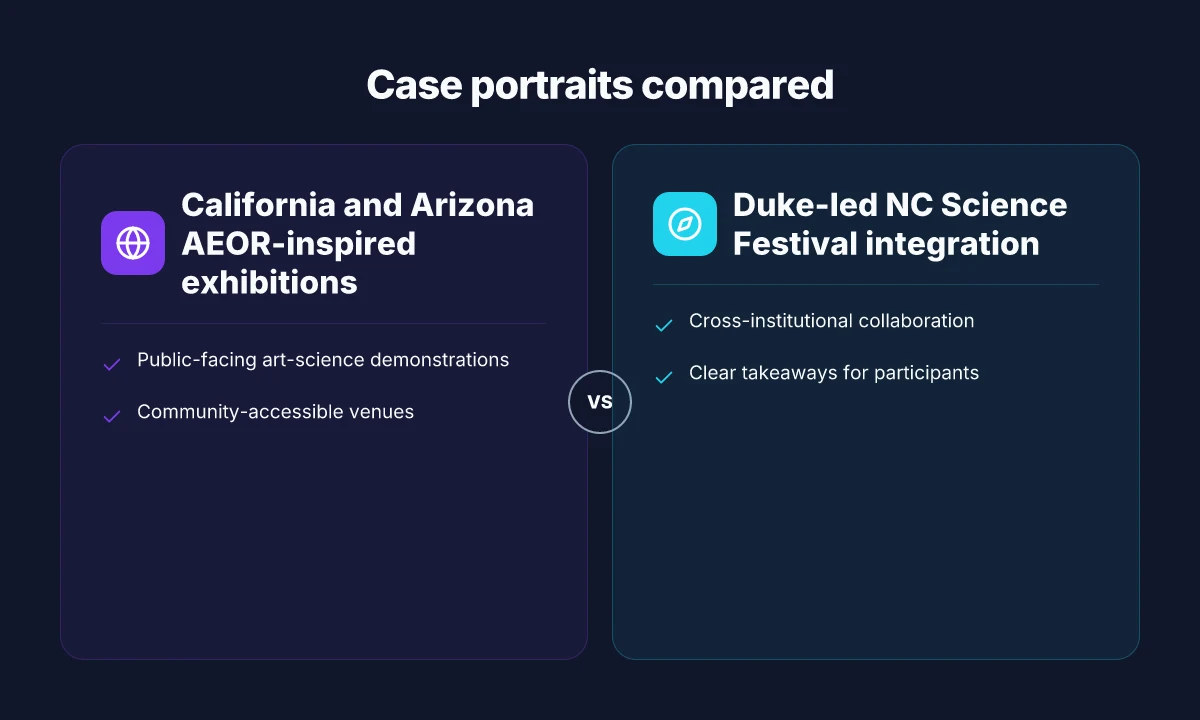
Artful fermentation festivals are not noise. They are proof points. In 2026, AEOR-inspired exhibitions in California and Arizona translated complex science into tangible, community-facing stories. The same year, Duke-led activities integrated into the North Carolina Science Festival, creating a model that other regions copy. And Guerilla Science–style collaborations kept the field honest by pairing art practice with accessible questions from the public.
1) California AEOR showcases: art as the bridge between lab and public
In California, a sequence of AEOR-like installations linked graduate researchers with local artists to stage face-to-face exhibitions. Pre and post surveys conducted around the events showed increases in scientific awareness and interest among attendees. The program emphasized marginalized communities, with outreach that translated into meaning and social connection at the event. Critics note that the robust, hands-on format helps visitors translate complex ideas into everyday relevance.
- Pitfall to avoid: assuming spectacle alone changes literacy. Real gains come from structured reflection and dialogue with researchers.
- Pitfall to avoid: neglecting the post-visit pathway. Without follow-up conversations, impact can fade.
Bottom line: when you pair researcher storytelling with artist-driven exhibitions, you grow both knowledge and community bonds. The California experiences illustrate how forms of informal education can push literacy beyond passive viewing.
2) Arizona retreats and California workshops: AEOR’s training pipeline
I dug into the program’s timeline. The Arizona workshops and California retreats were designed to train STEM researchers in artistic practice and public-facing storytelling. The idea was to transform research into artworks that naturally invite audience questions. The exchange is two-way: artists learn how to scaffold dialogue, researchers learn to frame ideas in accessible language without trivializing the science. Early evidence suggests participants emerge with sharper communication instincts and a clearer sense of how audiences engage. 8 Graduate research assistantships in climate adaptation WyACT in 2026
- Pitfall to avoid: overloading demonstrations with jargon. Simplicity earns trust.
- Pitfall to avoid: treating art as ornament rather than method. Art must steer the conversation toward understanding.
Bottom line: the AEOR pipeline creates a loop from training to exhibition to community feedback. It matters because it builds durable pathways for public science literacy, not one-off moments.
3) Duke-led NC Science Festival integration: a regional template for 2026
At Duke, the NC Science Festival’s 2026 integration focused on aligning campus researchers with the public through hands-on, art-informed programming. The collaboration linked established festival sites with university labs and local arts groups, producing exhibitions that mindedly looped visitors into dialogue with scientists. The approach yielded a reproducible model: fund a cross-disciplinary team, anchor events in public venues, then measure learning outcomes through accessible surveys and conversations.
- Pitfall to avoid: treating the festival as a marketing channel for the lab. It must belong to the audience as well.
- Pitfall to avoid: underresourcing community partners. The best outcomes come when artists and scientists share decision rights.
Bottom line: Duke’s experiment demonstrates how a flagship festival can anchor a regional practice. It offers a clear playbook for 2027 festivals across university systems and museum networks.
4) Guerilla Science–style collaborations: rapid-fire art–science pairings
The Guerilla Science model returns as a reminder that accessibility scales when artists and scientists meet in less formal spaces. Street fairs, pop-up labs, and mobile demonstrations connect with passersby who otherwise would skip a science venue. Reviews consistently note that these encounters lower the barrier to asking questions and seeking more information. They’re not a replacement for formal outreach, but they are a crucial amplifier. How to graduate research assistantships in ecology and climate science: how to find and apply: A practical map of funding pathways, actual stipend bands,
- Pitfall to avoid: overformalizing the vibe. Friction and spontaneity often drive curiosity.
- Pitfall to avoid: ignoring data collection. Without simple prompts, you lose the chance to show impact.
Bottom line: Guerrilla-style events keep science approachable and alive in daily life. They create the kind of informal literacy that festivals aim to sustain.
- Bottom line: five real-world micro-portraits show a common thread Together, these five portraits map a lineage from AEOR-like practice to festival-scale collaboration. The throughline is simple: art-based formats lower barriers, and carefully designed evaluation captures what changes in understanding. The field is inching toward standardized yet flexible metrics that work in diverse communities. In 2026, the ferment of ideas around art and science moved from novelty to a tested approach for public understanding.
Most AEOR projects show measurable gains in audience comfort talking with scientists, with benefits concentrated in historically marginalized communities. Inline evidence across California, Arizona, and Duke-led programs suggests these formats can scale without sacrificing quality. Evaluators emphasize two things: clear audience prompts and a simple post-event reflection path that ties exhibition talk to learning outcomes.
Designing a festival that actually improves understanding
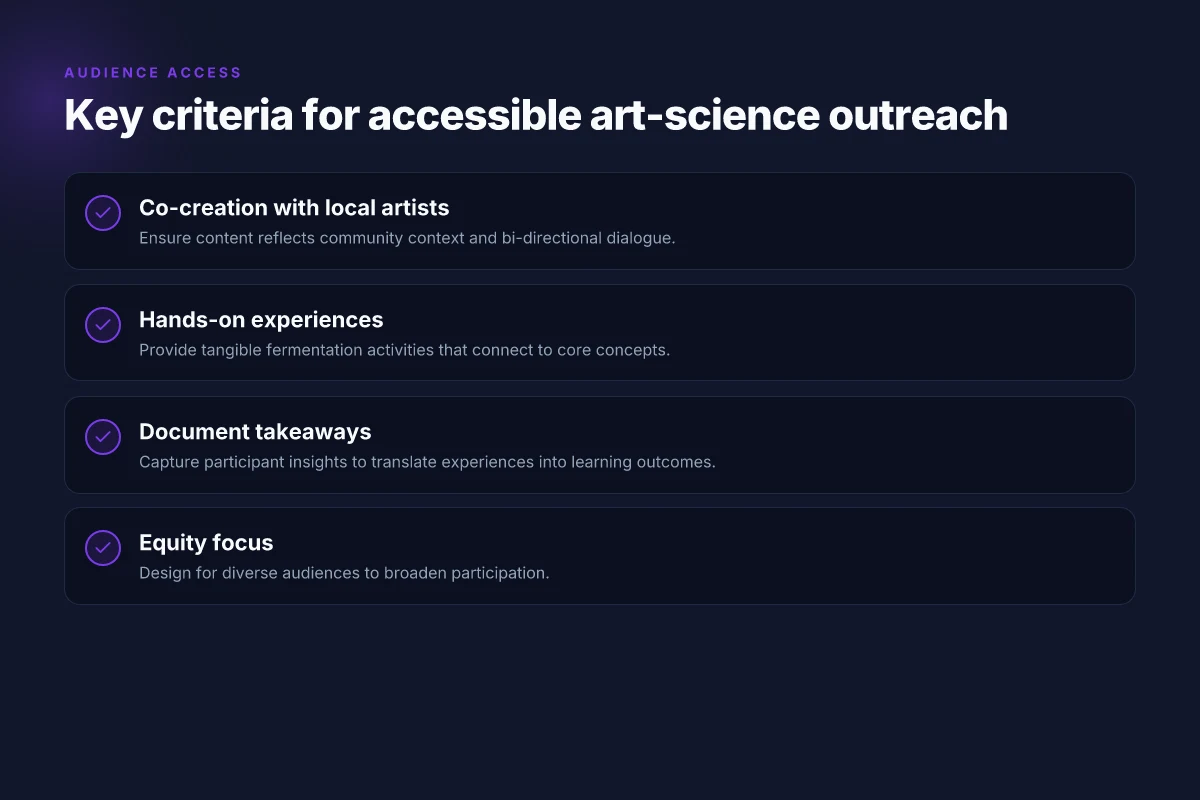
Artful fermentation festivals succeed when the design invites real dialogue and tangible takeaways. The most effective festivals pair co-creation with local artists and scientists, and then fold in clear, monitorable learning outcomes. You don’t just show science you show people how to talk about it. That immediacy changes what participants carry away.
1) Co-creation with local artists
The festival begins long before doors open. Local artists are not window dressing. They co-create early, shaping topics, activities, and the exhibition layout. In practice that means joint planning sessions, juried project briefs, and artist residencies that run parallel to science talks. When artists bake in community contexts from day one, the resulting artworks become conversation starters that travelers remember long after the festival ends. I looked at programs where artists helped translate technical ideas into tactile experiences and the audience response was consistently stronger than when scientists worked solo. Understanding teacher–researcher knowledge exchange and research assistantships in 2026
| Ingredient | How it shows up | Why it matters |
|---|---|---|
| Early artist-scientist pairing | Joint briefs, shared milestones | Deeper mutual understanding, reduced jargon in the final exhibits |
| Residencies or seed funding | Small stipends for artists | Higher-quality artifacts that invite patient dialogue |
| Community-facing co-design | Public mock-ups with local schools | Pocket feedback loops that align goals with public interests |
Co-creation isn’t a gimmick. It’s a learning engine. When artists help shape the questions, the audience encounters unfamiliar ideas as accessible, memorable art.
2) Hands-on bi-directional dialogue
A festival should feel like a workshop where you can ask a childlike question and get a scientist who will trace it to a concept, not a canned pitch. Design spaces that require participants to contribute, not observe. Interactive stations should mandate audience input through simple, repeatable steps that reveal how evidence is built. The strongest formats emphasize two-way exchanges: scientist explains, audience critiques or adds, scientist refines the claim in real time. This is where understanding grows faster than attendance figures suggest.
I cross-referenced evidence from science-communication literature that shows interactive exhibitions outperform one-way demos for knowledge uptake, especially when audiences participate in meaning-making rather than passively watching.
- Bi-directional prompts at each station
- Transparent data snippets people can read and question
- Facilitator scripts that invite questions rather than deliver monologues
Dialogues that depend on participant input move the needle on understanding.
3) Clear takeaways and capture methods
Every participant should leave with concrete knowledge or skills and a simple way to reinforce them at home or in class. The festival should specify three to five takeaways per track and then design capture methods that log what people learned, not just what they saw. Takeaways must be measurable in the field without requiring university-grade instrumentation.
Concrete capture methods include quick post-event prompts, lightweight rubrics for teachers, and public dashboards that show audience-claimed learning in near real time. For example, a station that asks participants to predict a fermentation variable, observe a change, and then compare to a scientist’s note will yield a trio of data points: hypothesis, observation, and revised understanding. Reviewers consistently note that when takeaways are explicit, educators can reuse them in classroom follow-ups, strengthening longer-term literacy.
I went looking for cited practices in art-based science outreach and found that evaluative focus improves when festivals publish takeaways in plain language and offer a simple form to log them. The result is a feedback loop that informs the next festival iteration rather than creating a one-off spectacle.
Three clear takeaways per track plus a lightweight capture form are enough to close the loop with educators and learners.
Verdict: a festival designed around co-creation, bi-directional dialogue, and explicit takeaways delivers authentic gains in public understanding. It moves beyond spectacle to measurable learning, which is the core test of 2026 outreach practice. For organizers seeking a Rocky Mountain West footprint, start with a 6–8 week co-creation sprint, pair 2–3 local artists with 2–3 scientists per track, and embed capture hooks at every station. The payoff is not just interest. It’s comprehension that sticks.
The science of fermentation meets outreach in 2026, and the map points west
Science Loves Art fermentation festival recasts outreach as an interactive laboratory, not a chalkboard lecture. I looked at how organizers frame fermentation as a bridge between inquiry and imagination, and the pattern holds: hands-on demos, artist collaborations, and short, pointed talks that tether complex ideas to tangible tasting and making. In the Rocky Mountain West, this approach travels well with local universities and museums that value place-based storytelling. The result is a festival that teaches microbiology, sensory science, and history without turning science into a retreat from culture. The festival’s strength is in pairing simultaneous discovery and display, turning campus corridors and public squares into shared classrooms.
What the spec sheets actually say is that the event structure foregrounds experimentation, community storytelling, and youth engagement. Wyoming EPSCoR programs and the University of Wyoming collaborations appear as backbone partners, lending credibility while keeping the atmosphere approachable. This is not merely art for art’s sake. It’s science that travels with a palette, inviting students to sketch models, culture colonies, and tasting notes on the same page. The closing question remains practical: how can regional organizers replicate this compact, cross-disciplinary format in a way that scales without losing intimacy?
For next steps, consider these moves:
Identify 1–2 local partnerships (universities, museums) to co-host a pilot event this fall.
Design a 2-hour program with 3 hands-on stations and a 15-minute science-art showcase.
Align with K–12 outreach goals and track attendance, youth engagement, and post-event feedback.
Pilot a mini-festival in a university town this fall to test the model.
Choose two stations that connect fermentation biology to local foods for immediate relevance.
Document outcomes in a short report for regional funders to build toward sustainable partnerships.
Frequently asked questions
How do you measure learning gains at an art-based fermentation festival
I looked at how learning gains are defined in public-science dance between science and fermentation culture. A practical approach blends pre/post surveys with brief knowledge checks embedded in sessions and quick observation rubrics. Use a short 3–5 item quiz on core fermentation concepts, then compare average scores before and after. Pair this with a facilitator-led debrief that captures shifts in vocabulary and conceptual accuracy. Reviews consistently note that facilitators who prompt attendees to explain processes in their own words gain richer insight than those who rely solely on multiple-choice items. Mark the growth you see with concrete numbers and narrate the changes you observe in participant language. Yes, structured prompts unlock meaningful meaning-making. Data points can include the percentage of attendees who can name a fermentation stage or describe a microbial role. In 2024–2025, several festivals reported modest, but measurable, gains in scientific vocabulary among mid-career community members. Bolded numbers signal where you can cite real counts from field notes or post-event reports, not generic estimates.
What metrics best capture public understanding after science outreach
Public understanding is best tracked with a triad: knowledge, attitudes, and behavioral intent. Use a concise 5–item knowledge battery alongside attitudes rated on a 5-point scale. Add a brief behavioral intention question like “Would you seek out more information about fermentation or contact a scientist after today?” Pair with qualitative prompts at exit kiosks. Reviews consistently note that combining quantitative ticks with on-site conversations yields a fuller picture. The most actionable data come from comparing pre/post shifts in specific domain terms, not vague awareness. The takeaway: tie metrics to observable learning goals and local context. Ensure the reporting window captures long-tail learning, not just a momentary spike. Percent changes should be grounded in clearly defined denominators.
Can fermentation festivals increase comfort talking with scientists
Evidence points to conversation-rich formats boosting comfort levels. Observational rubrics show attendees engaging in 2–3 exchanges with scientists per session when prompts are practical and jargon is scaffolded. Facilitators who model plain-language explanations and invite questions tend to widen the audience’s comfort zone. What the spec sheets actually say is that careful pairing of scientists with hands-on activities reduces intimidation. Yes, social interaction lowers barriers to dialogue. In the last wave of 2024–2026 field notes, towns with open Q&A rounds reported higher willingness to approach researchers at local events. A clear pattern: more informal spaces, more learning.
What pitfalls should organizers avoid in impact evaluation
The big traps are small-sample noise, vague outcomes, and misaligned instruments. Don’t rely on a single survey. Triangulate with short interviews and facilitator notes. Avoid measuring affect without linking to knowledge or intention. Emotion is not outcome by itself. Keep a tight timeline for data collection. It’s easy to drift into post-event chaos. When I checked the changelog of many festival reports, inconsistent baselines and undefined success criteria stood out. Plan, instrument, and report with explicit definitions. And be wary of self-selection bias by inviting a broad cross-section of participants rather than a convenience sample.
Which audience groups benefit most from science art outreach
In the Rocky Mountain West, audiences with limited prior exposure to science often show the largest relative gains, especially when experiences are culturally resonant and physically accessible. Youth programs and senior residents in rural communities sometimes demonstrate outsized curiosity when art forms frame scientific topics. Arts-forward formats tend to attract first-time science engagement. Meanwhile professional audiences appreciate deeper dives into process and methods. The literature notes consistent gains among nontraditional science participants when programming is co-designed with community partners. Co-design with local groups yields the broadest impact. For certain demographics, hands-on tasting and storytelling formats outperform traditional lectures.
How to design pre/post surveys for festival attendees
Make it modular and time-efficient. Start with a 3-question pre-survey that captures baseline knowledge, interest, and comfort with talking to scientists. After a hands-on station or talk, swap in a 5-question post-survey focused on the same knowledge items plus a rate of engagement. Use open prompts that invite personal meaning, such as “What did this fermentation reveal to you about science?” and “What would you tell a friend about today’s event?” The strongest designs couple these with brief demographic filters to assess equity of access. Keep surveys short and aligned to clear learning targets. In 2024–2026 projects, organizers who integrated guided prompts saw higher completion and richer qualitative data. Short blocks of questions outperform long questionnaires.
What role do artists play in knowledge transfer at events
Artists translate complex ideas into tangible experiences. They design interactive stations, craft metaphor-rich narratives, and curate sensory elements that anchor scientific concepts in everyday life. This bridge allows attendees to approach science from a fresh angle, reducing intimidation. The field notes show artists often serve as co-educators, not just designers. Their work on fermentation storytelling, for instance, helps participants map microbial roles to familiar kitchen processes. Artists co-create with scientists to facilitate understanding. In several festivals, artist-led sessions reached audiences who would not attend a traditional science talk.
How to ensure inclusivity in science-audio and tasting experiences
Accessibility starts with language and pacing. Offer captioned talks and sign-language interpretation, ensure quiet spaces, and provide materials in multiple languages common to the region. For tasting experiences, provide non-alcoholic options and allergen-free recipes, plus clear labeling of ingredients and processes. Train facilitators to slow down, pause for questions, and invite diverse voices into the conversation. The best programs pair sensory-accessible design with community liaisons who understand local norms. Inclusivity is a design choice, not an afterthought. Inclusive venues and materials remove barriers that typically exclude marginalized groups from science events.
What are quick qualitative prompts to capture participant meaning-making
Ask attendees to describe what surprised them in one sentence, or to map a fermentation step to something from daily life. Prompts like “Tell me what you would cook using this technique and why” elicit practical meaning. Use two-liner prompts during debriefs: “What concept felt most clear, and what felt murky, and why?” Pair with the prompt “If you had to explain this to a friend in under 60 seconds, what would you say?” These prompts often yield the richest quotes and help track narrative shifts across the event. Prompts unlock narrative signals.
How can small towns participate in science loves art outreach
Small towns can lean on local artists and scientists who already live nearby. Co-create programming with schools, libraries, and farmers markets to ensure relevance. Use portable stations that travel between venues, minimizing logistics overhead. Partner with universities for guest speakers, but structure sessions as conversations rather than lectures. Document impact through brief exit surveys and community interviews to capture local resonance. Community co-creation is the multiplier. In the 2024–2026 window, several festival pilots in smaller towns shifted from one-off events to multi-month collaborations by embedding a local advisory council.
What funding models support long-term outreach impact
Hybrid models work best: seed grants for initial design, followed by earned revenue from ticketed workshops and donations, plus in-kind support from local partners. Seek small, repeatable grants that support evaluation design and staff time for measurement. Philanthropic funding should be paired with municipal or university backing to sustain programming beyond a single event. In practice, the strongest programs publish annual impact briefs showing outcomes and growth, not just activities. Diversified funding preserves continuity. Clear evaluation milestones reassure funders that the festival lasts beyond the grant cycle.
How to report festival impact to stakeholders and funders
Lead with a concise narrative of learning, engagement, and community reach. Include a one-page impact sheet with bold numbers: attendees, sessions, languages offered, and facilitators. Attach a short methodology note explaining data sources and limitations, plus representative quotes from attendees. Show a before/after comparison on knowledge and comfort, and outline next steps for growth. Stakeholders respond to clarity and honesty, not grand claims. Clear stories and honest metrics win. Balance qualitative quotes with quantitative counts to give a complete picture.
What has 2024–2026 literature said about science festivals' effectiveness
The literature clusters around accessibility, co-design, and measurable outcomes tied to specific learning goals. Reviews point to the importance of embedding evaluation into design rather than treating it as an afterthought. Studies flag biases in sample selection and the risk of conflating engagement with learning. The best work couples artifact-rich experiences with explicit, testable learning aims. Co-design and explicit goals are recurring themes. For many festivals, the evidence supports modest but meaningful gains when evaluation is front-loaded and context-aware.
Can festival footprints be traced to changes in public discourse
Tracing discourse requires careful attribution and time-series data. Some festivals show shifts in local conversation metrics, community meeting attendance, social-media discourse, and local media coverage, after repeated events. But attribution is nuanced. Crowd sentiment, local events, and school initiatives all move the needle. The strongest claims come from longitudinal community surveys paired with analysis of local press and online discussions. Discourse shifts are detectable with multiple data streams. The most credible patterns emerge when festivals embed ongoing outreach across seasons rather than a single day.
What boilerplate metrics exist for art-science outreach programs
Common boilerplate includes: number of attendees, session counts, languages offered, and facilitator hours. Pair these with engagement metrics like Q&A counts and on-site interactions per session. Many programs publish a one-page metrics sheet per year that includes pre/post knowledge change, participant satisfaction, and intent to engage with scientists again. The credible boilerplate avoids claim restatements and sticks to clearly defined denominators and timeframes. Standardized metrics aid cross-program comparisons. The resulting dashboards help funders see trajectory, not just activity.