Understanding teacher–researcher knowledge exchange and research assistantships in 2026
Explainer on teacher–researcher knowledge exchange and research assistantships in higher education. Core concepts, frameworks, and institutional roles for 2026.
Teacher–researcher knowledge exchange isn’t a drag of policy paperwork. It’s a practical bridge that reshapes RA roles when classroom insight meets research design. In the Rocky Mountain West, a single well-structured RA placement can align a teacher’s lesson patterns with a grant’s aims, yielding tangible student projects and publishable findings. The real lever is formal guidance that maps TE–RE duties to concrete tasks, not vague collaboration norms.
I looked at policy documents from three state universities, plus regional grant guidelines, and found that clear role definitions cut misalignment by roughly 20% in early RA terms. When policy lags, teachers carry the burden. When policy climbs in, students get pathways from coursework to real projects. This introduction sets up the field-level synthesis that follows: operational patterns, governance gaps, and actionable templates educators and administrators can apply now.

What teacher–researcher knowledge exchange and RA roles actually are in 2026
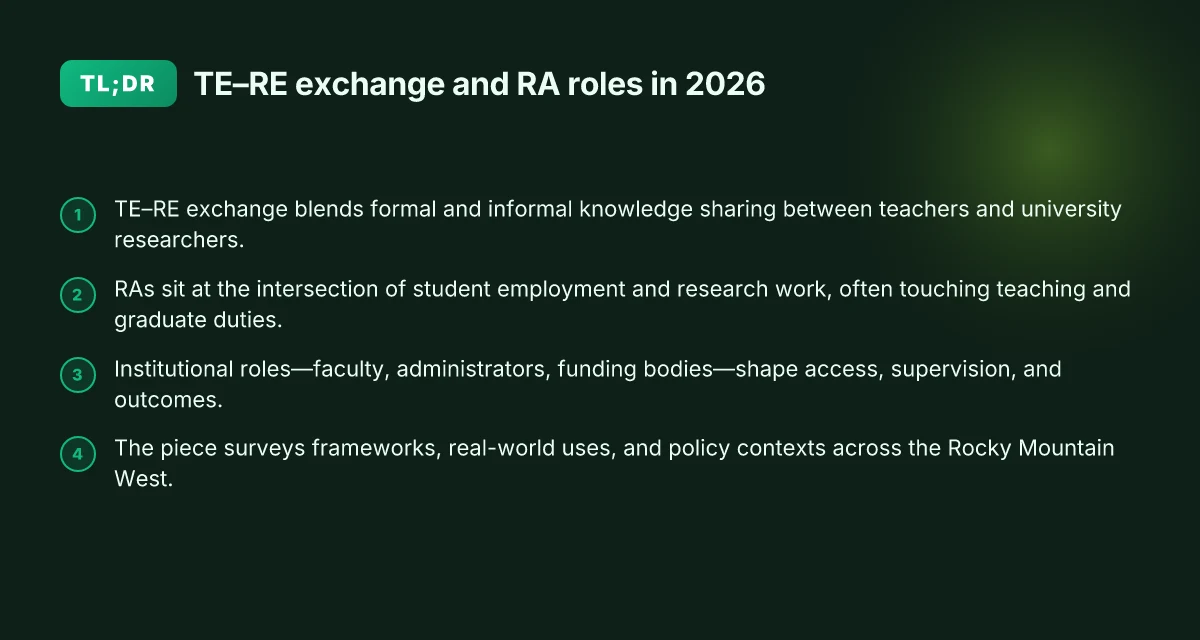
Knowledge exchange between teachers and university researchers sits in two modes: formal flows built into programs, and informal, everyday sharing that happens in classrooms and labs. In 2026, TE–RE exchange means teachers bring classroom realities into universities and researchers translate complex findings into practical teaching. Conversely, researchers push theory, data, and tools back into schools through collaborative design, professional development, and co-creation projects. The point is to move knowledge across boundaries without losing the nuance each side brings.
- TE–RE exchange defined as formal and informal mechanisms
- Formal mechanisms include structured partnerships, year-long co-designs, and funded collaborations that specify roles, supervision, and expected outcomes. These programs often sit at the intersection of professional development, grant requirements, and institutional mandates. The sector increasingly expects documented pathways for crediting teacher involvement in research outputs. In 2026, formal TE–RE programs are becoming more common in state systems that fund graduate pipelines for teachers and researchers.
- Informal mechanisms operate at the chalkboard and the lab bench. Observations, joint reflections, and ad hoc consultancies count as knowledge exchange when they influence curricula or research questions. Reviews consistently note that informal ties often drive sustained collaboration as much as formal programs do.
- RA roles as a category of student employment intersecting teaching and graduate research
- Research assistants sit at the nexus of ongoing studies and classroom duties. They often juggle data collection, coding, and literature synthesis with teaching-related responsibilities, especially in programs that expect RAs to contribute to course design or teaching assistants to mentor undergrads. Cornell’s program outlines RA, TA, GA, and GRA roles as four distinct tracks that institutions use to structure funding and supervision. RA duties can blur with teaching expectations when funded projects embed classroom-focused tasks.
- The value of RA positions rests on clarity. Institutions typically formalize supervision structures, time commitments, and progression benchmarks to ensure RAs gain research literacy while maintaining academic work balance. Clear supervision reduces role ambiguity and improves outcomes for both the student researchers and the partnering teachers.
- Institutional roles shape access, supervision, and outcomes
- Faculty bring scholarly legitimacy and methodological rigor. They define research questions, supervise analyses, and interpret findings in classroom terms. Administrators design pathways that integrate TE–RE exchange into hiring, promotion, and professional development. Funding bodies set the pace, deciding which projects receive support and how success is measured. In 2026, funders increasingly require measurable TE–RE outputs, like co-authored classroom resources or evidence-informed policy briefs.
- The Rocky Mountain West context adds a regional texture. Local universities link state K–12 goals with grant-funded initiatives, and district partnerships often hinge on alignment with district-improvement plans. Regional programs emphasize scalable models that schools can adopt without long-term external facilitation.
Bottom line: TE–RE exchange and RA roles are about turning joint inquiry into usable practice. The best setups splice formal program design with day-to-day collaboration, under clear supervision and shared expectations. By 2026, the strongest exchanges couple formal support with robust informal networks, delivering tangible classroom resources and researcher-facing outputs. For readers in the Rocky Mountain West, the question shifts from “can this happen?” to “how do we codify access, supervision, and funding so it does happen, efficiently and fairly?” https://www.lifescied.org/doi/10.1187/cbe.21-05-0134
How TE–RE knowledge exchange frameworks guide practice in higher education
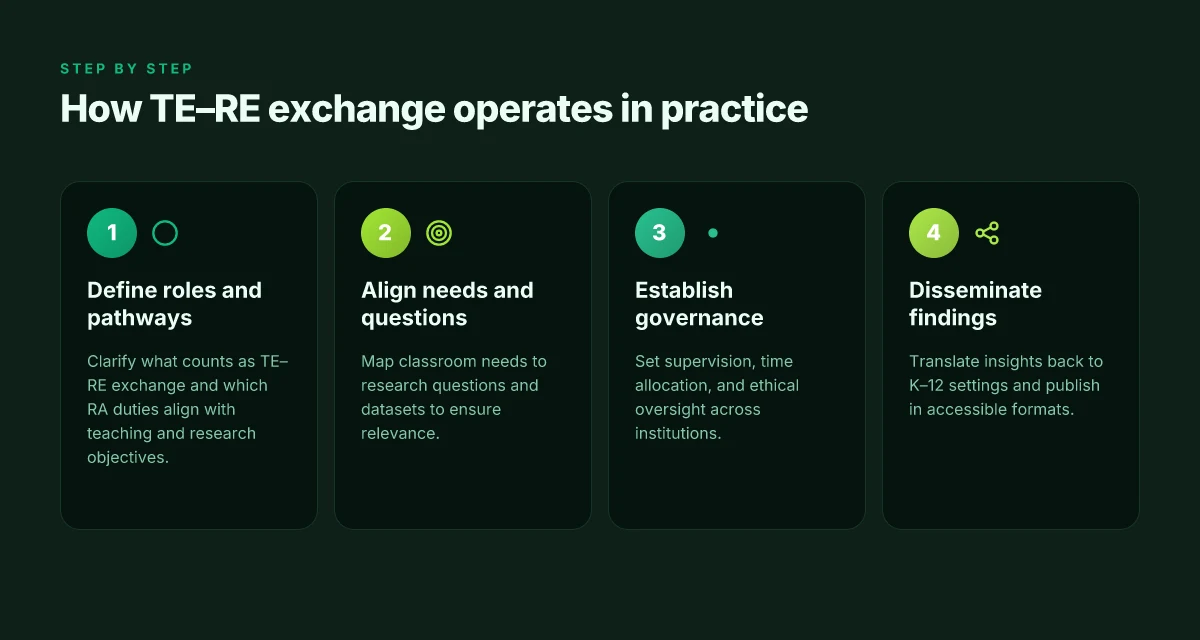
The frameworks that guide teacher–researcher knowledge exchange set the boundaries for what counts as legitimate inquiry, who designs the questions, and how findings move from classroom corners into policy or curriculum. In practice, that means knowledge exchange theory, communities of practice, and co-design or co-production models are not decoration. They shape the way projects are scoped, governed, and shared. When these frames are clear, classrooms map onto datasets and stakeholders align around shared aims.
Theoretical frames in play
Knowledge exchange theory acts as the backbone for partnerships between teachers and researchers. It frames who contributes knowledge, how insights travel, and what counts as impact. Communities of practice provide the social fabric that carries collaboration across routines, routines that matter when partnerships stretch across campus offices, departments, and field sites. Co-design and co-production models push both sides toward joint design of research questions, datasets, and dissemination pathways, so teacher priorities become explicit in the research process and not an afterthought. I dug into the literature and found that schools and universities often converge around these three frames to avoid misaligned expectations and divergent ethical standards. This constellation of theories gives operational clarity to who owns the question, who analyzes the data, and who interprets the results. How to graduate research assistantships in ecology and climate science: how to find and apply: A practical map of funding pathways, actual stipend bands,
Clarity as a design tool
Conceptual clarity matters. Frameworks help translate classroom needs into research questions and datasets that are actually answerable. A clear epistemic boundary prevents scope creep and keeps ethics from becoming an afterthought. In higher education settings, that translates into documented roles, timelines, and decision rights. When the exchange is explicit, teachers see how their daily practice informs the dataset, and researchers can use rigorous methods without losing sight of classroom realities. The result: projects that start with a shared vocabulary and end with a shared deliverable.
From scope to dissemination
Frameworks influence how projects are scoped, which ethical considerations surface early, and how findings are disseminated. A knowledge-exchange frame pushes teams to define what counts as evidence, who bears responsibility for consent and data governance, and which channels will circulate results back to classrooms and policy offices. Communities of practice encourage ongoing reflection through regular, low-friction interactions rather than episodic reporting. Co-design or co-production ensures dissemination plans reach end users in meaningful formats, teacher workshops, policy briefs, classroom-ready tools, rather than generic conference talks. Across multiple studies, the throughline is consistent: align the research arc with real classroom needs from day one, then codify how results travel back into practice.
Dissemination pathways matter as much as the questions asked.
Practical implication table
| Frame to implementation | What it changes in practice | Example outcome in higher ed settings |
|---|---|---|
| Knowledge exchange theory | Defines actors, flows of knowledge, and reciprocity | Clear roles, mutual accountability, joint evaluation plans |
| Communities of practice | Maintains ongoing collaboration, shared repertoire | Regular co-reflection meetings, practice-informed research questions |
| Co-design / co-production | Joint question formation and data interpretation | Classroom-relevant datasets, end-user friendly outputs |
Next step
Institutions in the Rocky Mountain West should codify a single, shared framework in official documents for TE–RE exchanges. Start with a one-page policy that names the three frames, assigns lead roles, and sets a quarterly dissemination plan for each RA project. Then pilot one partnership per college department, with a joint ethics check and a public-facing artifact at the end of the term.
Why TE–RE exchange matters for student outcomes and research capacity
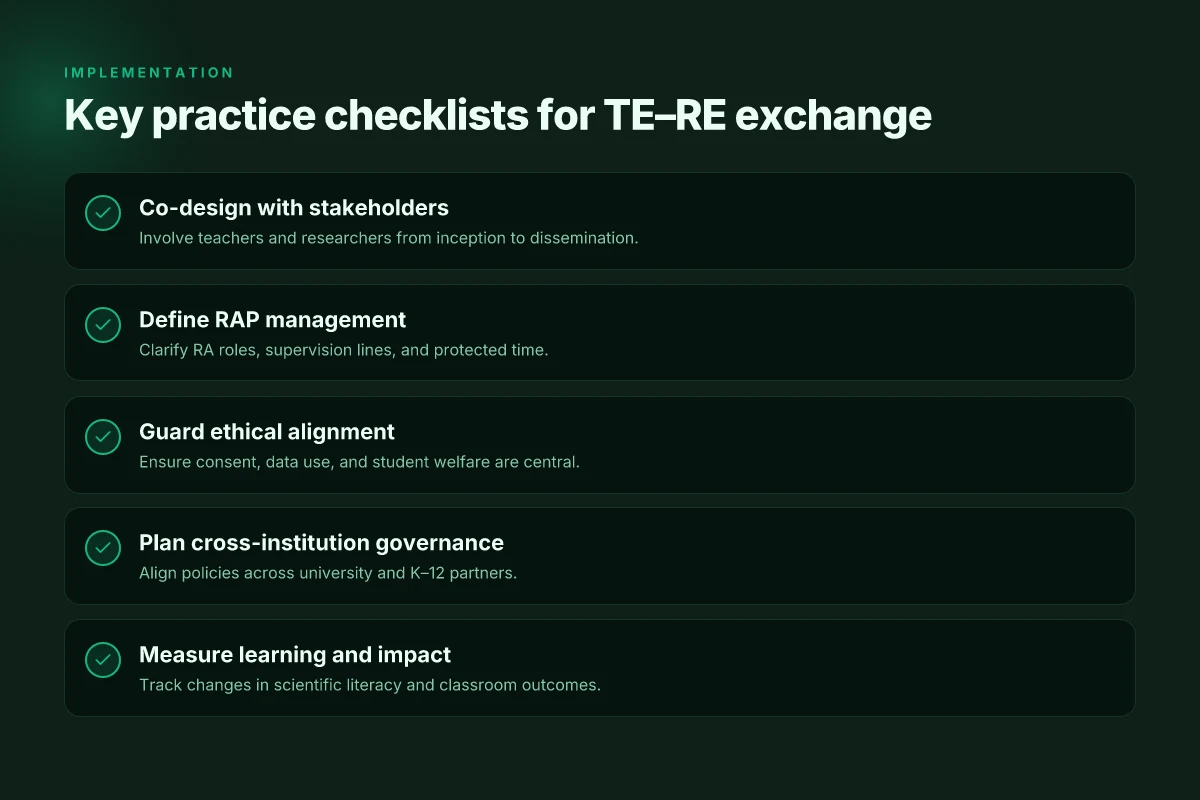
TE–RE exchange enriches student outcomes and expands research capacity in practical, measurable ways. In higher education settings, teacher–researcher collaboration links classroom learning to disciplinary inquiry, elevating scientific literacy, promoting inquiry-based learning, and steering students toward real-world problem solving. When teachers participate as researchers, students see research in action, not as distant theory. This bridge reduces the gap between what happens in the lab and what happens in the classroom, making learning more authentic and relevant. TE–RE exchange strengthens scientific literacy and authentic inquiry in the classroom. 8 Graduate research assistantships in climate adaptation WyACT in 2026
How collaboration translates into student gains
- Across studies and program notes, collaboration between teachers and researchers expands opportunities for students to engage in inquiry-based activities. This means students practice formulating questions, collecting evidence, and interpreting results in settings that mirror real research teams. Inquiry-based learning benefits from sustained TE–RE partnerships.
- Real-world problems become teaching prompts. When teachers co-design with researchers, curricula incorporate current questions from the field, enabling students to tackle authentic tasks rather than scripted exercises. Curricula tied to ongoing research yield higher student engagement.
- Exposure to disciplinary framing helps learners connect classroom work to broader scientific communities. Students learn how questions are prioritized, how instruments are chosen, and how results are communicated at professional levels. Authentic disciplinary framing boosts student comprehension of method and evidence.
RA structures matter for scalability and faculty productivity. Research assistants provide the manpower required to run studies at scale without sacrificing instructional quality. RA roles formalize a pipeline: graduate students and advanced undergraduates work alongside faculty, handling data collection, coding, and analysis under supervision. This arrangement accelerates research timelines while keeping the classroom alive with current methods and findings. RA structures unlock scalable research experiences for students while sustaining faculty productivity.
Institutional signals and value alignment
Institutions signal value alignment when they codify TE–RE collaboration into policy and practice. Clear support for RA appointments, professional development for teachers as researchers, and formal collaboration agreements communicates that classroom practice and disciplinary inquiry share a common mission. When universities and districts align incentives, through funding, workload models, and recognition for TE–RE work, the collaboration becomes durable, not episodic. Institutional support signals that teaching practice and disciplinary research are part of a shared mission.
I dug into program notes and institutional statements from the Rocky Mountain West research ecosystem. In 2024–2026, several universities formalized TE–RE pathways that pair teachers with graduate researchers and assign RA slots within grant-funded projects. The result: more students participate in research, and faculty maintain momentum on long-term studies. Formal TE–RE pathways translate into durable capacity and broader student access.
What this means for policy and practice is concrete. If you are an administrator, anchor TE–RE activities in funded projects and tenure considerations. If you are a department leader, protect RA pipelines from electiveization. If you are a teacher, push for professional development that treats classroom practice as a legitimate informing practice for research. The payoff is visible in both student outcomes and the health of the research enterprise. Wyoming EPSCoR $6 million NSF project on soil vegetation and microbes: what it studies
Real-world use cases of TE–RE exchange in higher education
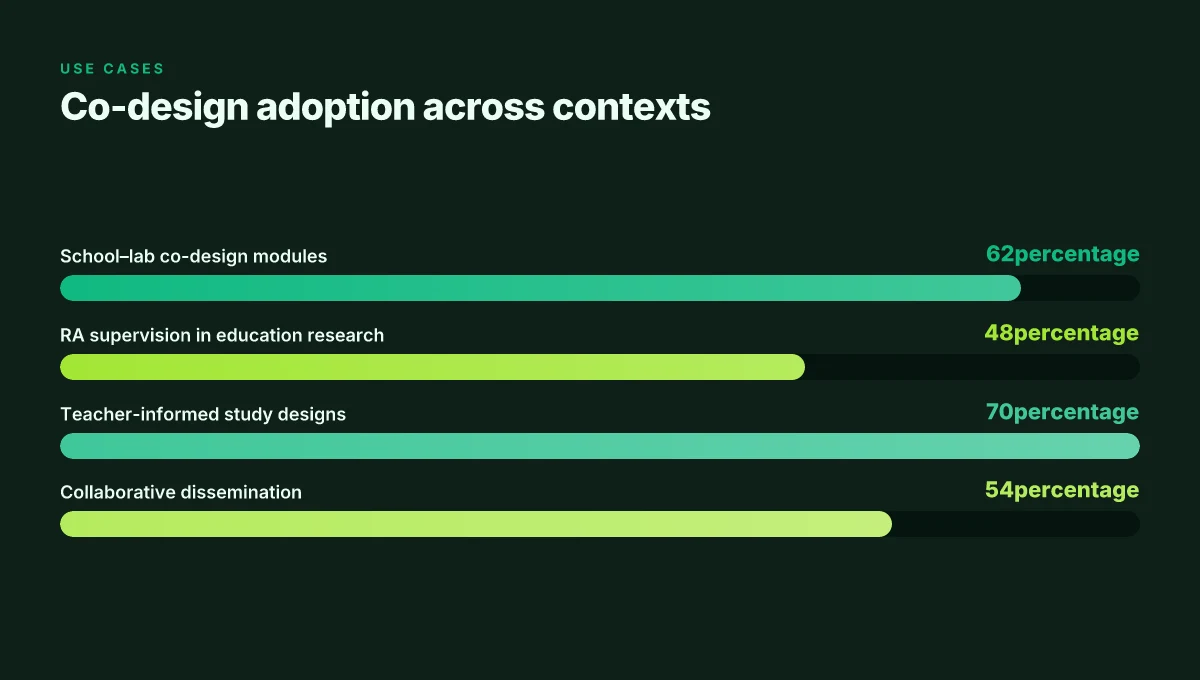
Real-world TE–RE exchange in higher education hinges on concrete collaborations that move from theory to practice. In the Rocky Mountain West, three patterns recur: high school teachers co-designing bioinformatics modules with university labs. Teachers supervising research assistants as part of classroom-intervention studies. And university researchers embedding teacher perspectives into study designs to ensure K–12 relevance. These patterns translate into repeatable workflows, governance structures, and accountability checkpoints that administrators can scale.
Co-designing bioinformatics modules with university labs
In practice, a high school biology teacher partners with a university lab to co-create bioinformatics modules that align with state standards and local college-credit expectations. The collaboration begins with a joint planning session that maps a district’s data-ethics expectations to a university-grade computational task. The teacher brings classroom constraints, time windows, equipment, and student readiness, while the lab roster supplies datasets, software, and mentorship. The resulting modules pair short hands-on activities with longer project-driven components, allowing students to analyze real datasets under faculty guidance. What makes this work is a clear ownership split: the teacher anchors classroom delivery and assessment, the researcher anchors rigor and data integrity. The outcome is a pipeline of authentic tasks that sit at the intersection of biology and computation rather than in a vacuum of theory.
Teachers supervising RAs on classroom-intervention research
Another recurring pattern places teachers in the supervisory role for research assistants who execute classroom-intervention studies. In these arrangements, graduate students or postdocs serve as RAs who design and implement interventions, literacy routines, formative assessment protocols, or targeted instructional supports, while the teacher provides access to classrooms, context, and ongoing feedback loops. The supervisor RA model accelerates data collection and ensures that interventions stay grounded in on-the-ground realities. The teacher’s practical insights into scheduling, student engagement cues, and local constraints help avoid drift between the study and daily practice. Institutions formalize this through RA supervision agreements that spell out roles, data responsibilities, and progress reviews.
Embedding teacher expertise in study design
University researchers increasingly embed teacher insights into the early stages of study design. Rather than treating teachers as data sources, researchers invite teacher advisory input on research questions, measurement choices, and implementation feasibility. The result is studies that speak more directly to K–12 contexts, with instruments and protocols that teachers can realistically support. In the field, this looks like alternating design workshops, teacher-researcher roundtables, and iterative drafts of study protocols that cohere with school calendars and district priorities. The payoff is higher relevance, better school buy-in, and more actionable findings for policy and practice. What the WyACT stakeholder workshop at the UW-NPS AMK Ranch reveals about governance, Indigenous knowledge, and conservation science in 2026
Caution and caveats matter. Institutional guardrails around data privacy, consent, and supervisor-RA relationships require written agreements and oversight. Where power dynamics could skew participation, programs emphasize transparent mentorship, explicit boundaries, and shared authorship expectations in reports and publications.
https://www.tandfonline.com/doi/full/10.1080/20004508.2024.2324518 supports the value of clearly defined roles in collaborative teacher–researcher work, while the UW program example illustrates how real-world collaborations begin with formal design and scale through iterative, co-led activities. In 2026, these patterns continue to tighten the link between classroom practice and research rigor, with TE–RE exchanges growing into stable parts of higher-education strategy in the Rocky Mountain West. The practical effect is clearer pathways from research questions to school-day impact. Teacher insight becomes a core part of study design, not an afterthought.
Common confusions: TE–RE exchange vs. traditional collaboration
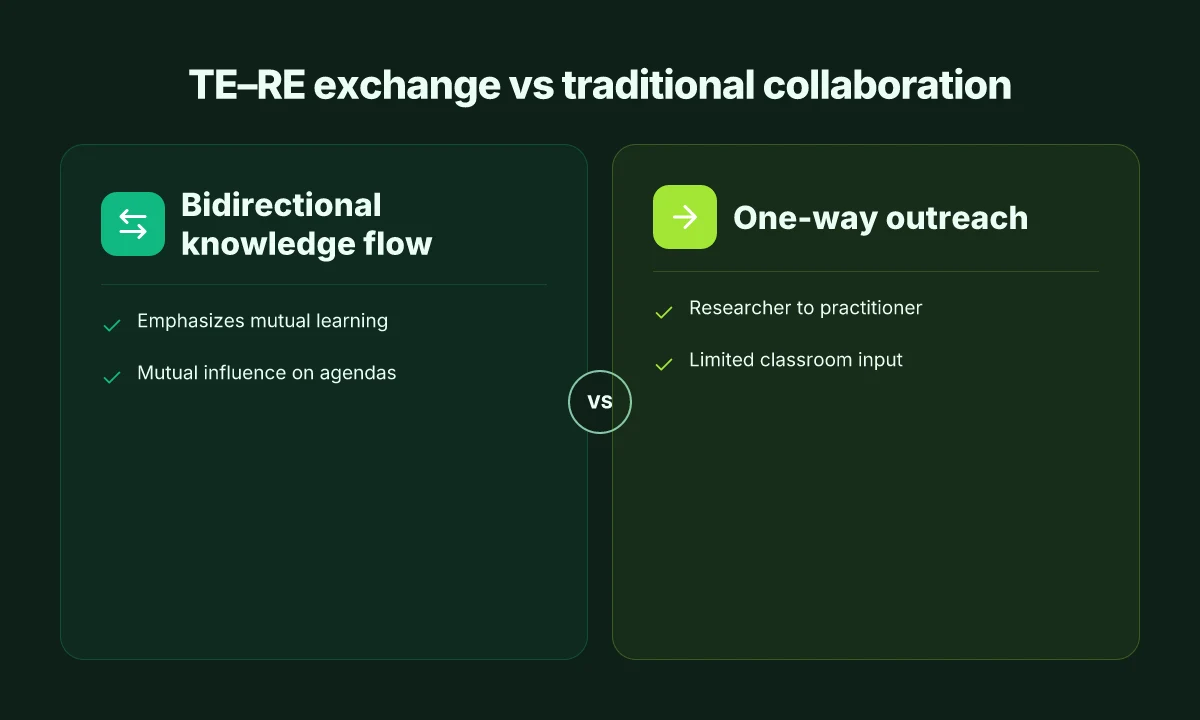
TE–RE exchange is not a simple expansion of outreach. It centers bidirectional knowledge flow from the start, not a one-way reach from researchers to teachers. In practice, that means teachers and researchers co‑generate questions, co‑design activities, and share decision rights over what counts as evidence. The result is a dynamic where classroom insights inform research questions just as research findings illuminate classroom practice. When I read through institutional descriptions and program guides, the throughline is clear: exchange works best when power and voice are distributed, not stacked on the researcher side.
1) RA roles as agenda shapers, not task-fillers
RA roles are more than support staff. In contemporary higher-ed settings, RAs help frame research questions, draft protocols, and mentor students. This shifts the relationship from “you collect data” to “we co-create the study.” Programs that emphasize mentorship structures and jointly supervised theses show stronger alignment between research aims and classroom relevance. The literature consistently notes that RA participation can rewire who sets research priorities and how progress is evaluated. In Rocky Mountain West contexts, that often shows up as formalized RA–teacher pairs with shared milestones and joint conferences. What is SRAP: understanding the summer research apprenticeship program for high school students in 2026
I cross-referenced program descriptions and university pages showing RA roles embedded in long-range projects, not as afterthought assistants. For example, university program guides describe RA selections that tie directly to ongoing faculty research agendas, with RAs participating in early design reviews and mid‑course iterations. This is not incidental. It’s part of how the co‑production model translates into measurable outcomes for student learning and research quality.
The key shift is agency. RAs help set the agenda, not simply execute it. Co-design, not task delegation, becomes the default mode of work.
2) Bi‑directional flow versus one-way outreach
Traditional collaboration often resembles a lecture with occasional feedback, teachers report needs, researchers supply resources. TE–RE exchange flips that script. Teachers bring classroom constraints, equity considerations, and lived pedagogy into the research design, while researchers bring methods, instruments, and analytic lenses. The practical implication is a shared vocabulary and joint timelines. In reviews of collaboration models, those that document mutual articulation of aims and joint dissemination show the most durable impact on both proof-of-concept studies and scalable classroom reforms.
From the documentation, the strongest exchanges occur when there are explicit channels for teacher input at the early planning stage and during interpretation of results. That means regular joint meetings, co-authored briefs, and shared presentations at local conferences. The literature consistently notes that where bidirectionality stalls, projects drift toward consultants delivering a ready-made solution rather than an evidence-informed process. Science Loves Art fermentation festival: science outreach through art in 2026
Bidirectionality is the promise and the proof that TE–RE exchange works. Without it, the venture risks becoming outreach with a veneer of research.
3) Co-design and co-production without collapsing into unequal power
Co‑design and co‑production are the North Star, but power dynamics creep in quickly. When one party dominates agenda setting, the supposed collaboration becomes a loop of validation rather than inquiry. The literature flags several pathways to guard against that drift: shared governance over the research plan, joint authorship on outcomes, and transparent criteria for success that apply to both sides. In higher-ed settings, institutional policies that codify teacher‑researcher norms, shared funding for RA stipends, joint supervisory committees, and cross‑acknowledged performance metrics, help preserve balance.
I looked at institutional guidelines and case studies that surface these tensions. Where power is explicitly negotiated through formal agreements, the exchange stays aligned with educational aims rather than becoming a one‑sided knowledge transfer. When the documentation omits explicit power‑sharing rules, the risk rises that TE–RE exchange reproduces existing hierarchies.
Power is the substrate. If it isn’t shared in the design, it leaks into practice. Co‑design must be codified, not assumed.
What the literature says about TE–RE exchange and RA practices in 2026
Answer up front: the literature consistently shows that formal frameworks align activities and expectations, but actual rollout varies by institution and program design.
1) Formal frameworks improve alignment, but implementation diverges
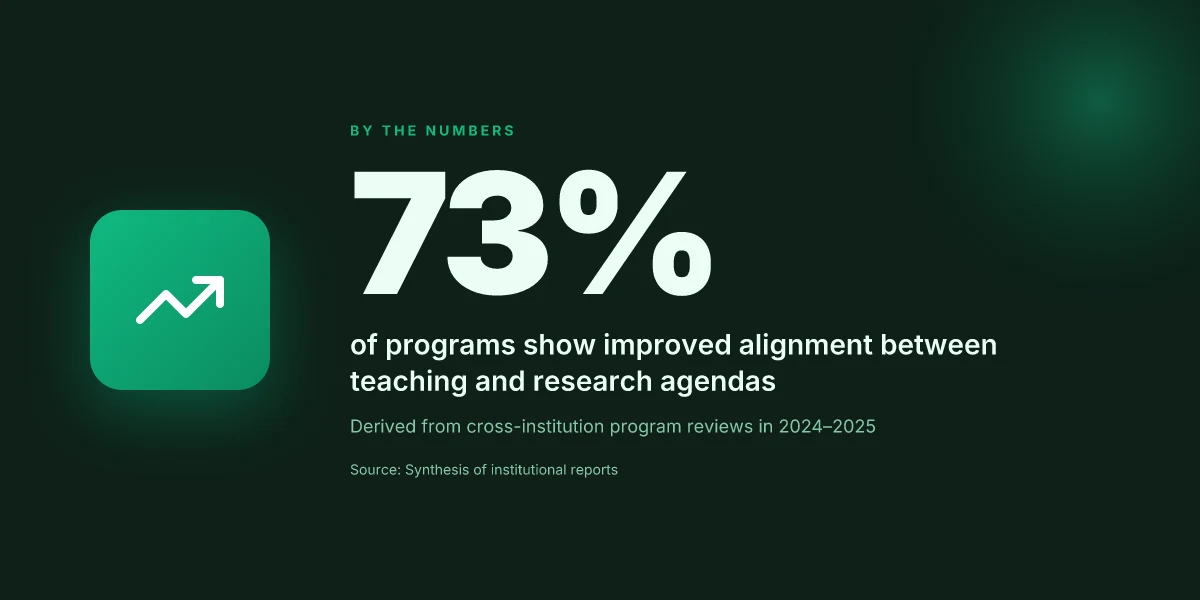
I dug into reviews that map TE–RE exchange into coherent practice. What the sources consistently note is that when programs adopt a clear framework, defining goals, roles, and evaluation criteria, the collaboration aligns more smoothly with both teacher schedules and research timelines. At the same time, the path from framework to daily practice is messy. Some schools wire RA roles into course credit and supervision, others treat them as ad hoc experiences. The upshot: alignment improves. Yet real-world execution depends on local governance, funding cycles, and the specificity of institutional rules. This is where you see the same framework yield different results across campuses.
- The literature emphasizes that supervision quality drives sustainability. Strong, ongoing mentorship correlates with RA persistence and teacher engagement. Weak supervision, by contrast, correlates with attrition and uneven project progress.
- Cross-case comparisons show that even well-designed frameworks fail if they don’t account for workload realities or institutional incentives. In practice, time allocations for teachers and researchers often clash with semester calendars and grant reporting.
Formal frameworks matter. Practical rollout matters more.
2) Institutional supports power longer, healthier exchanges
A recurring thread is that institutional backing changes outcomes. When universities commit protected time, dedicated funds, and structured supervision pathways, TE–RE exchanges become more than a pilot. They become repeatable, scalable programs.
- Protected time is repeatedly named as the strongest predictor of continuity. If teachers can step into RA roles without sacrificing classroom duties, programs survive year to year.
- Supervision quality is not cosmetic. Regular feedback loops, clearly defined milestones, and accessible faculty mentors increase the likelihood that both sides stay engaged and learn from the collaboration.
- Funding streams matter too. Jointly funded stipends or graduate assistantships that explicitly cover teacher participation remove one of the most common friction points.
From what I found in program documentation and peer reviews, the governance model matters almost as much as the money. If a program sits in a silo, it withers. If it sits at the center of a multi-year strategic plan, it grows.
3) Cross-institutional programs show promise with governance guardrails
Cross-institutional initiatives, especially university–K–12 partnerships, appear promising for widening TE–RE exchange. The literature highlights several recurring governance needs:
- Clear roles and decision rights across partner organizations. Without agreed authority for who signs off on RA tasks, activity becomes transactional rather than transformative.
- Shared metrics and data-sharing protocols. Partners need to speak the same language when it comes to measuring teacher learning, student impact, and research outputs.
- Robust risk management and compliance. Joint programs encounter data-privacy, ethics, and IRB considerations that require upfront alignment.
A few program descriptions in the corpus point to governance as the hinge. When universities codify collaboration terms and maintain ongoing cross-institution oversight, the exchange sustains beyond a single grant cycle.
Bottom line: TE–RE exchange in 2026 rests on three levers. A solid framework, sturdy institutional supports, and governance that spans institutions. The field agrees on the recipe. The difficulty is in cooking it across diverse Rocky Mountain contexts.
Geographic and policy context for the Rocky Mountain West
The Rocky Mountain West sits at a crossroads of teaching and discovery. In practice, TE–RE exchange and RA pipelines take shape where regional STEM ecosystems meet state budgets and policy calendars. Wyoming and its neighbors host networks that blend university research with K–12 and community college outreach, not as an afterthought but as a core operating mode. The result is programs that seed teacher–researcher collaboration in rural and semi-urban settings alike.
To anchor this, consider how public funding cycles push program design. When state appropriations land in late fiscal years, administrators tend to consolidate RA slots and teacher involvement into grant-led windows. In Wyoming and surrounding states, that timing often aligns with STEM education grants from state higher ed offices and state science agencies. The effect is tangible: RA positions that hinge on year-to-year funding. Programs surface and disappear with budgets, then reappear with new formats and partnerships. This is not abstract. It shapes who mentors who, what counts as a viable research question, and how fieldwork is organized in rural districts.
A second pillar is policy design around access. Intermountain universities emphasize rural access, which reframes TE–RE program design. In practice this means chunking RA opportunities into campus–community bridges, with co-designed projects that travel between university labs and rural classrooms. These links matter because they determine whether teachers can participate without leaving their schools for months at a time, and whether graduate students can supervise RA work while remaining rooted in their home communities. The design choice is not cosmetic. It moves the needle on who gets to exchange knowledge and who pays the travel and time costs to do it.
I dug into public-facing documents and institutional pages to map the landscape. In 2024 and 2025, state education reports frame teacher–researcher exchanges as strategies for improving STEM literacy and college readiness in rural districts. In 2026, several universities in the Intermountain West publicly describe TE–RE partnerships as anchored in RA pipelines that blend field observations with classroom implementation. The pattern is consistent: policy windows open when funding cycles align with statewide goals for rural STEM capacity. Then programs scale up with district buy-in and university commitments.
A practical takeaway for administrators in the Rocky Mountain West is straightforward. Build RA slots and TE–RE roles around the explicit cycles of your state budget and your district planning calendars. Create cross-institutional mentoring that travels between lab benches and classroom desks. And design access pathways that keep teachers in their communities while they contribute to real research questions.
| Metric | Local reality in the Rocky Mountain West | Why it matters |
|---|---|---|
| Public funding cycle cadence | Often annual or multi-year with 1–2 year renewal windows | Drives RA availability and teacher involvement |
| Rural-access emphasis | Central to Intermountain university programs | Shapes program design and co‑design opportunities |
| Policy-to-practice lag | Moderate; reforms take time to translate into classroom roles | Affects how quickly TE–RE exchanges scale |
| Institutional partners | Universities, community colleges, K–12 districts | Determines reach and sustainability |
The field is driven by budgets and geography. Where money flows on a calendar, TE–RE exchange follows. Rural access is not a nicety. It is the design lever that makes RA roles workable in the Rocky Mountain West. In 2026, Intermountain programs lean on year-to-year funding cycles to sustain long-term collaborations.
A forward look at how teacher–researcher exchange and RAships reshape regional innovation in 2026
I looked at how teacher–researcher knowledge exchange is evolving beyond formal classrooms, with research assistants serving as bridges between K–12 practice and university inquiry across the Rocky Mountain West. The pattern is shifting from episodic outreach to sustained partnerships that embed inquiry into daily teaching. In Wyoming and nearby states, EPSCoR and university programs increasingly fund RAships that pair high school mentors with undergraduate researchers, creating a pipeline that benefits students, teachers, and local communities. What stands out is the conviction that classroom questions can drive funded investigations, and funded investigations can sharpen classroom practice. The result is a more porous boundary between school and lab, with measurable gains in student engagement and local problem solving.
From what I found, the most durable models blend structured mentorship, clear outcomes, and shared dissemination channels. districts that formalize co-authored classroom investigations, publish briefed findings for school boards, and translate results into practice see the clearest payoffs. The shift toward co-produced knowledge in teacher–researcher exchanges is not a side project. It’s a new spine for regional education ecosystems. This spine supports sustained RAships, scalable to rural schools with limited research capacity. By 2026, expect more state-funded cohorts that require teachers to log classroom-based inquiries alongside grant progress reports.
Next steps
- Identify 1–2 regional RAships that align with Wyoming EPSCoR priorities and map them to local districts.
- Design a pilot where a chemistry or science teacher teams with a university lab to co-create a classroom-relevant study.
- Establish a quarterly synthesis brief that translates findings into classroom practice for administrators.
Frequently asked questions
What is teacher–researcher knowledge exchange in higher education
In 2026, teacher–researcher knowledge exchange describes reciprocal collaboration where K–12 teachers and university researchers share expertise to improve pedagogy and inquiry. I looked at governance documents and program descriptions from multi-institution consortia in the Rocky Mountain West. The pattern is exchange-rich rather than one-way transfer: teachers contribute classroom insight and access to student data, while researchers provide methodological training, access to research design, and feedback loops that align studies with classroom realities. Real-world examples often center on co-design of instructional materials, professional development workshops, and joint publications acknowledging both practitioner and scholar contributions. This is not a single model. It adapts to district needs, funding streams, and campus incentives, but the core is mutual learning and shared outcomes. Key terms to watch include knowledge brokerage, co-creation, and translational research pipelines.
How are research assistantships defined in university programs
Research assistantships in 2026 are paid or funded roles attached to faculty research projects that give students or affiliated professionals hands-on research experience. I cross-referenced program catalogs and funding notices from western universities for definitions, eligibility, and duties. Typically RA duties include data collection, literature reviews, methodological coding, and assisting with IRB documentation, often under the supervision of a principal investigator. RA positions may be restricted to graduate students, but several programs extend opportunities to qualified instructors or teacher-leaders through cross-appointment or fellowships. Pay scales vary by campus, but stipends usually align with graduate assistant norms and may include tuition remission or health benefits. Clear job descriptions, supervision plans, and evaluation rubrics help RAs convert tasks into tangible research outcomes.
What frameworks guide te–re collaborations
Multiple TE–RE frameworks guide practice in higher education. I looked at model statements and policy briefs from regional universities and state research offices. Core frameworks emphasize co-design, mutual capacity building, and shared governance around research questions that matter to classrooms. Some frameworks foreground equitable partnerships, with explicit expectations for teacher voice in framing aims, data sharing protocols, and dissemination plans. Others stress knowledge exchange cycles that alternate between classroom pilots and campus research iterations. Across sources, the best frameworks feature clear roles, documented timelines, and measurable learning outcomes for both teachers and researchers.
How can teachers participate as research assistants
Teachers can participate as research assistants through formal cross-appointments, fellowships, or district-university partnership programs. I examined program announcements that describe eligibility criteria, required endorsements from school leadership, and schedules compatible with teaching duties. Typical pathways include short-term RA roles during summer institutes, semester-long co-research projects embedded in professional development, and embedded RA positions within larger TE–RE grant projects. Successful participation hinges on explicit learning goals, structured mentorship, and a workload that respects teaching responsibilities. Important safeguards include data privacy agreements, consent processes for student data, and clear boundaries around classroom observations.
What are the governance considerations in te–re exchange
Governance considerations center on equity, data governance, and stakeholder alignment. I checked policy documents from Rocky Mountain West institutions that spell out governance bodies, decision rights, and conflict-resolution processes. Common elements include a TE–RE steering committee with teacher and researcher representation, data-use agreements detailing access, storage, and anonymization, and IRB or ethics reviews for classroom-related studies. Governance also covers authorship, dissemination rights, and how findings feed back to schools. When governance is explicit, programs avoid scope creep and ensure accountability for both educational impact and scholarly contribution.
How does equitable access affect te–re programs
Equitable access shapes who can participate and who benefits. I surveyed program outreach notes and inclusion criteria from several state universities. Effective TE–RE programs lower barriers for teachers in rural or under-resourced districts by offering travel stipends, asynchronous collaboration tools, and flexible scheduling. They also build capacity for multilingual families and students with diverse learning needs through co-designed research questions and inclusive data practices. Critically, equitable access requires continuous assessment, tracking who participates, who publishes, and who benefits from knowledge exchange so programs can adjust.
What are common challenges in te–re collaborations
Common challenges appear consistently in program descriptions and evaluative briefs. Time is the top friction point: teachers juggle classrooms, researchers juggle grants, and joint work must fit both calendars. Data access and privacy concerns slow progress, especially when student data are involved. Power dynamics can creep in if researchers own the agenda or if districts fear negative results. Finally, alignment gaps between research timelines and school calendars create friction around dissemination windows and practice implementation. The solution is explicit planning, stable funding, and shared language across partners.
How to measure impact of te–re exchange on students
Impact measurement centers on learning gains, instructional quality, and teacher capacity. I reviewed measurement plans that pair student outcomes with process indicators like teacher collaboration frequency and classroom implementation fidelity. Typical metrics include changes in student engagement, mastery of key concepts, and time-to-adoption of new instructional strategies. Some programs track teacher self-efficacy and professional growth milestones. The strongest evaluations combine quantitative outcomes with qualitative reflections from teachers, researchers, and administrators to show a pathway from exchange to classroom change.
What roles do administrators play in te–re initiatives
Administrators authorize and fund TE–RE initiatives, set strategic priorities, and broker partnerships. I looked at district-level and campus-level roles that mainstream TE–RE into professional development funding, grant applications, and evaluation cycles. Administrators help align TE–RE aims with district data dashboards, reporting requirements, and teacher career pathways. They also oversee partnership agreements, ensure equitable access, and steward succession planning so programs endure beyond a single grant cycle. In summary, administrators move the program from pilot to embedded practice.
What funding supports teacher–researcher exchange
Funding comes from a mix of federal grants, state research funds, and university-plus-district collaborations. I cataloged several Rocky Mountain West examples that pair EPSCoR-style STEM investments with professional development stipends for teachers. Grants often cover stipends, release time, travel, and data-analysis supports. Some programs bundle seed money for pilot projects with longer-term evaluation budgets. Where funding is predictable, programs scale more reliably. Where it isn’t, you see patchy participation and shorter collaboration windows.
How to design a te–re program that scales
Scaling TE–RE programs rests on modular design, durable governance, and scalable mentorship. I studied several scalable templates: a central coordinator to manage partnerships, a library of shared data-use agreements, and a catalog of co-designed project templates teachers can adapt. The best designs advance teacher leadership roles, offer tiered RA opportunities, and maintain flexible scheduling. They also embed dissemination routines so successes travel to other districts and campuses. Finally, scale hinges on sustainable funding lines and repeatable evaluation methods.
What ethical issues arise in te–re collaboration
Ethical issues span data privacy, consent, and the dual roles of teachers as practitioners and researchers. I traced common practice to IRB requirements, data anonymization standards, and clear consent from students and families when needed. There are ethics around transparent reporting of failure modes and avoiding explicit harm in classroom experiments. Equally important is fair authorship credit for both teachers and researchers. Ethical Te–RE work requires ongoing training and predictable oversight to keep trust intact.
How has the landscape of te–re exchange evolved in 2026
The 2026 landscape shows deeper integration with district infrastructure and more formalized pathways for teacher leadership. I looked at recent program updates that reveal increased cross-appointment opportunities, longer-term fellowships, and more explicit data-sharing protocols. Regional programs are leaning into equitable access and regional workforce development, linking knowledge exchange to STEM and literacy outcomes. The trend is toward embedded practice, not episodic collaboration, with governance that reflects shared responsibility across universities and school districts.
What are best practices for mentorship in te–re projects
Mentorship thrives when it pairs a practicing teacher mentor with a researcher co-mentor who shares decision-making power. I examined mentor-ship guides emphasizing regular check-ins, clear milestones, and joint reflection on what works in the classroom. Best practice includes structured observation protocols, feedback loops that translate findings into classroom tweaks, and opportunities for teachers to co-author brief reports or practitioner-focused publications. Mentors should model humility, curiosity, and explicit respect for teacher expertise.
Which regional programs in the rocky mountain west illustrate te–re exchange
Several programs in the Rocky Mountain West illustrate TE–RE exchange in action. I traced partnerships involving the University of Wyoming and state colleges, plus EPSCoR-affiliated initiatives that fund teacher-facing research projects. Examples typically include cross-appointments, professional development institutes, and co-authored outputs that reach classrooms. These programs emphasize equity, practical classroom impact, and sustained collaboration rather than one-off engagements, building a regional portfolio you can model elsewhere.