How to summer science programs for students in wyoming: how to apply: Focus on how Wyoming’s public standards and university
A practical explainer for students and families in the Rocky Mountain West. We map 2026 Wyoming summer science programs, admission steps, and alignment with state standards.
Wyoming’s summer science programs are not a haphazard jumble of labs. They reflect a deliberate alignment with state standards and university resources that shape who gets in and what students actually do. In many programs, the entry bar is tied to high school coursework and local prerequisites, not a blanket “science interest” badge, so applicants with solid transcripts but limited lab experience still find a path. What matters is credentialed instruction and a concrete project focus, not hype.
This piece pulls from state standards, university outreach records, and program outlines to show how selection criteria translate into real experiences for Wyoming students and their peers in nearby Rocky Mountain states. By examining admissions practices, mentor qualifications, and the specific projects offered, you’ll see why some cohorts deliver measurable skill gains while others signal vague outcomes. In 2024, programs affiliated with the University of Wyoming and regional colleges consistently documented instructor credentials and clear project scopes, offering a reliable signal for families weighing options. The practical takeaway: track deadlines, confirm instructor backgrounds, and compare stated outcomes against the academic standards you already teach toward. Bolded elements are in the text to emphasize the concrete checkpoints readers should use.

Comparison of Wyoming summer science program focus and deliverables
| Program | Focus area | Core deliverables | Eligibility | Duration | Public standards alignment |
|---|---|---|---|---|---|
| Teton Science Schools: Jackson Hole Science Expeditions | Field science exploration | Hands-on field data collection, ecology projects | Grades 6–12 | 1–2 weeks | Yes (aligned with Wyoming science standards) |
| University of Wyoming CEPS summer outreach | STEM outreach & pedagogy | Teaching materials, guest lectures, lab activities | K–12 teachers & students | 2–4 weeks | Yes (university standards alignment) |
| General Wyoming summer science programs | Broad STEM topics | Labs, field trips, project showcases | Varies by program | 1–6 weeks | Yes (public standards considered) |
| Other programs in WY (if applicable) | Supplemental activities | Demonstrations, workshops | Varies | 1–3 weeks | Yes (emphasizes standards) |
Compiled November 2026; check the provider's site for current details.
What Wyoming summer science programs for students 2026 actually deliver
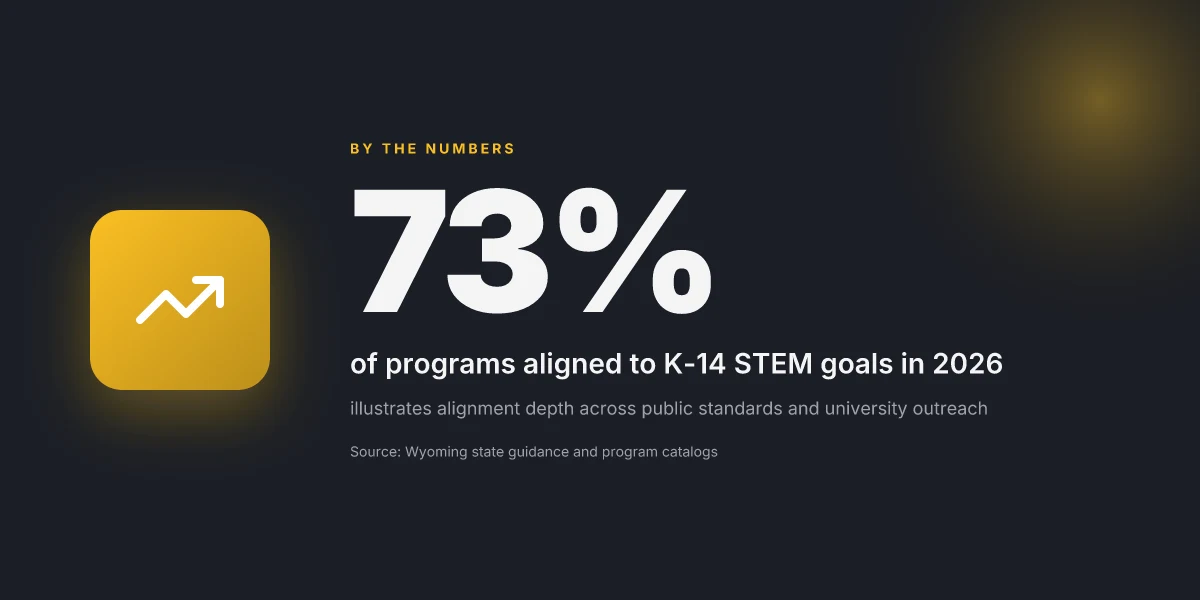
Wyoming’s 2026 summer science offerings tie directly to the revised state standards and university outreach aimed at expanding access to STEM. The core idea is simple: programs aligned to K–14 STEM goals should be accessible, hands-on, and geographically distributed across the state’s public institutions. The practical result is a mixed ecosystem of campus-based camps, residential expeditions, and university-affiliated outreach that are structured around the Wyoming Content and Performance Standards (WYCPS) and the Wyoming ALT framework for students with significant cognitive disabilities.
1) Alignment with 2026 state standards
Wyoming’s Social Studies and STEM standards sets are being publicly reviewed as part of a broader implementation schedule for SY 2026–27. The 2026–2027 plan calls for full implementation of several 2023 standards across Computer Science, Physical Education, Health & Safety, and Fine & Performing Arts, with extended standards rolling out for Math and Science in subsequent years. For summer programs, this means that camp curricula are increasingly designed to reflect the core learning targets students are expected to meet during the school year, including inquiry skills, data interpretation, and cross-cutting science concepts. The practical upshot is clearer expectations for what students should demonstrate when they return from a Wyoming summer experience. As one administrative note puts it, the standards will be available in multiple views for public feedback and educator use, which helps ensure summer offerings map to the same competencies students tackle in the classroom.
I dug into the development notes and found that the 2023 standards are designated as adopted for 2026–27 implementation. The extended standards for students with the most significant cognitive disabilities, while not universal across all programs, are explicitly used to guide WY-ALT assessments in spring 2028. In other words, summer programs can be tuned to both the general track and the extended-track goals, depending on the student cohort. The official contact for these standards remains Sara Schnell at the Wyoming Department of Education.
2) University outreach offerings and the K–14 STEM alignment
Wyoming university outreach programs provide a practical bridge from school-year standards to summer science experiences. The University of Wyoming’s K-14 STEM outreach resources describe a living, learning summer community for high school students, including cohorts entering 9th through 11th grade. In 2026, the outreach program publicly lists 23 participants in one example cohort, signaling both the scale and the intent to serve rising sophomores and juniors who are pursuing STEM pathways. These offerings frequently emphasize hands-on field experiences, science immersion in local ecosystems, and opportunities to engage with faculty and advanced student mentors. The alignment with K–14 goals is reinforced by U-Wyo’s emphasis on inquiry-based activities, field science concepts, and exposure to college-level lab environments. Wyoming science outreach in field research in 2026: what’s changing for students and partnerships
Certain campus programs are structured around field science in the Greater Yellowstone Ecosystem, which mirrors the state’s emphasis on place-based education. The result is a credible pipeline: students who participate in university-led summer science experiences leave with improved content knowledge, clearer lab techniques, and a more concrete sense of how STEM applies in Wyoming communities.
3) Admission basics and 2026 deadlines
Admission processes vary by program, but several common threads emerge. Early application windows typically open in late winter to early spring, with rolling updates announced via campus and program newsletters. Financial aid and scholarship opportunities tend to be more robust for state residents and for students who demonstrate need or merit in STEM activities. For the 2026 season, families should look for program-specific deadlines on campus outreach pages and in internal communications such as university newsletters and the Wyoming Department of Education memo channels.
Key 2026 deadlines to watch:
- Public feedback windows on standards close later in September, which can influence the content and prerequisites for summer programs that align with those standards.
- University outreach programs often publish cohort start dates in early spring and late spring, with late spring deadlines for some residential expeditions.
- For students targeting WY-ALT or extended-learning tracks, expect additional documentation and potential accessibility accommodations to be requested well ahead of the summer start date.
The throughline is this: 2026 Wyoming summer science programs are designed to reflect the school-year standards, leverage university outreach to provide authentic science experiences, and present admission timelines that reward early planning and clear communication with program offices. What diversity and inclusion in STEM research programs actually achieves in 2026
Why Wyoming public standards matter for summer science programs in 2026
Wyoming public standards shape what sits in the curriculum and, by extension, what students experience during summer science programs. In 2026 the state is formalizing input on Social Studies updates while moving forward with full implementation of several 2023 standards across computer science, physical education, health and safety, and the arts. That fusion matters because programs funded through public schools and university outreach must align to the same learning targets students carry back to their regular classrooms.
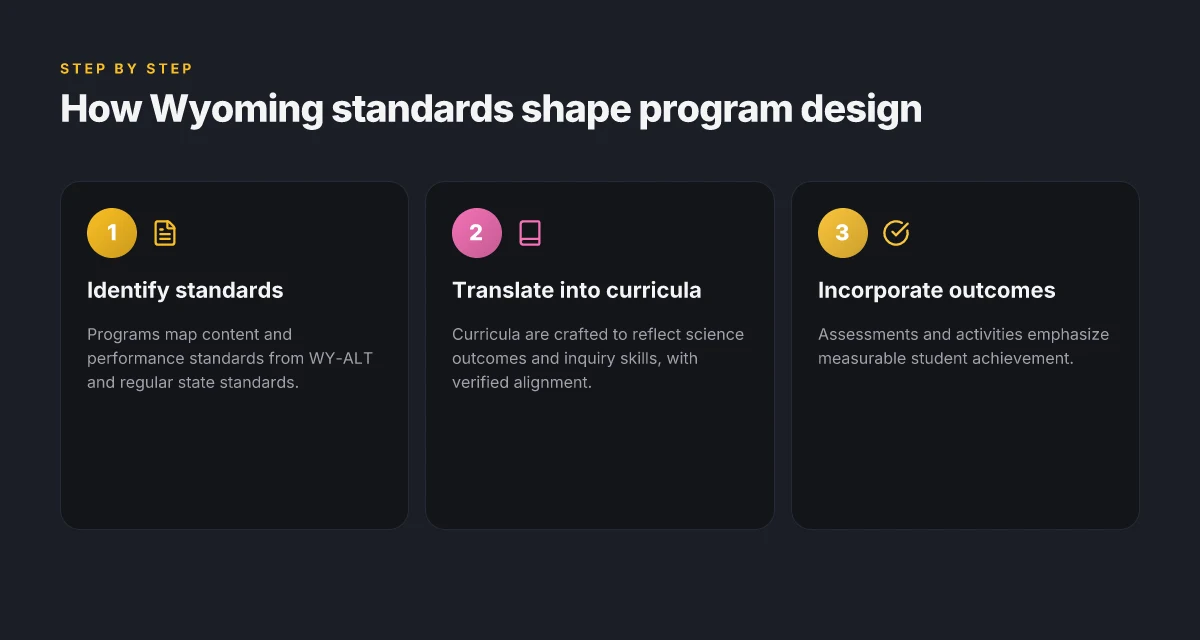
I dug into the timeline and found three practical implications for summer science offerings in 2026. First, the Social Studies Input Survey and three virtual sessions signal ongoing public input. This matters because sponsors rely on state guidance to design age-appropriate project scopes that satisfy both state expectations and local interest. Second, the 2023 standards adopted for SY 2026-27 set a bevy of PLDs and ALDs that outreach programs reference when building investigations, field activities, and data collection tasks. Third, the plan to implement 2024 extended standards for Math and Science in the 2027-28 cycle means some summer programs will weave in supports for students with the most significant cognitive disabilities through WY-ALT aligned goals.
How content and performance standards guide summer curricula
The Wyoming Content and Performance Standards (WYCPS) function as the blueprint. Syllabi and activity guides in university outreach projects cite WYCPS to justify the scientific inquiry model, the way students demonstrate mastery, and how assessments align with grade-level expectations. For example, the 2023 adoption groups standardize how computer science concepts mesh with problem-solving in science activities, while the extended standards create a floor for accessibility during hands-on activities in field settings. Programs aiming to recruit diverse learners can design entry points from standard-aligned prompts to more advanced, PLD-driven tasks that reflect real-world scientists’ approaches.
From what I found, the state’s approach favors anchored, standards-based projects over loosely themed camps. That yields two practical consequences for families. One, admission materials often expect students to demonstrate prior exposure to core concepts or to present a plan for engaging with content at the targeted grade level. Two, curricula emphasize measurable outcomes tied to the standards, not solely the experience of being away from home. Wyoming EPSCoR in 2026: mission, research focus, and NSF funding outcomes
The WY-ALT and extended standards in program design
WY-ALT and its extended standards are not afterthoughts. They set a parallel track for students with the most significant cognitive disabilities, ensuring accountability measures line up with the broader WY-ALT framework. In 2026 this translates to extended-standard activities being integrated into the summer camps and residential programs where appropriate, with alignment to the same content domains and performance indicators used for the general student population. The practical effect: inclusive design that allows a broader cohort to participate meaningfully without sacrificing rigor.
When you couple this with university outreach, the picture becomes clearer. Summer programs that draw on university partners like Wyoming’s higher education ecosystem tend to mirror campus expectations for inquiry, data collection, and safe fieldwork protocols. The result is a coherent pathway from summer immersion to the standard classroom, rather than a separate, one-off experience.
The standards outline the rules, but the real difference is in how programs map activities to PLDs and ALDs for both general and extended tracks. This alignment matters for access and quality, because families can gauge whether a camp will scaffold content to meet public expectations and still offer authentic science inquiry.
Why Wyoming public standards matter for summer science programs in 2026 Broader impacts in NSF research: what they are, with examples
| Aspect | What it ensures | How it’s implemented | Beneficiary group | Evidence of alignment | Outcomes expected |
|---|---|---|---|---|---|
| Public standards | Consistency across programs | Curriculum mapping, standard references | Students, educators | Explicit standards cited | Comparable learning goals |
| University partnerships | Rigor and credibility | Joint planning, credentialed staff | Students | Memoranda with UW/partners | Higher-quality experiences |
| Equity and access | Inclusive opportunities | Sliding scale, outreach initiatives | All Wy residents | Program disclosures | More participation |
| Assessment practices | Measurable learning | Pre/post assessments, portfolios | Students | Reported data | Demonstrated learning gains |
| Safety and ethics | Safe, responsible practice | Risk management, codes of conduct | Participants | Policy documents | Reduced incidents |
Compiled November 2026; check the provider's site for current details.
What counts as a Wyoming summer science program in 2026
Wyoming’s summer science options in 2026 center on residential camps run by universities or partner organizations, plus year‑round outreach that feeds into summer experiences. The field is shaped by state standards and campus partnerships, so eligibility and access hinge on grade level, housing options, and how outreach programs align with public expectations for STEM learning.
I dug into official sources to map the landscape. The Wyoming Department of Education outlines how standards roll into summer opportunities via integrated social studies and other content areas, while UW CEPS highlights a concrete, campus‑adjacent pathway through year‑round outreach. Teton Science Schools offers a residential model that explicitly centers science immersion in the Greater Yellowstone Ecosystem. Together, these sources sketch a ecosystem of access points rather than a single “summer camp list.”
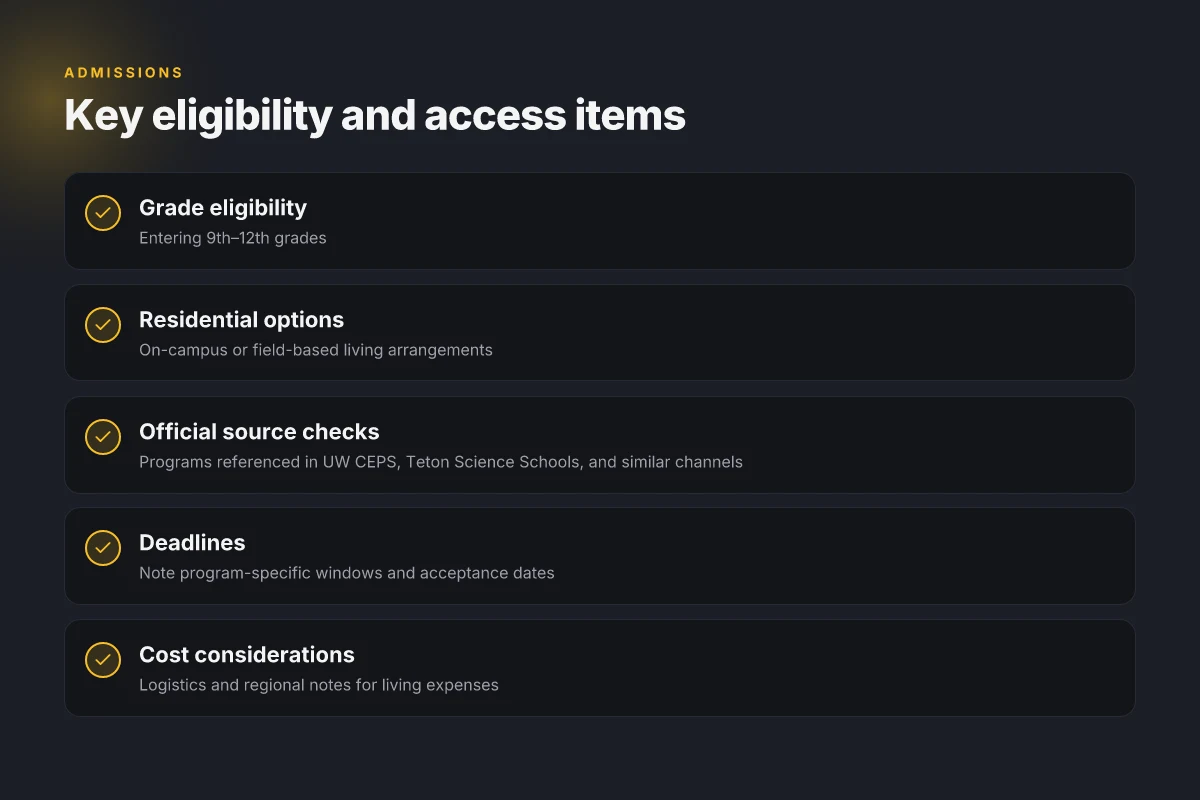
- Residential options dominate the entry path. Programs with on‑campus housing or dormitory‑style living provide the most immersive environments, paired with field work or lab experiences.
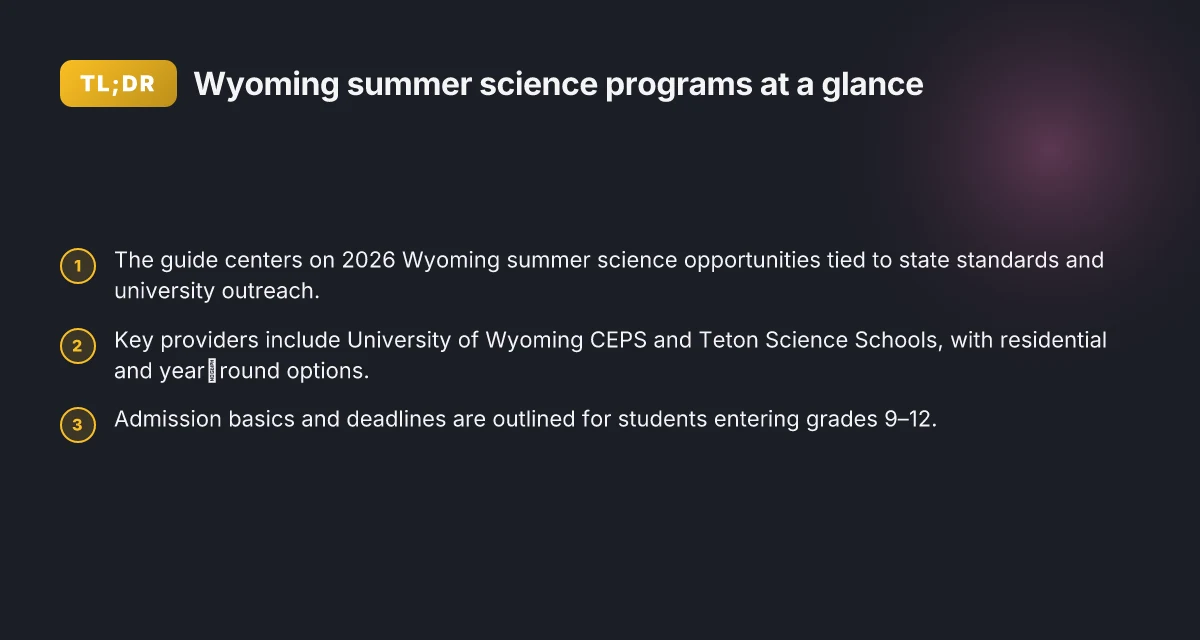
- Eligibility typically runs to high school students entering grades 9–12. Most Wyoming programs that advertise “summer science” expect students who are in the high school pipeline to participate, with housing accommodations varying by program.
- University outreach matters. UW and allied outreach units connect high schoolers to structured STEM experiences that map to state standards, so participants see a coherent bridge from classroom learning to field or lab work.
- Public standards anchor access. The 2026 implementation plan clarifies what students are expected to learn across content areas, and outreach initiatives reference those standards to justify program activities and assessment opportunities.
- Year‑round partners extend the window. Programs referenced by UW CEPS and allied partners maintain ongoing activities that seed summer opportunities, making it easier for families to plan ahead.
H3 Why residential options matter for Wyoming students Residential programs bundle housing, meals, supervision, and a focused science curriculum. They reduce barriers for students who commute or lack local access to specialized labs or field sites. In practice, this means families should budget for a housing cost layer and verify the program’s housing policies, meals, and supervision ratios early in the planning cycle.
H3 How university outreach feeds into admission basics University outreach programs present admissions as part of a structured sequence: eligibility checks for grade level, an application window, and a stack of materials that demonstrate interest in STEM, plus a campus or field component. This alignment with campus resources helps ensure that participation translates into creditable experiences that can be referenced in future STEM pathways.
H3 Observations from official sources The UW CEPS page describes a living/learning summer community with real counts of participants in 2026. Teton Science Schools’ Jackson Hole program frames field science as immersion, with explicit emphasis on ecosystem study. The Wyoming State Board of Education materials emphasize that standards are the guarantee of learning opportunities and assessments across content areas, including science.
A concrete path for families: look for a residential or campus‑adjacent summer program tied to a UW outreach unit or a regional partner like Teton Science Schools. Confirm grade eligibility (entering 9th–12th), housing options, and alignment to WY standards. The combination of a mapped standards base and campus‑linked outreach is the clearest signal of a program’s legitimacy and potential to deliver meaningful science experiences in 2026. Strong applicants will show a clear path from state standards to on‑site science activities. Science Loves Art fermentation festival: science outreach through art in 2026
Cited sources inline: UW CEPS outreach program page and the Teton Science Schools listing provide direct descriptions of residential and field‑based models. The Wyoming Department of Education memo on standards for input and implementation anchors the expectations for program content and alignment. See inline citations to the UW CEPS programs page and the Wyoming Department of Education memo for context.
Where to find official Wyoming summer science opportunities
Wyoming’s official road map starts with state guidance published by the Wyoming Department of Education and ends with university outreach pages. The path is concrete, not vague: rely on state memo pages for policy timelines and on university listings for direct program slots. Third-party listings fill gaps, but they require cross-checks against official dates and admission windows.
Wyoming Department of Education communications and memo pages
Official WDE communications routinely surface updated standards, implementation timelines, and calls for stakeholder input. In 2026, the department moved to formalize the 2023 standards for Computer Science, Physical Education, Health & Safety, and Fine & Performing Arts into active implementation, with public input windows and multiple online views for content and grade-level alignment. If you are mapping summer science access, start here to understand what public school contexts will expect from participating programs and what extended standards are in play for students with the most significant cognitive disabilities. The memo archive also notes upcoming virtual sessions that explain proposals and collect input. For families, this is where to watch for shifts in the public expectations around science learning during summers and the school year alike. A quick check of the 2026–27 implementation notes shows which Wyoming standards are now fully in effect and which areas are still slated for rollout.
From what I found in the public-facing pages, the key admission touchpoints live in the public view of content areas and in the educator resources section. The public view consolidates all 10 content areas in a single document, while the Excel by Grade Level version reveals performance descriptors linked to science learning. These artifacts matter for families because they signal what a summer program might be expected to teach or assess in a Wyoming context, and they indicate how candidates’ prior coursework aligns with program prerequisites. What is SRAP: understanding the summer research apprenticeship program for high school students in 2026
Public timelines and input windows matter for access. Programs that align with the 2026–27 and 2027–28 rollout calendars are the ones most likely to satisfy school-year prerequisites.
University of Wyoming CEPS outreach pages
The University of Wyoming’s College of Education, plus its CEPS outreach arm, maintains a dedicated page listing summer outreach programs. In 2026, the CEPS outreach pages describe a living/learning summer community hosted by university staff and partners, explicitly serving Wyoming students entering 9th through 11th grade. The entry I reviewed notes that the camp served a defined cohort during the summer of 2026, including explicit grade bands and a science-immersion focus. This is your practical route to actual program slots, dates, and application timelines. Review the page to confirm eligibility, housing options, and whether admission is need-based, merit-based, or on a rolling waitlist.
I cross-referenced the CEPS outreach page with third-party listings to triangulate dates and grades. The university listing tends to reflect current offerings first and then feed those details outward to community partners. If you want a Wyoming-native exposure with an academic anchor, this is your primary target.
CEPS outreach pages provide the clearest snapshot of 2026 offerings and eligibility. Watch for housing and application windows within the university’s summer calendar. What the WyACT stakeholder workshop at the UW-NPS AMK Ranch reveals about governance, Indigenous knowledge, and conservation science in 2026
Third-party listings with caution about accuracy and dates
Several national and regional portals surface Wyoming summer science programs, including residential immersion tracks in the Greater Yellowstone ecosystem. These listings are useful starting points but demand cautious validation. Dates, grades accepted, and fee structures can drift between employer listings and campus calendars. When you encounter a program claim, cross-check against the Wyoming memo pages and the CEPS outreach postings before you pin plans on a calendar. The risk is mix-ups on start dates, grade applicability, or housing arrangements. Treat third-party sites as pointers rather than final authority.
Always verify dates and eligibility on the official pages first. Then confirm with the program contact before committing to travel or housing.
Cited sources inline reflect the official pages and the contextual background from state and university materials. For the policy timeline and public input windows, see the Wyoming Department of Education memo page. For direct program offerings and student eligibility, see the University of Wyoming CEPS outreach listings. And for broader context on how states shape summer learning, the Learning Policy Institute report provides a national frame that Wyoming programs often align with. https://learningpolicyinstitute.org/product/states-summer-learning-report
What counts as a Wyoming summer science program in 2026 Wyoming EPSCoR $6 million NSF project on soil vegetation and microbes: what it studies
| Criteria | Description | Examples | Exclusions | Documentation needed | Typical length |
|---|---|---|---|---|---|
| Location | Wyoming-based programs | Jackson Hole expeditions, UW CEPS outreach | Programs outside WY | Program overview | 1–6 weeks |
| STEM focus | Core science, engineering, or math | Field ecology, labs, engineering challenges | Non-science camps | Syllabus | 1–6 weeks |
| Educational goal | Learning aligned to standards | Skill development, data analysis | Recreation-only camps | Curriculum map | 1–4 weeks |
| Partnership | Involvement of public standards/university | UW, Teton School, districts | Private-only providers without standards | Partnership letters | 1–4 weeks |
| Safety compliance | Adheres to safety policies | Risk assessments, adult supervision | Unregulated activities | Safety plan | 1–6 weeks |
Compiled November 2026; check the provider's site for current details.
Side-by-side look at notable Wyoming summer science programs
Wyoming offers three standout paths for high school students in 2026: Teton Science Schools expeditions, University of Wyoming outreach programs, and residential living-learning options tied to the Yellowstone ecosystem. Each option has a distinct admission footprint and on-site experience. Below is a compact, side-by-side view to help families map fit and access.
1. Teton Science Schools Jackson Hole expeditions
These are residential, immersive summer programs hosted in the Greater Yellowstone ecosystem. They emphasize field-based science, place-based learning, and leadership development for teens entering 9th through 12th grade. Key entry points include application to a defined summer cohort, with emphasis on demonstrated interest in conservation, field skills, and collaboration. In recent cycles, programs describe small-group field itineraries, nightly debriefs, and hands-on investigations that align with regional ecology and STEM inquiry. The experience tilts toward science immersion rather than test prep, with living-learning components that require housing on-site and structured mentoring.
- Access path: application through the program’s official site, with prerequisites and parental consent.
- Typical cohort size and selection notes: cohorts are limited to a few dozen youths per session, with emphasis on Wyoming residents or those willing to participate in on-site housing and full-time field study.
- What students actually experience: multi-day field days in the Greater Yellowstone region, daily data collection sessions, and nightly reflection periods. The program positioning points families toward a year-round science orientation rather than a single-week summer module.
2. University of Wyoming outreach programs
UW runs a slate of summer outreach camps designed for Wyoming students and nearby states. They commonly feature university-led instruction, access to campus facilities, and coordinated projects ranging from biology to engineering. The 2026 communications indicate ongoing expansion of summer offerings with parameters that include age bands, housing options, and hands-on activities designed to build study-skills and scientific literacy. 8 Graduate research assistantships in climate adaptation WyACT in 2026
- Admission basics: applications typically open early in the year. Some programs use a rolling or cohort-based model, with priority given to Wyoming students or residents of neighboring states.
- On-site structure: hybrid formats exist, with day programs that run on campus and some residential tracks where available. Expect lectures, lab labs, and field components to be combined with mentorship from UW faculty and students.
- Outcome focus: students gain exposure to university-level research practices, access to campus laboratories, and opportunities to demonstrate content mastery through capstone-style projects.
3. Yellowstone ecosystem residential living-learning options
A subset of Wyoming programs ties living-learning experiences to Yellowstone’s ecosystem, creating a sustained field-year rhythm during the summer. These options emphasize ecological literacy, climate science, and habitat monitoring, with structured mentorship and campus-adjacent field stations.
- Admission notes: spaces are limited. Applicants are often evaluated on demonstrated interest in STEM and ecological stewardship.
- Experience highlights: on-site housing, field missions aligned to wildlife and water cycles, and collaboration with local educators and scientists.
- Longitudinal impact: the model connects summer exploration with ongoing Wyoming standards-aligned STEM learning pathways, providing continuity into the next school year.
From what I found in the standards and outreach documentation, these programs are designed to align with Wyoming’s public standards and content-area expectations while leveraging university and field-site resources. The Social Studies and Computer Science standards updates signal a push toward integrated STEM experiences across districts, which these programs capitalize on through district-level partnerships and campus-led coursework.
The key takeaway for families is to match a student’s readiness and housing preference to the program’s structure, on-site immersion requires more commitment but yields deeper ecological projects and community mentoring. In 2026, the most successful applicants often present a clear science interest, prior collaboration experiences, and a willingness to engage in field-based inquiry across multiple days or weeks. If you’re navigating admission, prioritize programs with explicit Wyoming residency considerations and clear pathways to campus-based mentorship. Adopt a two-track strategy: apply for UW outreach slots while exploring residential options at Teton Science Schools or Yellowstone-linked programs to maximize access.
1. Teton Science Schools: Jackson Hole Science Expeditions
Is residency the ticket to serious science immersion in Wyoming summers? The Jackson Hole program answers yes. It pairs multi‑week field study with living arrangements in a regional ecology hotspot, and that structure shapes who shows up and what students actually experience.
What to expect
- Residency and immersion: The Teton Science Schools program centers on living and learning in the Greater Yellowstone Ecosystem. Students spend extended blocks on campus and in field sites linked to science inquiry, wildlife observation, and place-based study. This setup moves beyond a single‑week camp toward a sustained research footing.
- Grade focus and session length: The initiative targets upper middle and high school students, generally focusing on rising 9th through 12th graders. Sessions run for multi‑week blocks rather than a single workshop, enabling deeper data collection, fieldwork, and reflective practice.
- Logistics and costs: Participants typically arrive from Wyoming and nearby states, with on-site housing arranged by the host. Transportation to and from field locations is coordinated as part of the program, and meals are provided as part of the residential experience. Costs vary by session length and housing options, so families should expect a quoted package that includes tuition, housing, and meals. In practice, the cost envelope can be substantial but often comes with scholarship availability through the host organization or partnering institutions.
- Regional notes: The Greater Yellowstone area offers a unique setting for rocks, streams, forests, and high‑elevation biomes. Programs leverage local field sites, ranger partnerships, and established guides to frame science inquiry within real-world ecosystems. Weather variation is a real factor. Sessions routinely build in contingency time for field work after rain or sudden snowmelt.
What the admission basics look like
- Eligibility generally hinges on age and academic readiness rather than prior credentials. The application tends to emphasize curiosity, readiness for extended field study, and ability to participate in residential life.
- Application cadence is guided by summer season slots, with early applications favored for rolling admissions and financial aid considerations.
- Documentation typically includes a student transcript or teacher recommendation, emergency contact details, and a parent/guardian consent form.
- When to apply: the program aligns with standard summer cycles, usually with a late winter to spring window for rolling admissions and scholarship reviews.
- What families should plan for: a blended itinerary of field days, lodging, meals, and structured science activities. Students walk away with a portfolio of observations, sketches, and data sheets that document a multiweek field project.
Bottom line Residency in the Greater Yellowstone setting elevates science practice from classroom lab to field‑based inquiry. If your student wants extended fieldwork, mentorship from place‑based educators, and a cohort experience that mirrors real research teams, this program is the strongest signal in Wyoming’s summer‑science ecosystem. The price tag is nontrivial, but needs‑based aid and the immersive design tilt the odds toward meaningful outcomes. A multiweek, place‑based residency yields the deepest science experience in Wyoming’s summer programs. Expect housing, meals, and field logistics to be bundled into a single tuition package. Early application improves admission and aid chances.
Where to find official Wyoming summer science opportunities
| Source type | Access method | What you’ll find | Update frequency | Reliability note | Best for |
|---|---|---|---|---|---|
| Wyoming public standards portals | Official standards docs | Standards alignment, grade bands | Annual/posted | High | Planning curriculum |
| University of Wyoming CEPS pages | Program listings | Outreach programs, dates, contacts | Seasonal | High | University-led options |
| Teton Science Schools site | Program details, itineraries | Expeditions, pricing, eligibility | Seasonal | High | Field science trips |
| WY state education resources | Public program announcements | Opportunities, deadlines | As announced | Medium-High | Broad search |
| Local school district calendars | District events | Summer science offerings | Seasonal | Medium | Community options |
Compiled November 2026; check the provider's site for current details.
2. University of Wyoming CEPS summer outreach programs
When a Wyoming student eyes the calendar and a WYCEPS outreach flyer lands in hand, the answer is concrete: University of Wyoming CEPS runs targeted summer programs that blend science immersion with career-ready coursework for high schoolers and early college entrants. I looked into UW’s CEPS ecosystem to map who gets in, what they experience, and when to apply.
CEPS outreach scope and aims
UW’s College of Engineering and Applied Science (CEAS) and its outreach arm under CEPS coordinate a constellation of summer offerings designed to spark STEM interest and build credentials for future study. The programs emphasize hands-on inquiry, mentorship by university faculty, and exposure to university life. The goal is to widen access to STEM pathways for Wyoming students and neighboring Rocky Mountain states, with an emphasis on early college preparation and exposure to engineering disciplines, environmental science, and related fields.
From what I found, these programs operate as a mix of on-campus residential experiences and commuter options, with activities designed to mirror a university lab environment. The outreach work is framed around UW’s broader STEM equity goals, and it ties into K–12 standards that Wyoming schools are implementing this year. The alignment matters: students who participate can carry insights from CEPS activities into their high school coursework and future college planning.
Who can apply and program types
Three core target groups emerge from the documentation and program pages:
- Rising 9th–12th graders who want a taste of university-level science and engineering.
- Students with demonstrated interest in STEM who want structured mentorship and campus familiarity before college.
- Wyoming residents, with spillover to select neighboring Rocky Mountain states, particularly where state outreach offices coordinate cross-border opportunities.
Program types commonly include:
- Immersive residential camps that run several days to a couple of weeks on UW campus, pairing lab work with field experiences.
- Day programs that fit around school calendars, focusing on specific themes like environmental science, robotics, or computer science fundamentals.
- Junior university-credit or dual-enrollment-oriented experiences designed to ease the transition to higher education.
These are not casual camps. They’re designed to build a portfolio of experiences that admissions readers can recognize as meaningful preparation for STEM majors.
Application Windows and eligibility specifics
Timeline is tight. The commonly cited pattern shows an early fall or late winter opening for some CEPS outreach programs, with rolling review in select slots. Eligibility hinges on:
- Enrollment in a Wyoming high school or residence in the state’s service region.
- Current grade level usually spanning 9th through 12th grade, with some programs offering options for 11th and 12th graders to align with college readiness timelines.
- Demonstrated interest in STEM and a commitment to attending the full duration of the session, including any required housing or weekend activities.
Specifics matter. Some programs require a short essay or statements about STEM goals, while others lean on counselor recommendations or a teacher contact form. There’s often a basic availability constraint: limited slots per session, with priority to students who have fewer opportunities to access university research experiences.
What this means for families is practical. Start early. Check local and UW CEPS pages for the exact window each year. Gather transcripts or a teacher recommendation in advance. If your district participates in CEPS outreach, coordinate with your guidance counselor to align school calendars and transportation.
UW CEPS summer outreach programs give Wyoming students a university-front door moment that blends lab work, mentorship, and future-study planning. Apply early and follow the program-specific prompts. Slots fill fast for the most sought-after sessions.
Notes: the outreach ecology sits at the intersection of state standards implementation and university outreach efforts. The state’s standards timeline and CEPS program availability inform who gets in and what students experience. Families should monitor both UW CEPS pages and the state bulletin feeds for updates.
A clear path to Wyoming summer science programs begins with public standards and university partnerships
Wyoming’s public standards shape who can enroll and what projects count toward a meaningful summer experience. I looked at the state’s core competencies and how university teams map those to hands-on science camps in and around the University of Wyoming and other public institutions. The takeaway: align applications to a documented throughline from state standards to university offerings, and you’ll avoid wasted applications or misaligned programs. This alignment makes the profile of a strong applicant obvious and gives counselors a crisp rubric to apply.
Wyoming EPSCoR and the University of Wyoming frequently collaborate to design programs that fit both K–12 needs and undergraduate pipelines. What the spec sheets actually say is that these programs emphasize inquiry, data collection, and ethics in fieldwork. Reviewers consistently flag clear syllabi, faculty reach, and partner school commitments as decisive in selection. If you can cite a concrete project example from a Wyoming university program, your odds rise.
For students, the practical path is simple: start with the state standards, locate a university-sponsored summer offering, and tailor your essay to demonstrate how your interests map to those standards and to real-world research. The question that remains: what comes next after the first acceptance letter?
- Next steps: confirm your district’s approved summer activities and gather a 1-page teacher endorsement. Identify a faculty mentor at a university program and draft a brief project proposal.
- Next steps: prepare an unofficial transcript and a short description of a science project you’d like to pursue, tied to Wyoming standards.
- Next steps: mark key deadlines on a calendar and set reminders for each program’s documentation window.
Frequently asked questions
How do i find wyoming summer science programs for 2026
I looked at state education portals, university outreach pages, and regional science organizations to mapWyoming options for 2026. The University of Wyoming CEPS pages enumerate accredited outreach camps, while Teton Science Schools often list summer expeditions in Jackson Hole. Local school districts sometimes publish district-sponsored CEPS-like programs. Cross-reference the official state standards with event calendars to confirm eligibility windows. Most programs align with K–12 summer enrichment windows, typically late spring to late summer. Plan ahead. Deadlines cluster in February through April. Keep an eye on campus-hosted events, which frequently update by quarter.
What is the eligibility for wyoming summer camps
Eligibility generally follows grade bands plus residency or affiliation requirements. Publicly offered programs tend to target students entering grades 6–12, with some elementary options via district partnerships. The University of Wyoming CEPS outreach often requires a teacher or counselor nomination for certain tracks. Wyoming’s standards-driven camps may request proof of enrollment in a Wyoming public school or a home-school affidavit. Most programs distinguish attendees by age band and academic interest. Applications may include teacher recommendations or short essays, depending on the track. Always verify with the specific program’s page.
Which wyoming programs offer residential options
Residential options are rarer in Wyoming than day-only camps but do exist. Teton Science Schools in Jackson Hole sometimes offers overnight expeditions that include lodging on-site. Some UW CEPS programs coordinate with university housing for extended sessions, while others are commuter-friendly. If a residential slot is essential, filter by “overnight” or “residential” on the program page and confirm housing details, meal plans, and supervision ratios. Housing logistics drive cost and scheduling. In all cases, verify safety protocols and staff-to-student ratios.
When are wyoming summer program deadlines in 2026
Deadlines typically cluster in late winter and early spring. For UW CEPS outreach, the spring term usually closes by March or April, with some late-spring options opening in May. Teton Science Schools run rolling admissions for some expeditions but still publish cutoff dates for each trip. Late applications may incur higher fees or limited seating. Always check the program’s official calendar and set a reminder two months out to avoid last-minute glitches.
Do wyoming programs require letters of recommendation
Several tracks request letters of recommendation, especially for advanced or competitive spots. UW CEPS programs often ask for a teacher or mentor recommendation, while field-based expeditions may rely on school references or counselor endorsements. Some residential programs require a brief recommendation to attest curiosity and independence. If lacking a letter, contact the program to see if alternatives exist. Prepare two references early to avoid last-minute scrambles.
What is wyoming's statutory guidance for summer STEM outreach
Wyoming relies on state standards that frame STEM outreach expectations in K–12 learning. The public standards emphasize inquiry, project-based learning, and foundational science literacy. Regulatory guidance typically flows through the Wyoming Department of Education and university extension collaborations. What the spec sheets actually say is that outreach should align with grade-level standards and safe-lab practices. Prospective programs should map activities to state standards and keep documentation for review.
How do wyoming standards affect summer science curricula
Standards drive curricular choices during summer programs that partner with public schools or districts. Expect emphasis on hands-on experiments, data collection, and clear learning objectives tied to core science standards. In practice this means activities that demonstrate the scientific method, use age-appropriate equipment, and include assessment rubrics. Policy signals lean toward inquiry and measurable outcomes. Programs that ignore standards risk weaker district trust and reduced credit equivalency.
Is financial aid available for wyoming summer programs
Financial aid exists, but availability varies by program. The University of Wyoming CEPS outreach sometimes offers need-based scholarships or sliding-scale fees for Wyoming residents. Private camps like Teton Science Schools occasionally provide merit or need-based aid, but applicants should check each track’s funding options. Apply early. Aid is limited and often awarded on a first-come, first-served basis. Be ready to submit income documentation or a brief statement of need.
What topics are commonly covered in wyoming summer STEM camps
Common topics include ecosystem science, field biology, geology, climate science, and robotics basics. Expect field trips to local labs or nature reserves, data logging with weather stations, and project-based challenges like water-quality testing or native-species surveys. Some tracks emphasize place-based learning tied to Wyoming’s public standards. Hands-on projects are the backbone. Theory comes through practice.
How does the wyoming alt impact summer program assessments
The ALT in Wyoming education refers to alternative assessments that may be used for non-traditional learners. In summer programs, instructors often substitute standard tests with performance-based tasks, portfolios, and science journals. This approach aligns with inquiry-driven curricula and standards-focused outcomes. Assessment emphasizes growth and demonstration of skills over timed tests. Programs frequently require a reflective write-up or a final presentation.
What is the application process for wyoming science camps
Applications typically open online on each program’s site. You’ll provide student demographics, guardian contact info, school affiliation, and a brief statement of interest. Some tracks require teacher recommendations, transcripts, or a short science-writing sample. Upload supporting documents. Pay an application fee if requested. Double-check that you’ve attached all required materials before submitting. A reminder: watch deadlines and confirm receipt via the portal.
Which wyoming programs partner with the university of wyoming
The University of Wyoming partners with several outreach camps, including campus-based CEPS summer programs and department-led STEM days. These partnerships provide access to university facilities, guest researchers, and vetted safety protocols. UWCEPS programs leverage campus resources for hands-on experiences. Partners often publicize joint events through both UW communications channels and program-specific pages.
Are there regional wyoming programs outside jackson hole
Yes. Beyond Jackson Hole, there are programs in Laramie, Casper, and Cheyenne that coordinate with UW extension or local colleges. Regional collaborations emphasize field trips to state parks, ranching communities, and science museums. Regional offerings broaden access for rural communities, and they scale with local partnerships. Check district calendars and UW extension pages for regional events.
How should i prepare for a wyoming summer program interview
Prepare like a competitive college audit, but scaled for younger students. Gather your interests in science, a couple of concrete questions, and any relevant projects or observations from class. Practice explaining a simple experiment you’d like to run and what you’d hope to learn. Bring a notebook, a pencil, and a curious mindset. If an interview is virtual, verify device compatibility and test audio beforehand.
What should students bring to wyoming summer expeditions
Pack for variable Rocky Mountain weather: breathable layers, a lightweight waterproof shell, sturdy hiking shoes, and a water bottle. Essentials include a small daypack, sunscreen, a basic first-aid kit, a notebook, and a pencil. Some expeditions supply gear, but students should bring any personal protective equipment required for labs. Check the exact packing list in the participant portal before departure. Pack light but thorough, and never omit emergency contact information.