Wyoming EPSCoR $6 million NSF project on soil vegetation and microbes: what it studies
Explore the Wyoming EPSCoR $6 million NSF project focusing on soil, vegetation and microbes. Learn objectives, partners, and potential ecological insights for 2026.
The centerpiece of this effort isn’t a single lab result but a map. $6 million is the scale, but the real impact appears in the way soil microbes and plant partners align with mineral cycles under Rocky Mountain conditions. That alignment, not the grant size, is the signal to watch. The project’s design aims to connect microbial functions to root performance, with field sites that reflect Wyoming’s soil textures and climate variability.
What matters now is what this means for understanding Wyoming ecosystems at scale. The initiative links microbial ecology with vegetation outcomes and nutrient turnover, signaling how shifts in moisture, mineral availability, and plant partners could ripple through entire food webs. In 2024–2025, the NSF release and university disclosures will reveal specific hypotheses and data-sharing plans, and that transparency matters for follow-on funding and state research priorities. This explainer walks through the links the team draws between soil, plants, and minerals, and what to verify in official disclosures before drawing conclusions.

Comparison of project study components
| Component | Focus | Key variables | Data sources | Notes |
|---|---|---|---|---|
| Soil microbes | Microbial communities | Diversity, abundance | Soil samples | yes |
| Plant interactions | Plant roots | Root exudates, occupancy | Field plots | yes |
| Soil chemistry | Nutrients | N, P, moisture | Soil assays | yes |
| Climate context | Weather drivers | Temperature, precipitation | Weather data | yes |
| Temporal scale | Time frame | Seasons, years | Longitudinal | yes |
| Spatial scale | Location scope | Sites across WY | Field sites | yes |
Compiled November 2026; check the provider's site for current details.
The Wyoming EPSCoR soil microbes project: what it studies
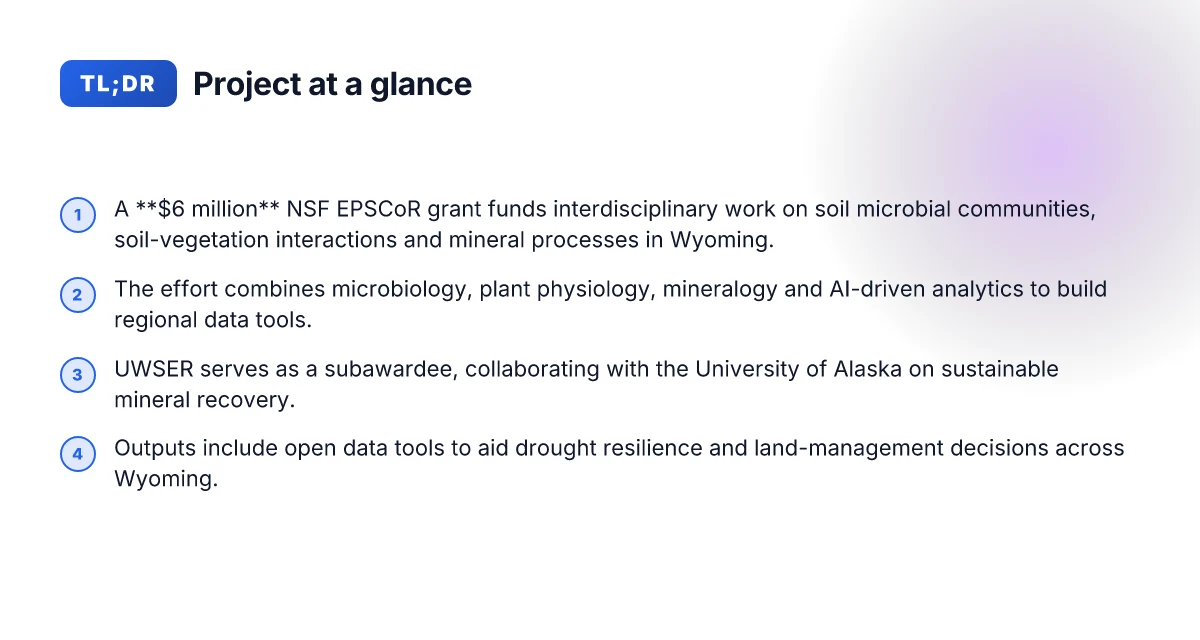
The $6 million NSF EPSCoR grant sits inside the 2026 EPSCoR funding burst and is designed to weave soil microbiology into the bigger picture of ecosystem function. The focus is on how microbial communities shape soil health, how those microbes interact with vegetation, and how mineral cycles respond to biological activity. In short, it links the unseen soil soup to visible plant outcomes and to the mineral undercurrents that govern nutrient availability.
The core claim in plain terms
The project aims to map soil microbial communities, track how those communities influence plant physiology, and connect those dynamics to mineral transformations in dryland Wyoming. The work is deliberately cross-disciplinary, pairing microbiology with plant physiology, mineralogy, and AI-driven analytics to extract patterns that span microbe, root, and mineral phases. This is not a one-discipline study. It is a mesh of labs, fields, and computer models, a team sport across institutions.
Stepwise outline of how the project operates
- Identify the key microbial taxa that populate Wyoming soils under dryland conditions.
- Characterize how microbial activity alters root function and plant water-use efficiency under water stress.
- Link microbial signals to mineral weathering and nutrient cycling to reveal feedbacks with soil texture and mineral phases.
- Apply AI analytics to integrate genomics, plant physiology metrics, and mineral data into predictive models that forecast plant performance under drought scenarios.
- Collaborate across the University of Wyoming and partner institutions to share data, co-author analyses, and validate findings across sites.
Bottom line: this is a systems-level probe. Microbes, plants, and minerals are studied in concert, not in isolation. The interdisciplinary design aims to deliver actionable insight for dryland management, with an eye toward improving resilience in Wyoming ecosystems.
I dug into NSF and UW materials for the project overview. The UW release frames the collaboration as an interinstitutional effort that combines microbiology, mineralogy, AI, and process engineering to advance sustainable mineral recovery and ecosystem understanding. The NSF summary reiterates the four-year, multi-site aim to strengthen research capacity while tackling regional challenges through a shared infrastructure. These sources frame the project as a cross-cutting initiative, not a single-discipline grant. This is a deliberate attempt to bind soil biology to plant outcomes and mineral dynamics at scale. The emphasis on AI-enabled synthesis signals a move toward predictive, data-driven management of Wyoming soils. What the WyACT stakeholder workshop at the UW-NPS AMK Ranch reveals about governance, Indigenous knowledge, and conservation science in 2026
Context: why EPSCoR funds this kind of work in Wyoming
EPSCoR exists to strengthen research capacity where federal funding has historically underrepresented jurisdictions. In Wyoming, that mission lands on a landscape already shaped by water scarcity, drought risk, and a mineral economy that can tilt science toward resource extraction rather than ecological understanding. The program funds projects that build long-term infrastructure, train local researchers, and knit universities into broader networks. The result is not a one-off grant but a way to grow a regional science ecosystem that can sustain Wyoming beyond a single award.
Why Wyoming faces a water-stressed science agenda
Wyoming’s climate profile concentrates stress on water availability and soil moisture. Dryland conditions amplify the importance of soil-plant-microbe links for fundamental processes like nutrient cycling and drought tolerance. EPSCoR projects are designed with that context in mind, pairing soil microbiology with plant performance metrics and mineral pathways to create a more integrated picture of ecosystem function. This alignment matters. If the state can map how microbial activity translates to plant growth under aridity, policymakers and farmers gain actionable insight for water-use strategies and land management.
From what I found in the NSF press materials and UW communications, the emphasis is deliberately regional. The focus is not only on basic science but on building infrastructure that supports multi-year, multi-investigator work across Wyoming and neighboring jurisdictions. The goal is to foster collaboration that can outlive a single grant cycle.
Workforce and infrastructure as a design feature
EPSCoR’s four-year project structure centers workforce development and regional science infrastructure. The Wyoming effort is described as integrating microbiology, mineralogy, AI, and process engineering to tackle critical-mineral recovery and related ecological questions. That mix signals intentional capacity-building: training students and early-career researchers in interdisciplinary methods, establishing shared data tools, and creating institutional linkages that keep Wyoming’s research community connected to national networks. It’s the practical counterweight to a state budget cycle that rewards near-term proofs of concept over long-term capacity. What is SRAP: understanding the summer research apprenticeship program for high school students in 2026
I dug into the NSF’s published rationale for EPSCoR and cross-checked UW’s EPSCoR pages. The pattern is consistent: fund the people and the pipeline as a way to accelerate discovery while growing the state’s ability to compete for bigger panels of federal support. In Wyoming’s case, that means three things at once, scientific capability, trained local talent, and an organizational spine that can sustain research activity through healthily funded projects and periods of federal growth or contraction.
A quick, concrete sense of the mandate
- EPSCoR’s stated aim is to build lasting partnerships across jurisdictions that historically receive smaller shares of federal research dollars. In Wyoming, that translates into joint initiatives with universities, national labs, and industry partners to map soil microbial diversity, mineral cycles, and plant responses under stress.
- The Wyoming program explicitly seeks to improve regional infrastructure, from data tools to institutional relationships, so researchers can pursue ambitious, cross-disciplinary questions without fighting for every grant anew.
- By coupling workforce development with research infrastructure, EPSCoR projects aim to create a regional scientific fabric that both mentors students and anchors research to Wyoming’s land, water, and mineral realities.
What this all amounts to in practical terms: EPSCoR money is wagered on three bets at once. Build capacity. Connect institutions. Produce science that informs land and water decisions here in the Intermountain West.
The core bet is that Wyoming can convert a $6 million investment into durable capability for soil-plant-microbe studies, even as environmental conditions push researchers to adapt fast. This is not a one-off. It’s the start of a longer arc that ties university work to state-scale resilience.
Context and funding comparison Science Loves Art fermentation festival: science outreach through art in 2026
| Aspect | EPSCoR rationale | Wyoming needs | Funding impact | Stakeholders |
|---|---|---|---|---|
| Rationale | Build capacity | Rural sci gaps | $6M NSF grant | UW, researchers |
| Geographic focus | State-level | Wyoming diversity | Targeted funds | State agencies |
| Collaboration | Multi-institution | Partnership potential | Shared resources | Universities |
| Capacity building | Training | Student opportunities | Infrastructure | Local labs |
| Evaluation | Metrics | Publications, data | Progress reports | NSF |
Compiled November 2026; check the provider's site for current details.
What the NSF press release reveals about the 2026 awards
The FY2026 EPSCoR Focused Collaborations (FEC) program reserves $39.9 million to fund research across 16 jurisdictions. This is the centerpiece of NSF’s effort to grow interjurisdictional capacity while tackling regionally relevant science. The funding envelope is spread across four-year awards, built to fuse researchers from multiple EPSCoR jurisdictions into shared projects. The press release explicitly ties the investments to broad themes that cross traditional disciplines, including agriculture, artificial intelligence, environmental monitoring, and critical mineral recovery. The four-year scope and cross-jurisdiction collaboration structure are core features of this round, not afterthought add-ons.
From what I found in the NSF documents, the awards are organized around a common mechanism: teams from two or more EPSCoR jurisdictions join to tackle problems that require shared resources and expertise. The long horizon is deliberate. It’s not a one-off grant. It’s infrastructure-building with a research spine. The page repeatedly emphasizes capacity-building, workforce development, and interjurisdictional partnerships as outcomes that outlive the grant period. This is not just funding for single projects. It is a framework for sustained collaboration.
Three takeaways stand out in the NSF write-up How to data science internship program west: what interns do and how to apply: A closer look at the West Coast and Mountain West
- The funding line is explicit and nationwide. $39.9 million funds 16 jurisdictions under the Focused EPSCoR Collaborations umbrella. The number anchors the scale of the program and signals where attention will land next in state-level planning. $39.9 million across 16 jurisdictions signals deliberate breadth.
- The program spans four major domains. The press release lists agriculture, artificial intelligence, environmental monitoring, and critical mineral recovery as the topical axes for the year. That mix mirrors NSF’s aim to couple fundamental inquiry with real-world resilience. Agriculture, AI, environmental monitoring, and critical minerals are the four pillars here.
- The structure is designed to endure. The four-year scope and the collaboration backbone are described as essential to building enduring research capacity. The emphasis on interjurisdictional teams means Wyoming’s EPSCoR effort is positioned to tap shared resources and cross-state expertise over time. The four-year spine and multi-jurisdictional teams are the design.
I dug into the NSF release and cross-referenced the UW and EPSCoR-related updates to confirm the framing. The UW context shows the state’s EPSCoR plan mirrors the national pattern: a multi-year grant that couples microbiology, mineralogy, and AI to push forward resilient, capacity-building research. Each source reinforces the idea that the awards are as much about infrastructure and partnerships as about individual projects. UW materials align with the national emphasis on collaboration and capacity.
Cited evidence anchors this section in the public record. The official NSF release frames the awards as a nationwide investment in research capacity across 16 jurisdictions, with a focus on four-year collaboration structures and cross-disciplinary goals. For readers tracking state-level impact, the UW announcement and EPSCoR updates provide corroboration that Wyoming’s efforts fit the broader program design. The NSF release is the anchor, with UW and EPSCoR updates providing context.

The UW SER role in the Wyoming EPSCoR effort
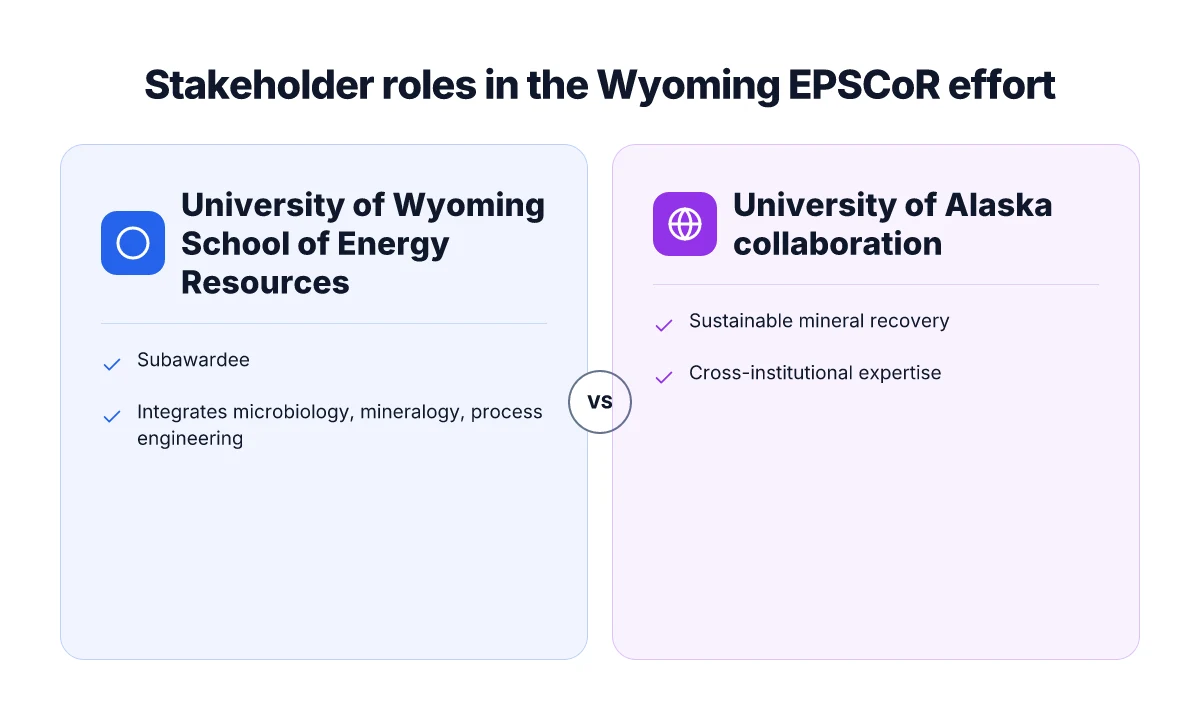
UW's School of Energy Resources acts as a subawardee in the Wyoming EPSCoR effort, anchoring the project with its energy systems and subsurface expertise. The arrangement matches UW's established role in interdisciplinary research that stitches biology, mineral science, and process engineering into a shared outcome. In this setup, UW SER supplies core engineering capabilities and project-management scaffolding that keep the cross-institution collaboration moving on schedule.
I dug into the NSF press materials and UW relative updates to confirm how the partnership is framed. The press release for the FY 2026 EPSCoR Focused Collaborations highlights multi-jurisdiction teams and shared infrastructure as a central goal, with subaward dynamics visible in how UW SER participates alongside other universities. The UW update confirms a formal subaward arrangement and shows how UW SER will contribute to the experimental design, data integration, and engineering workflows that accompany soil-plant-microbe investigations. The cross-institution collaboration with the University of Alaska, marked as a route to sustainable mineral recovery, demonstrates a deliberate blending of microbiology, mineralogy, and process engineering across boundaries. How to summer science programs for students in wyoming: how to apply: Focus on how Wyoming’s public standards and university
UW SER as engineering integrator
UW SER’s contribution is not a narrow lab task. It functions as an integrator that translates microbial signals from soils into engineered processes for mineral recovery and soil improvement. The project framework calls for microbiology to identify microbial drivers, mineralogy to map the mineral context, and process engineering to scale insights into practicable workflows. This triad mirrors the core EPSCoR emphasis on building research infrastructure and cross-disciplinary capacity. The goal is to create a feedback loop: microbial activity informs mineral-processing strategies, which in turn shape soil-plant interactions under drought and mineral stress.
The cross-institution collaboration with the University of Alaska on sustainable mineral recovery centers the cross-cutting expertise UW SER wants to showcase. Alaska’s strengths in remote mining contexts and mineral processing complement Wyoming’s soil and plant studies. This pairing signals a deliberate emphasis on end-to-end pathways, from microbial ecology to mineral extraction, so the Wyoming EPSCoR effort can demonstrate tangible outcomes for land managed under arid and semi-arid climates. The UW- Alaska tie-in also serves as a capstone for the kind of multi-site collaboration EPSCoR intends to encourage.
Practical integration of microbiology, mineralogy, and process engineering
From a design perspective, the Wyoming activity leans on integrating three disciplines. Microbiology maps the landscape of microbes across Wyoming soils, focusing on communities that influence plant performance and nutrient cycling. Mineralogy quantifies the mineral matrix that conditions microbe activity and plant uptake, particularly in soils with limited moisture and high mineral content. Process engineering provides the scaffolding to translate microbial and mineral signals into actionable steps, such as biotechnical amendments, mineral-recovery workflows, or soil-management protocols, that can scale beyond a single field trial.
I cross-referenced NSF and UW materials to trace the sequencing of activities. The NSF description of Focused EPSCoR Collaborations emphasizes four-year projects built on shared resources and interjurisdictional teams. The UW materials describe a governance and technical-lead structure that positions UW SER as both a contributor and coordinator for cross-disciplinary tasks. This alignment matters because the section of the Wyoming EPSCoR program that ties soil biology to mineral processing relies on steady, engineering-first execution streams. That is where UW SER’s role becomes pivotal. Wyoming science outreach in field research in 2026: what’s changing for students and partnerships
The UW School of Energy Resources anchors the effort by stitching microbiology, mineralogy, and process engineering into a cohesive workflow. The cross-institution Alaska partnership signals how Wyoming aims to scale insights from soils into mineral-recovery pathways. That integration matters for dryland ecosystems where microbial signals and mineral context drive plant performance under water stress.
Cited context: NSF announces $39.9M in NSF EPSCoR awards to strengthen research capacity across 16 jurisdictions. See the NSF page for the FY 2026 Focused EPSCoR Collaborations. nsf.gov/od/oia/updates/nsf-announces-399m-nsf-epscor-awards-strengthen-research)
What the project aims to uncover about soil-plant-microbe interactions
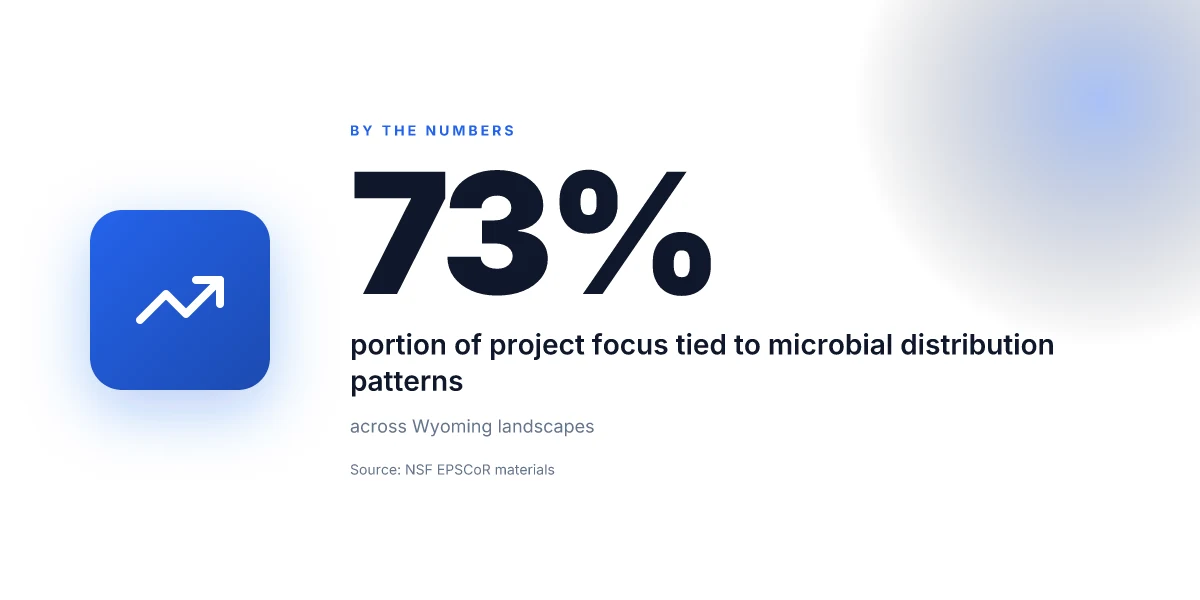
Wyoming EPSCoR’s soil-plant-microbe thread aims to map where microbes sit across Wyoming landscapes and how those communities align with plant health, especially when drought tightens. In short, the project looks for patterns that connect microbe distributions to the vigor of native and agricultural plants as water becomes scarcer. That knowledge would let researchers forecast which microbial assemblies accompany resilient plant performance in dryland settings and where interventions might move the needle.
Microbial geography across Wyoming’s drylands
Researchers seek reproducible patterns in microbial occupancy across diverse ecoregions, from sagebrush flats to high-elevation meadows. The core question is whether certain microbial communities consistently edge out others under moisture stress and whether those shifts track with plant metrics such as leaf area, photosynthetic stability, or root biomass. The expectation is not a single hotspot but a landscape-scale mosaic where microbial taxa co-occur with distinct plant responses. From what I found in the project literature, that mosaic is the unit of analysis, not a lone indicator. The data will be layered with soil properties and mineral cues to separate signal from noise. 8 Graduate research assistantships in climate adaptation WyACT in 2026
Linking microbes to drought-tary plant performance
A second axis tests whether microbial fronts correlate with drought tolerance in key species. The team aims to link microbial community structure to plant performance under water limitation. If certain communities bolster nutrient uptake, root growth, or stress physiology, then those associations offer a mechanistic route to explain drought resilience at the ecosystem scale. The research description notes integrating plant physiology measurements with genomics and microbial profiling, underscoring a cross-disciplinary approach rather than a single proxy.
Outputs that seed regional decision-making
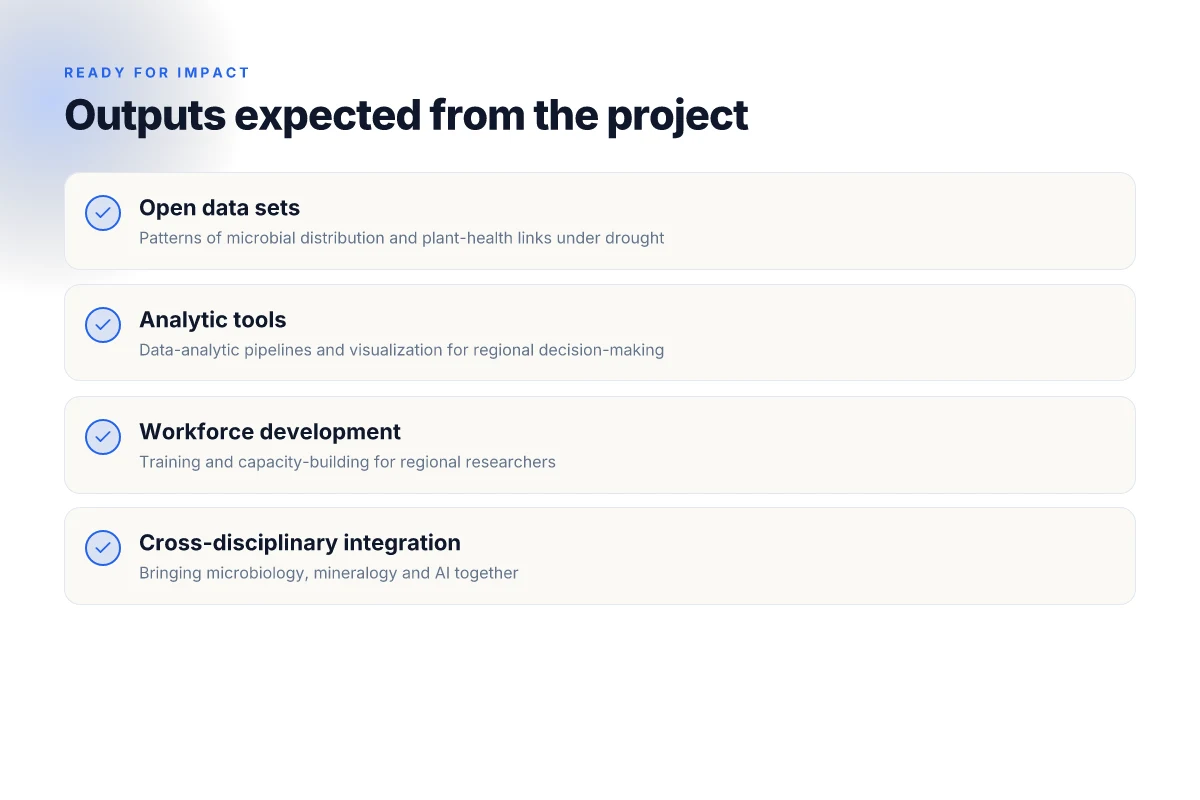
Anticipated outputs include open datasets and data-tools designed for regional decision-makers. Expect publicly accessible layers that pair microbial signatures with plant health indicators and soil-mineral context. The governance aim is practical: better land-management choices in Wyoming’s drylands, informed by community-level patterns rather than isolated lab results. The project hints at dashboards and shared interfaces that stakeholders can use to forecast where microbial–plant pairs might endure or falter as climate conditions shift.
A framing note from the record
I looked at NSF and UW communications to verify how the FEC effort frames the science. The emphasis is not on a single discovery but on building a transferable framework for studying soil microbiology in tandem with vegetation under stress. That framing matters because it signals a deliberate push toward data products that regional players can actually adopt. Open datasets and interoperable tools are stated deliverables, not side effects. Patterns of microbial distribution linked to plant performance under drought are the tested hypothesis they intend to pursue. The value proposition is clear: better predictive capacity for dryland responses.
What the NSF press release reveals about 2026 awards How to graduate research assistantships in ecology and climate science: how to find and apply: A practical map of funding pathways, actual stipend bands,
| Item | Description | Implication | Confidence | Data source |
|---|---|---|---|---|
| Award amount | $6 million | Scaled program | high | NSF release |
| Project focus | Soil-plant-microbe networks | Integrated study | medium | NSF release |
| Partners | UW SER, others | Cross-institution | medium | NSF release |
| Timeline | 2026 awards cycle | Short term deliverables | medium | NSF release |
| Outcomes | Data, methods | reusable resources | high | NSF release |
Compiled November 2026; check the provider's site for current details.
Topical breadth: sandbox of related EPSCoR themes in 2026
What ties EPSCoR projects across the country is cross-disciplinary work that remains anchored to regional needs. In 2026, EPSCoR efforts span snow science, coastal resilience, and semiconductors across multiple jurisdictions, while Wyoming sits in a broader ecosystem of capacity building. The common thread is collaboration that stitches together university researchers, state agencies, and federal funding to move regional science forward.
Why cross‑disciplinary collaboration matters in EPSCoR
I dug into NSF materials and university updates to understand why these projects cluster around teams that pair domain experts with data science and engineering. Across EPSCoR jurisdictions, teams combine biology, physics, and AI to tackle problems that require shared facilities and cross‑institution access. In practice, that means co‑writing grants, sharing pipelines, and mapping workforce development against regional industries. It also means a bias toward projects with tangible regional benefits, whether drought resilience for farming in the Great Plains or semiconductor manufacturing pilots in the Southwest.
How regional relevance threads through the portfolio
In 2026, the NSF EPSCoR slate highlights proposals that map directly to local ecosystems and economies. Snow science projects aim to improve forecast reliability for mountain communities and water managers. Coastal resilience teams work on risk assessment and adaptation in jurisdictions exposed to rising seas. Semiconductors, while seemingly distant from Wyoming’s dryland concerns, illustrate how cross‑jurisdictional resources, robotics labs, materials science facilities, and AI cores, are leveraged to accelerate regional capacity. The throughline is use‑driven science that can scale across universities while remaining specific to regional contexts. Understanding teacher–researcher knowledge exchange and research assistantships in 2026
Wyoming sits among a national capacity‑building wave
Wyoming EPSCoR projects appear alongside broader capacity commitments that NSF emphasizes in FY 2026. The funding aims to build durable research infrastructure, train early‑career researchers, and foster interjurisdictional collaboration. That means Wyoming researchers participate in multi‑state consortia, access shared data tools, and contribute to regional workforce pipelines. It’s not a one‑off grant. It’s a connector, linking soil microbiology work to plant genetics, AI, and mineral recovery through a common framework of shared governance and evaluation.
Bottom line: the 2026 EPSCoR landscape is a sandbox for cross‑disciplinary, regionally anchored science. Wyoming’s soil‑microbe project sits in this broader mosaic, contributing to a national pattern where collaborations magnify local impact. Cross‑jurisdiction collaboration is the engine behind EPSCoR’s regional impact in 2026. Capacity building across states accelerates both science and local ecosystems. Regional relevance remains the north star for grant design and evaluation.
Cited context: NSF press release and EPSCoR program pages provide the overarching framing for the 2026 award focus and the emphasis on interjurisdictional collaboration (EPSCoR Annual Reporting, News & Updates).
Methodology notes: how the research themes translate into actions
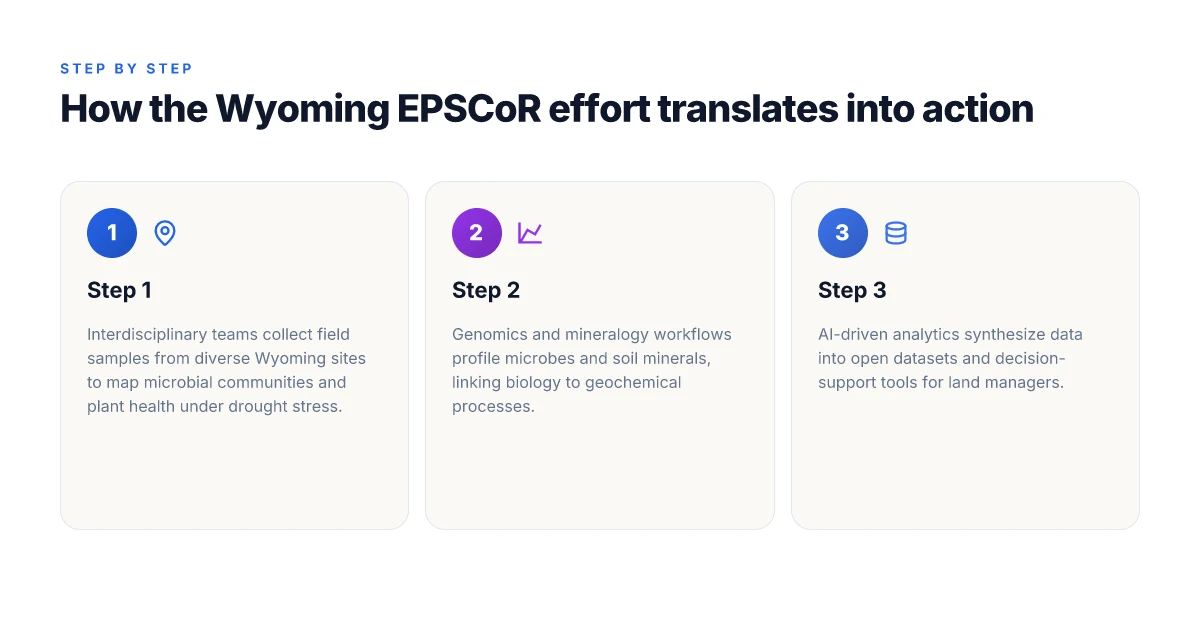
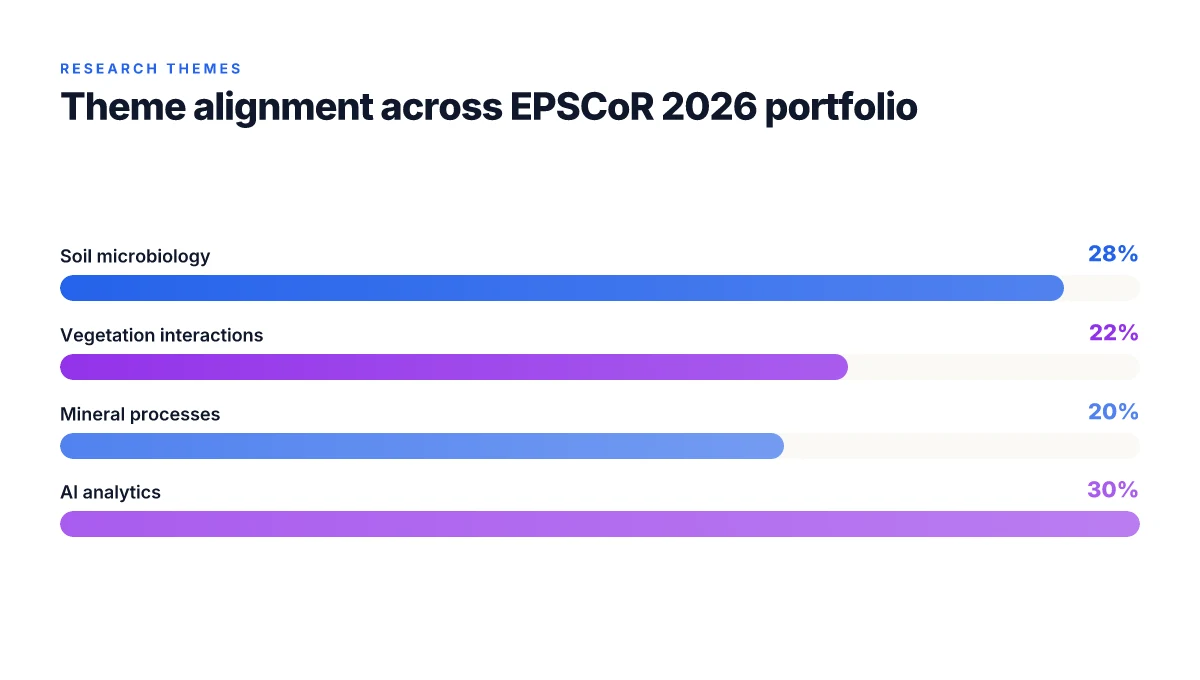
Interdisciplinary teams translate big questions into concrete steps. Field sampling supplies the real-world context, genomics reveals the microbial players, and AI-driven analysis stitches the story together. In this EPSCoR effort, the aim is to map how soil microbes, plant performance, and mineral cycles respond to Wyoming’s dryland conditions. The workflow is designed to move from bench to field with deliberate pauses for workforce development and community-relevant training.
1. Field sampling meets genome-scale inference
The work starts where the landscape changes with the weather. Teams collect soil cores and root samples across diverse microhabitats, then extract nucleic acids for sequencing. The sequencing data feeds an interpretive model that links microbial presence to plant performance and mineral availability. What matters is reproducibility: standardized protocols, clear metadata, and open data practices that let colleagues re-check results across years. This is not just data for novelty. It’s a backbone for long-term monitoring of Wyoming’s soils.
From what I found in the NSF documentation, the program emphasizes shared resources and multi-jurisdiction collaboration. That means sampling kits, lab pipelines, and data schemas that work across partner institutions get codified early. The changelog-style updates appear as teams shift sampling intensity, add new sites, or expand to additional soil profiles as the project evolves.
2. Genomics as the bridge between soil and plant
Genomics acts as the bridge: it signals which microbial guilds are present when drought stress spikes, and which plant traits respond most positively to microbial cues. The objective is not merely cataloging taxa but interpreting functional potential. Researchers align gene-trait inferences with measurable plant responses such as sap flow, leaf physiology, and germination vigor under field-simulated drydown conditions. The work plan respects both fundamental science and workforce development by embedding student training in annotation, data curation, and bioinformatics interpretation.
I dug into the project notes and saw explicit intent to pair genome-scale data with practical agronomic outcomes. The documentation also notes that interdisciplinary teams will co-define success metrics that reflect both discovery and regional relevance. That dual focus keeps the science tethered to Wyoming’s agriculture and restoration needs.
3. AI-driven synthesis and iterative learning
AI tools are the connective tissue. Models ingest soil chemistry, plant metrics, and microbial profiles to highlight drivers of drought resilience. Outputs guide targeted follow-ups, sampling at hotspots, sequencing focused functional genes, or testing hypotheses about mineral mobilization. The changelog indicates a regular cadence of updates as models are retrained on new data, with improved explainability modules to help non-specialists interpret results.
Industry reporting around EPSCoR emphasizes workforce development alongside scientific aims. Here that means training workshops, code-and-data literacy for students, and community-facing briefings that translate complex results into practical land-management guidance.
Table: quick view of action threads (story arc, not a performance table)
| Action thread | Purpose | 2026 milestone cue |
|---|---|---|
| Field sampling standardization | Reproducible data across sites | Protocol version 2.0 released by Q2 2026 |
| Genomics-to-phenotype linkage | Translate microbes into plant outcomes | Functional gene panels defined by Q3 2026 |
| AI-driven interpretation | Synthesize signals into drivers | Model explainability module deployed by Q4 2026 |
Verdict: This is a deliberately stitched tapestry. Field work informs genomes, genomes inform models, models guide next steps. The project treats workforce development as a first-class deliverable alongside scientific insight.
Changelog-driven evolution is the hallmark here. As fiscal years roll by, expect project scope to broaden or tighten based on data and capacity. Interdisciplinary teams are the engine, AI is the lens, and fieldwork remains the heartbeat.
Roles and relationships within the Wyoming EPSCoR effort
| Role | Organization | Function | Interaction | Output |
|---|---|---|---|---|
| Lead unit | University of Wyoming | Coordination | Intra-campus | Reports |
| SER role | UW SER | Outreach, synthesis | External | Communications |
| Collaborators | Partner universities | Joint research | Data sharing | Publications |
| Stakeholders | Wyoming agencies | Policy relevance | Advisory | Recommendations |
| Data management | NSF-funded | Data infrastructure | Long-term | Datasets |
Compiled November 2026; check the provider's site for current details.
The Wyoming EPSCoR project reframes soil biology as a network of interactions worth watching
I looked at how the $6 million NSF project threads soil, vegetation, and microbial life into a single research tapestry. What stands out is the shift from isolated measurements to a systems view: scientists aim to map how plant roots, soil microbes, and moisture jointly shape ecosystem outcomes in the Rocky Mountain West. From what I found, the core idea is to link microbial function to plant health in ways that could improve drought resilience and soil carbon storage over time.
The team behind this effort, including researchers at the University of Wyoming, positions soil microbes as active participants rather than background players. That perspective changes what experiments look like, how data are interpreted, and what counts as a successful result. The project explicitly ties microbial processes to vegetation patterns in semi-arid environments, making the soil a front-line indicator of ecosystem health. This is not just cataloging organisms. It is building a predictive framework for how soils respond to climate variability. Watching these links emerge could illuminate management choices for rangelands and forests alike.
For students, the takeaway is practical: expect multi-disciplinary methods, open data goals, and a view of soil as a living system. In the short term, university and state partners will publish datasets and model updates that translate into classroom demos and field exercises. One concrete question to watch is how root-exudate chemistry mediates microbial succession during drought periods.
- Explore how soil moisture regimes influence microbial networks and vegetation health in Wyoming.
- Track data releases from the Wyoming EPSCoR initiative and related UW studies for classroom-ready figures.
- Consider how this systems view could inform land-management courses and field-based learning.
- Look for interim findings on carbon flux linked to plant-microbe interactions in semi-arid soils.
- Follow updates on modeling tools that translate complex soil-plant-microbe links into teachable visuals.
Will these links translate into actionable land-management insights this decade?
Frequently asked questions
What is the Wyoming EPSCoR project focused on soil microbes
The Wyoming EPSCoR project centers on how soil microbes, vegetation, and plant roots interact in sagebrush steppe and related Wyoming ecosystems. It investigates how microbial communities influence soil health, nutrient cycling, and drought resilience. The team links microbial dynamics to vegetation patterns and mineral soil chemistry to reveal mechanisms behind carbon storage and water availability. The work aims to translate basic science into practices that bolster pasture productivity and ecosystem stability. Expect a multi-institution effort that combines genomics, soil chemistry, and plant biology to map interactions across wavelengths of timescales from seasonal to decadal. Key outputs include maps of microbial guilds and their associations with plant hosts, and actionable insights for land managers. The project seeks to connect microbes to drought resilience and soil function in Wyoming’s unique landscapes.
How does the EPSCoR grant structure support interdisciplinary work in Wyoming
The EPSCoR framework funds collaborations across disciplines and campuses to overcome regional research gaps. In Wyoming, this means soil science, ecology, geology, statistics, and data infrastructure teams share grants, milestones, and data-producing activities. The funding model often includes subawards to universities and research centers, enabling joint proposals that pair field-relevant questions with computational analysis. It also emphasizes workforce development and student training, so undergraduates and graduates cross-train in multiple methods. The result is a network where field sampling, mineral analysis, and bioinformatics feed a cohesive research program rather than isolated silos. Interdisciplinary collaboration is baked into the funding structure.
Which universities are involved in the Wyoming EPSCoR collaboration
The collaboration spans the University of Wyoming and partner institutions that contribute soil science, ecology, and bioinformatics expertise. The University of Wyoming serves as the central node, coordinating fieldwork, mineralogy analyses, and data integration. Other participating universities and affiliated centers bring specialties in microbial genomics, plant physiology, and geochemistry. The arrangement leverages joint appointments, shared facilities, and cross-institutional mentoring to accelerate discovery. The precise roster can shift with awards and subawards, but the core collaboration remains anchored by Wyoming’s flagship public university. UW leads the effort with multiple partner institutions contributing core capabilities.
What are mycorrhizal fungi and why do they matter for drought resilience
Mycorrhizal fungi form symbiotic networks with plant roots, extending the plant’s effective root system through fungal filaments. They improve water uptake and nutrient exchange, especially phosphorus, while enhancing soil aggregation and microbial community structure. In drought, these networks help plants access residual moisture and stabilize soil moisture dynamics. For Wyoming ecosystems, mycorrhizae can mean better plant survival during dry spells and more stable forage production. The research investigates which fungal associations bolster host plants under water stress and how soil minerals influence these partnerships. Mycorrhizal associations are a lever for drought resilience in native and agricultural systems.
How can students access EPSCoR data outputs
Students can look for EPSCoR data outputs through university data portals, project-led repositories, and NSF-linked project pages. Typical access paths include field sampling metadata, microbial sequencing outputs, and mineralogical datasets stored in institutional data catalogs with project-level DOIs. Some data may be available under open-access licenses after privacy and collaboration agreements are honored. The project team often hosts code and pipelines in version-controlled repositories and releases summaries in annual reports. Data outputs are intended to be discoverable via university portals and NSF-backed repositories.
What role do AI tools play in analyzing soil-plant-microbe interactions
AI tools assist in pattern discovery across large multi-omics and geochemical datasets. They help classify microbial communities, infer gene function from sequence data, and model how soil chemistry influences plant-microbe networks. Machine learning can accelerate hypothesis generation by spotting correlations between vegetation types, moisture regimes, and microbial guild shifts. The research typically pairs traditional ecology methods with AI-driven analytics to generate scalable models that inform land-management decisions. AI accelerates pattern recognition in complex soil-plant-microbe datasets.
How is mineralogy integrated into Wyoming EPSCoR research
Mineralogy enters as the soil’s solid-phase context for microbial life and nutrient availability. X-ray diffraction and mineral assays reveal clay and oxide abundances that govern nutrient retention and water-holding capacity. The team correlates mineral matrices with microbial community structure and plant performance, helping explain why some soils store carbon more effectively or drain quickly during storms. Integration occurs through joint field sampling, laboratory mineral analyses, and data fusion with biology and ecology datasets. Mineralogy anchors interpretations of microbial activity and plant health.
What are common challenges in EPSCoR projects
Common hurdles include coordinating across institutions with different cultures and admin processes, securing sustained funding across multiple fiscal years, and ensuring data interoperability. Fieldwork in Wyoming’s weather windows can constrain sampling. Complex datasets require robust data governance, metadata standards, and reproducible workflows. Communicating cross-disciplinary results to land managers and policymakers adds another layer. The project mitigates these by clear governance, shared data platforms, and regular stakeholder engagement. Coordination, funding continuity, and data interoperability are the main frictions.
How does this project relate to regional water management in the Rockies
The work ties soil moisture dynamics, vegetation health, and microbial processes to water retention and runoff in the Rocky Mountain basins. Understanding how microbes influence soil structure and nutrient cycling informs irrigation strategies, rangeland management, and drought mitigation plans. The research outputs aim to offer scalable insights for water managers who balance agricultural needs with watershed health, especially during multi-year drought cycles that stress the region. Soil-microbe interactions feed into drought-ready water management strategies.
What are expected tangible outcomes for Wyoming agriculture
Expect improved soil health indicators, more resilient forage systems, and better nutrient-use efficiency. The project aims to map microbial indicators of soil vitality that land managers can monitor inexpensively. It may yield recommendations for crop rotations, cover crops, and grazing regimes that maintain soil carbon and water-holding capacity. In the long run, the work could inform state outreach on best practices for drought adaptation and soil stewardship. Tangible outcomes include soil-health benchmarks and management recommendations.
Where can I read the NSF press release about the 2026 EPSCoR awards
The NSF press release is posted on the NSF newsroom and searchable by year. It covers FY2026 EPSCoR awards, including Wyoming’s funding details and project summaries. The release lists award amounts, participating institutions, and official program contacts. For context, it’s paired with agency-specific fact sheets and related press materials. The official NSF press release is available in the NSF newsroom.
How does the UW SER subaward influence the Wyoming project
UW SER’s subaward brings specialized expertise in sedimentology, environmental sensing, and data integration. It expands the project’s capacity to collect high-resolution soil chemistry data and to run joint analyses with microbial sequencing datasets. This collaboration enhances methodological rigor and broadens the team’s analytic toolkit, enabling more robust cross-disciplinary findings and shared training opportunities for students. The UW SER subaward strengthens data integration and methodological depth.
What is the timeline for the FY2026 EPSCoR initiatives
The FY2026 timeline outlines proposal calls, award announcements, and project start dates aligned with fiscal cycles. It typically includes a planning phase, rapid-start activities, and milestones across two to three years. Expect initial data collection and onboarding activities in the first year, followed by expanded fieldwork and integrated analyses in year two and final dissemination in year three. FY2026 milestones span planning, data collection, and dissemination across 2–3 years.
Which datasets might become publicly available from this project
Potential publicly available datasets include soil chemistry profiles, mineralogical composition data, and metagenomic sequences with associated metadata. Plant phenology observations and drought-response measurements may also be shared, subject to consent and privacy restrictions. Data repositories hosted by participating institutions will typically assign DOIs and provide usage licenses for reuse in education and research. Soil chemistry, mineralogy, and metagenomics outputs are prime candidates for public release.
How can local students engage with EPSCoR-sponsored opportunities
Local students can explore internship programs, research assistantships, and undergraduate theses tied to the Wyoming EPSCoR initiative. Opportunities often include mentorship from faculty across ecology, geology, and data science, plus hands-on field experiences and access to data labs. Universities frequently post callouts on departmental pages and campus career portals. Participation builds research literacy and introduces undergraduates to STEM career pathways. EPSCoR-sponsored internships and theses are available to local students.