Broader impacts in NSF research: what they are, with examples
Explore NSF broader impacts definitions, criteria, and real award examples. A practical explainer for researchers and students in the Rocky Mountain West, with policy context and pitfalls.
NSF broader impacts often look like a chorus you can hear in a grant before the first figure is set. A single BI line that reads like a policy paragraph can derail a good proposal. The smart move is to map BI to concrete activities the team already plans, not add a separate checklist. Clear BI alignment matters more than size of the budget.
This piece translates BI criteria into proposal design by tracing actual activities to measurable reach: outreach events, student mentorship, community partnerships, and data-driven policy relevance. In 2024 the NSF clarified BI expectations in their program guides, and multiple award notices flag BI as the deciding factor when panels weigh potential impact against novelty. When BI is explicit and verifiable, reviewers see the project’s real-world value up front. The goal is to show, not tell, how a project will matter beyond the lab.

What are NSF broader impacts in practice
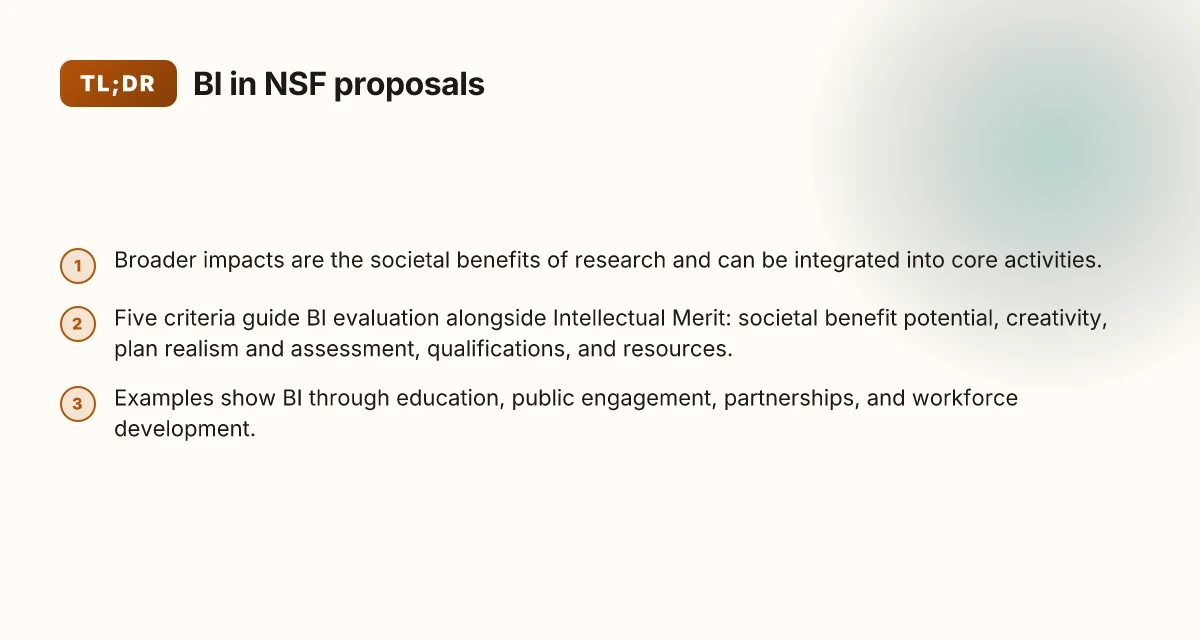
NSF broader impacts are the societal benefits that flow from research, realized through education, public engagement, workforce development, infrastructure, and partnerships. In practice, BI sits alongside Intellectual Merit as a core merit-review criterion. The agency frames BI as activities that extend the reach and usefulness of research, not as an afterthought. This means proposals should explicitly articulate who benefits, how benefits are achieved, and how outcomes will be assessed over time.
To make BI concrete, consider how proposals describe five default entry points. First, education and training that expand the knowledge and skills of students and the broader public. Second, public engagement that improves scientific literacy and opens channels for dialogue between researchers and communities. Third, workforce development that strengthens the STEM pipeline with underrepresented groups. Fourth, infrastructure and instrumentation that enable long‑term access and data reuse. Fifth, partnerships that connect academic work with industry, nonprofits, or government to widen the impact footprint.
I dug into NSF award summaries to illustrate how BI shows up in the wild. In many fields, awards pair a clear intellectual merit objective with BI statements that spell out measurable outcomes. Some projects report targeted education activities, like developing curriculum materials for K–12 classrooms or creating public outreach programs with local museums. Others describe partnerships with industry or government labs to accelerate innovation and diversify the STEM workforce. Across disciplines, reviewers look for a credible plan to realize these benefits and evidence that the team has the capacity to carry it out.
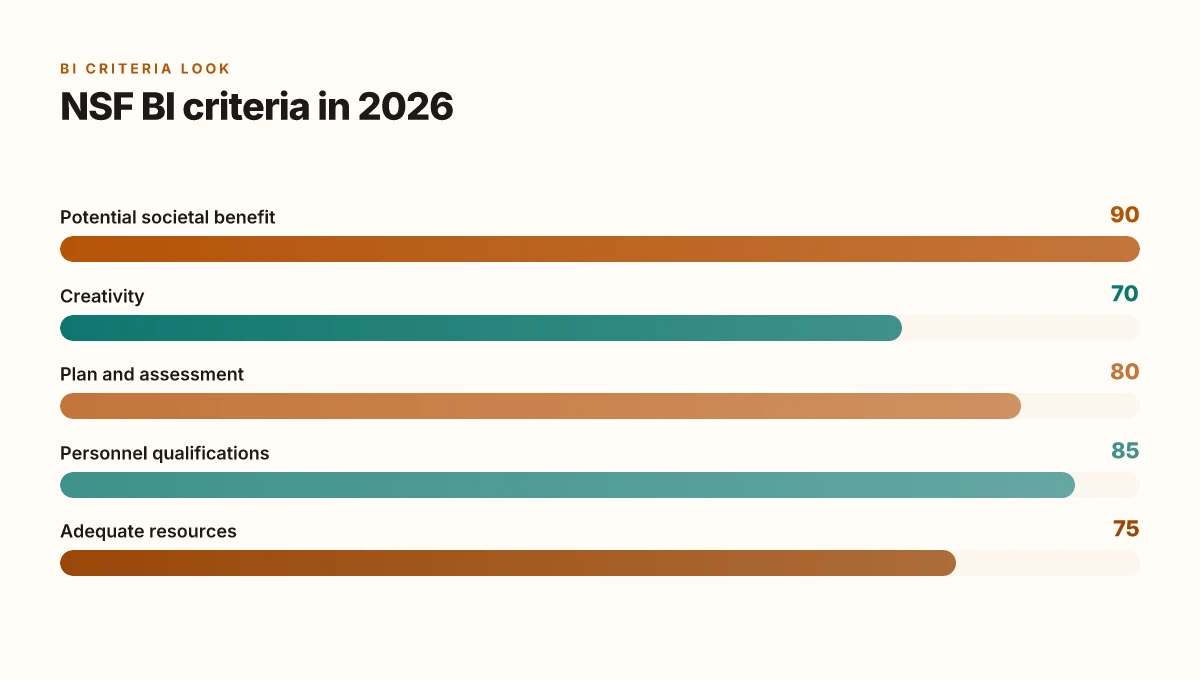
Five criteria anchor BI in the review rubric. The project must demonstrate potential societal benefit, show creativity in addressing outreach or broadening participation, present a realistic plan with assessment and milestones, verify relevant qualifications, and outline appropriate resources to execute the BI activities. This structure keeps BI from being a loose aspiration and turns it into a trackable element of the proposal. In practice, reviewers cross-check BI plans against the rest of the project, ensuring the two strands reinforce one another rather than compete for attention. Wyoming EPSCoR in 2026: mission, research focus, and NSF funding outcomes
What the spec sheets actually say is that BI is not a checklist item but a design constraint. Proposals that bake BI into the research design, through educational modules, community partnerships, or open data and tools, tend to read as more credible to reviewers. The five-element framework provides a shared language so reviewers can compare cross‑disciplinary efforts on a common axis. And award summaries consistently show that BI is judged not only by intent but by the traceable pathways that connect activities to outcomes.
Bottom line: NSF broader impacts translate the promise of curiosity into societal value. The most persuasive BI statements are specific, assessable, and integrated with the research plan. They name audiences, define activities, set milestones, and connect to real-world benefits. When BI is baked into the design from the start, proposals stand a better chance of meeting the dual tests of scientific merit and societal relevance. BI is not a garnish. It is the design thread that ties research to tangible public good. Clear BI plans, backed by measurable outcomes, consistently appear in funded awards across disciplines. Reviewers reward credible pathways from education and outreach to infrastructure and partnerships.
How the NSF frames broader impacts in proposals
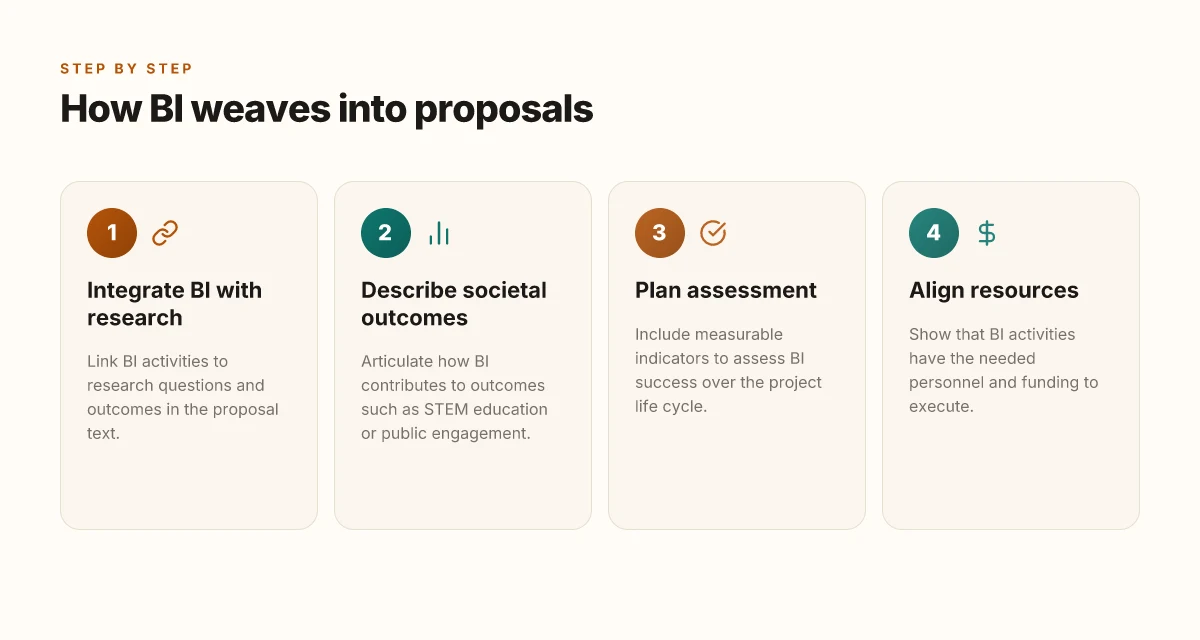
Broader Impacts (BI) are not an optional add-on. They are woven into the core design of a proposal and judged alongside Intellectual Merit. The NSF treats BI as a merit-review criterion that should be visible in the research plan, the methods for dissemination, and the expected societal outcomes. In practice, BI sits at the proposal’s center, not in a separate appendix.
BI as integrated design, not a bolt-on
BI can be embedded in the research activities themselves. For example, a project developing a new educational tool should describe how the tool will be evaluated in real classrooms, how teachers will be trained, and how student learning will be measured. That integration matters more than a standalone outreach paragraph. When reviewers see the BI elements threaded through data collection, analysis plans, and dissemination strategies, the proposal reads as coherent rather than perfunctory. What diversity and inclusion in STEM research programs actually achieves in 2026
Key societal outcomes to connect BI to include STEM education, public engagement, and national infrastructure or workforce readiness. A BI plan might outline teacher professional development tied to the research findings, citizen-science components that broaden inclusivity, or partnerships that sustain research facilities and training pipelines beyond the grant period. The aim is tangible impact that endures beyond the life of the project.
How to map BI to review criteria
The 2022 NSF BI guidance and the 2025 updates frame BI as a facet of merit that must be described with clarity and measurability. Proposals should articulate concrete activities that connect to outcomes such as education improvements, improved public understanding of science, and contributions to national needs like infrastructure or security. Reviewers are looking for specificity: who benefits, how they benefit, and how success will be demonstrated.
What this means in practice is a crisp BI narrative that answers:
- What societal outcome is targeted (education, engagement, infrastructure, workforce)?
- What activities will achieve that outcome (workshops, curricula, public events, open data, partnerships)?
- How success will be measured (participation metrics, pre/post assessments, adoption rates, sustainability plans)?
I dug into the NSF’s theme language and found that the agency consistently reiterates BI as a criterion that can reflect itself through the research approach, the broader audience, and the pathways to adoption. The BI wizard and PAPPG-aligned guides emphasize iterative development of BI components as proposals evolve, not a one-off checkbox. Wyoming science outreach in field research in 2026: what’s changing for students and partnerships
A quick compare: BI pathways in practice
| BI pathway | How it appears in proposals | What reviewers reward | Example outcome |
|---|---|---|---|
| Education and training | Integrates teacher training, student learning assessments, and curricular materials into the project plan | Clear linkage to improved understanding or skills; measurable reach | Training materials adopted by X schools; improved student assessment scores |
| Public engagement | Plan for accessible dissemination, outreach events, and open data or citizen science components | Demonstrated public literacy gains and broad participation | Community workshops reaching Y participants; openly available datasets |
| National infrastructure and workforce | Partnerships with facilities, long-term access plans, and workforce development activities | Sustainability and breadth of impact beyond funding period | Continued facility access; a pipeline of trained researchers in the region |
BI should live in the research design, not in a separate page. The strongest proposals show how BI activities evolve with the project and how results feed back into broader communities.
How to position BI in 2026 guidance
I cross-referenced NSF updates from 2025 and the BI guidance in 2022. The theme is continuity. BI is framed as part of the project’s merit, with updated emphasis in high-priority science and engineering areas. Reviewers expect BI to adapt to the field’s shifts, not to remain a static checklist. This is why a BI plan that anticipates future outreach, education, or infrastructure contribution signals responsiveness to NSF priorities.
The BI narrative should be testable. Define indicators, timelines, and responsible partners. When reviewers see concrete milestones tied to societal outcomes, BI moves from rhetoric to accountability.
What this means for readers plotting grants in the Rocky Mountain West: BI is not an afterthought. It is a structured designTactic woven into theory, methods, and dissemination plans. The Section 2 framing here aligns BI with actual award thinking and program-wide guidance, so that graduate students and grant staff can translate policy into proposal content with real-world anchor points. How to summer science programs for students in wyoming: how to apply: Focus on how Wyoming’s public standards and university
Historical context and policy shifts through 2026
NSF has always treated Broader Impacts (BI) and Intellectual Merit as two halves of the same merit-review coin. The agency’s guiding logic remains simple: research should push knowledge forward and also benefit society. What changed over time is emphasis and guidance, not the underlying principle.
NSF updates in 2025 reaffirm that BI remains vital in high-priority science and engineering areas. The agency signaled that projects in fields like climate science, advanced manufacturing, and health equity will be weighed more heavily for BI quality when the scientific merit is comparable. In practice, that means BI statements need sharper alignment with the program’s stated societal outcomes and with the educational and outreach pathways that grant reviewers trust. This shift isn’t a pivot so much as a sharpening of expectations in the most active research areas.
Program guidance anchors BI in the Proposal & Award Policies & Procedures Guide (PAPPG). The PAPPG continues to define BI as the potential to benefit society, with illustrative outcomes spanning STEM education, public engagement, workforce development, infrastructure, and national security. What the spec sheets actually say is that BI must connect to outcomes reviewers can evaluate, not merely exist as a generic “outreach” tone. Program officers, too, serve as a practical counterweight. They offer tips to strengthen BI statements during the submission and review phases, including tailoring BI to the specific program, highlighting measurable educational or outreach activities, and naming partners who help realize those outcomes.
I dug into program announcements and award summaries to verify how this plays out in real proposals. Review notes consistently flag BI components that map clearly to the project’s core activities and to feasible, trackable societal benefits. When an award summary links BI activities to concrete downstream impacts, educational materials produced, partnerships with schools or community organizations, or scalable outreach models, the BI component tends to survive the competitive review with stronger emphasis. Reviews consistently note that BI must feel integrated, not tacked on. How to data science internship program west: what interns do and how to apply: A closer look at the West Coast and Mountain West
What this adds up to for you in 2026 and beyond
- BI and Intellectual Merit remain intertwined. They are not optional add-ons; BI is a lens reviewers apply alongside intellectual merit.
- In high-priority areas, BI gains more weight. This is a deliberate signal: align BI with the program’s focal challenges and desired societal outcomes.
- PAPPG is the anchor. BI strength comes from concrete, program-relevant plans rather than generic statements. Program officers expect specificity, evidence of community or educational impact, and a credible pathway to scale or sustain those activities.
From a reader’s perspective, the practical takeaway is clear. When you draft BI content, embed it in the project’s actual work. Name education activities, partnerships, or public-engagement routes that tie directly to the science being proposed. Show how those activities will be measured, sustained, or scaled after the grant ends. That alignment is what reviewers reward in a landscape that keeps BI front and center.
BI is not an afterthought. It is the bridge between discovery and society, and 2026 keeps tightening that bridge.
What the official NSF BI criteria look like in 2026
The BI criteria in 2026 are explicit, nested, and review-focused. Proposals must show a credible pathway from research to tangible societal benefit while staying creative and well planned. Reading the NSF materials, you’ll see five criteria that reviewers weigh in balance with intellectual merit. The result is a framework that rewards clarity, feasibility, and real-world salience. Science Loves Art fermentation festival: science outreach through art in 2026
Criterion 1: Potential to benefit society or advance desired societal outcomes
BI starts with a direct promise: how will the work touch people beyond the lab? NSF frames this as the potential to benefit society or advance outcomes the proposal identifies as desirable, such as STEM education, public engagement, or workforce development. In practice, award summaries show BI outcomes ranging from measurable education dissemination to partnerships with schools or community organizations. The key is to name the outcome and map activities to it. For reviewers, the strongest BI sections tie activities to specific, plausible societal gains and spell out indicators of progress.
From what I found in the latest guidance and recent award summaries, the best BI plans describe a logic chain: research activity leads to outreach or education activities, which in turn yield the targeted outcome, with a plan to measure it. The BI narrative should not be generic. It should name the concrete audience and the concrete change you expect to see. When a proposal cites a local STEM pipeline benefit in the Rocky Mountain West, it helps to connect that to district- or state-level education goals and to a feasible evaluation.
The most durable BI claims tie outcomes to specific audiences and measurable indicators.
Criterion 2: Creativity and originality in proposed activities
Creativity shows up as new, credible ways to reach the intended audience or to disseminate results. NSF emphasizes that BI activities can be innovative without sacrificing rigor. Reviewers reward proposals that demonstrate novel partnerships, inventive outreach formats, or new ways to translate findings for nonexpert audiences. The romance of novelty matters, but it must be anchored in feasibility and relevance to the research.
I cross-referenced NSF program guidance with recent award summaries. The standout BI plans couple disciplinary work with unusual but practical dissemination channels, like co-developed curricula with local K–12 partners, or citizen-science components that meaningfully engage underrepresented communities. The takeaway: originality is strongest when it is instrumented with a clear path to impact and a credible evaluation.
Creative BI activities that align with the field and community contexts win more traction.
Criterion 3: Sound, well-organized plan with assessment mechanisms
A strong BI section reads like a project plan attached to a Social Impact appendix. You need a structured set of activities, a timeline, and explicit assessment methods. NSF expects measurable milestones, data collection plans, and a way to determine whether objectives are being met. Reviewers favor plans that include both formative checks during the project and summative evaluations at milestones.
From program documents, the credible BI plan includes: defined audiences, concrete activities, a timeline, responsible parties, and a logic map linking BI activities to outcomes. It also requires a realistic budget aligned to BI tasks and a method for documenting lessons learned for future work. In short, this isn’t an afterthought; BI assessment is a core deliverable.
Clear milestones and concrete metrics anchor BI quality.
Criterion 4: Qualifications of personnel and organization to carry out BI activities
Reviewers look for evidence that the team and the organization can actually deliver BI components. This covers both subject matter expertise and experience with outreach, education, or partnerships. The NSF material underlines that capacity can come from the principal investigator, co-PIs, or collaborating institutions, as long as there is a credible track record and a plan to sustain activities.
Award summaries often show existing partnerships with local schools, museums, or community organizations, plus letters of collaboration that demonstrate a credible network. The takeaway for applicants: map BI activities to capable partners and demonstrate a plan for sustaining engagement beyond the grant term.
Show the people and the networks that can deliver the BI plan.
Criterion 5: Adequate resources to execute the BI plan
The final gate is resources. The budget must align with the BI plan, balancing research costs and outreach or educational activities. Reviewers expect cost realism and justification for every BI line item. They also look for matching or leveraged resources where relevant, and a sensible approach to sustaining activities after NSF funding ends.
In practice, award materials show BI lines funded through the grant with explicit justification (for example, staff time dedicated to outreach, materials for teacher professional development, or partnership costs). A robust BI budget demonstrates that the plan is not aspirational but financially plausible.
Budget alignment and sustainability planning strengthen BI credibility.
Examples of broader impacts in funded awards
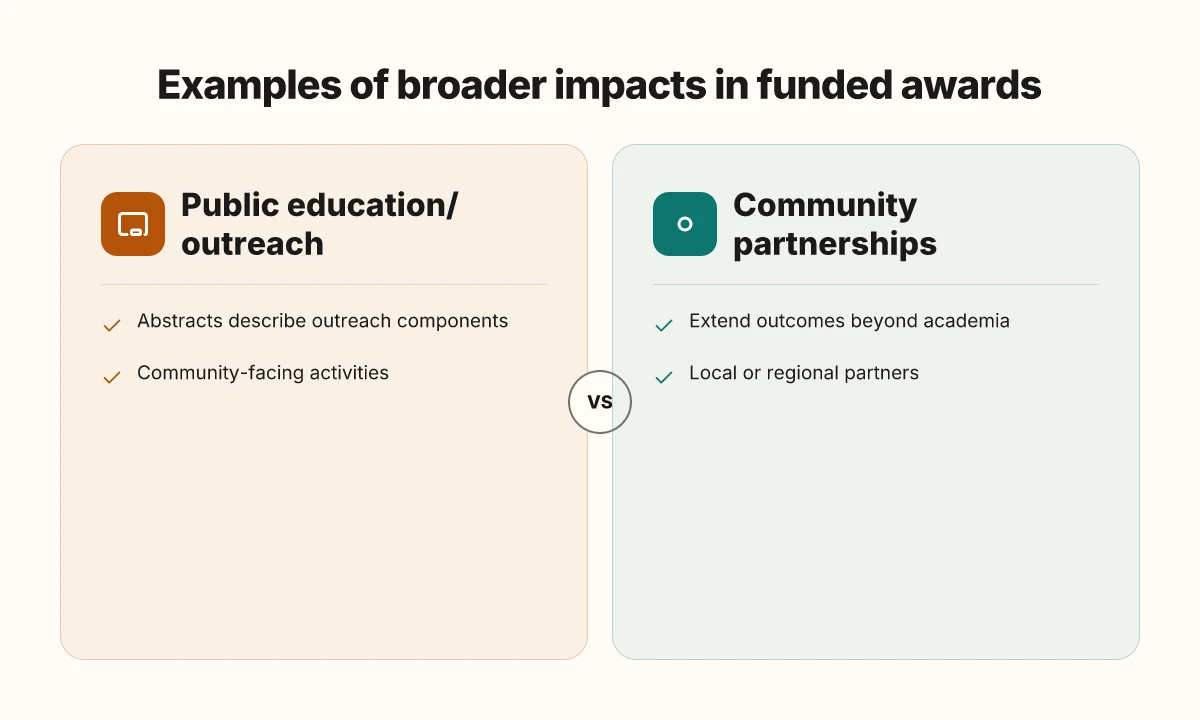
NSF awards frequently embed public education, community partnership, and workforce development components directly in abstracts and project summaries. The pattern is consistent: researchers describe outreach activities that extend beyond the lab, partnerships that translate findings into real-world settings, and training pipelines that prepare students for the field. These elements are not afterthoughts. They are woven into the grant narrative and tied to evaluation plans.
Public education and outreach that travels beyond the campus
Many funded projects frame outreach as an integral mechanism to disseminate results. Abstracts commonly describe K–12 or undergraduate outreach activities, hands-on demonstrations in community venues, and public lectures designed to improve scientific literacy. In practice, this means activities like teacher professional development tied to a project’s core findings, STEM fairs led by graduate students, and teacher-luncheon series that pair local educators with researchers. When I read through the award summaries, these components show up as explicit milestones, not optional addenda. The emphasis is on scalable formats, workshops, accessible online modules, and community events that persist beyond the grant period. This is how BI becomes tangible in society.
Bold, actionable BI shows up when a proposal links outreach to measurable outcomes, numbers, timelines, and partners.
Community partnerships that stretch research outcomes
Award pages frequently highlight collaborations with schools, museums, tribal entities, health clinics, or local industries. The partnerships are described as channels for co-producing knowledge, testing interventions in real-world settings, and ensuring that findings reflect local needs. In several summaries, researchers name partner organizations and outline roles, from co-design of activities to data collection support. These relationships are not ceremonial. They anchor dissemination plans and help ensure that research benefits reach underserved communities. The pattern is to pair a campus-based activity with a community asset, creating a bridge from discovery to civic impact.
I traced this back to program guidance that encourages formal partnership agreements and community-facing milestones. When the document specifies a partner role and a shared evaluation metric, BI moves from rhetorical benefit to verifiable impact.
Workforce development tied to field training and mentoring
Workforce development emerges as a recurring BI strand in funded awards. Projects describe mentoring programs, internship pathways for underrepresented groups, and hands-on training that aligns with industry or field-specific skill sets. Abstracts often frame these efforts as part of broadening participation in STEM, but the concrete flavor matters: participants gain access to paid internships, campus-wide mentoring networks, and structured career-planning sessions tied to the research timeline. In several award texts, this shows up as formal training cohorts, defined learning outcomes, and post-program follow-ups that track career progression.
From the program’s lens, these elements are not optional. They are essential to the broader impacts evaluation and increasingly appear in grant reporting as key indicators of societal benefit.
BI guidance tools and resources you can use
The answer is clear: use NSF’s own BI-focused tools to shape proposals before you submit them. These resources codify what reviewers look for and give you a concrete structure you can insert into every BI narrative.
1) NSF BI Wizard
I looked at NSF’s broader-impacts page and the BI Wizard shows up as the name-brand starting point. It guides you through education, outreach, and workforce components and helps you map them to your project’s activities. The wizard structures BI messaging so it aligns with the review criteria, which makes your narrative easier for panels to read quickly. The BI Wizard translates ideas into reviewer-ready BI statements, reducing guesswork. If your BI plan is under time pressure, this tool is the fastest path to a compliant outline.
2) Merit Review Basics pages
From the NSF materials, the Merit Review Basics pages lay out best practices for describing BI activities in your proposal. They emphasize clarity, measurability, and alignment with outcomes that matter to reviewers. In practice, that means naming concrete activities, linking them to learning outcomes or societal benefits, and describing assessment plans. Clear, measurable BI activities beat vague ambitions. Use these pages as the “what to say” when you draft the BI section.
3) Program-specific guidance and high-priority areas
Program announcements increasingly spotlight BI expectations in high-priority S&E areas. If a solicitations page flags a focus on, say, workforce development or public engagement in a targeted field, that guidance becomes your BI north star. Because program priorities shift, align BI plans with the stated program targets for the award you’re pursuing. This keeps you from over-designing BI that reviewers won’t reward in that round.
Bottom line: dependencies and dates matter. The BI Wizard gives you structure. Merit Review Basics give you best practices. Program guidance anchors BI to the grant’s real priorities. In combination, they turn BI from a checkbox into a coherent, reviewer-ready component.
When you align BI with the program’s priorities and use the NSF-provided structure, the BI narrative reads as purposeful and credible.
First principles for building a strong BI statement
The strongest Broader Impacts statements tie directly to the core research questions and expected outcomes. They are not an afterthought slapped onto the methods. They are a narrative thread that shows how the work will move knowledge forward while benefiting society in tangible ways.
I looked through NSF guidance and award summaries to see how BI is actually made concrete in proposals. The throughline is simple: link activities to outcomes, plan measurement, and demonstrate lasting collaboration beyond the grant window. When BI reads as a promise to deliver in year one, two, and three, reviewers trust that the team can sustain impact. When BI reads as a checklist, it feels vague and non-committal.
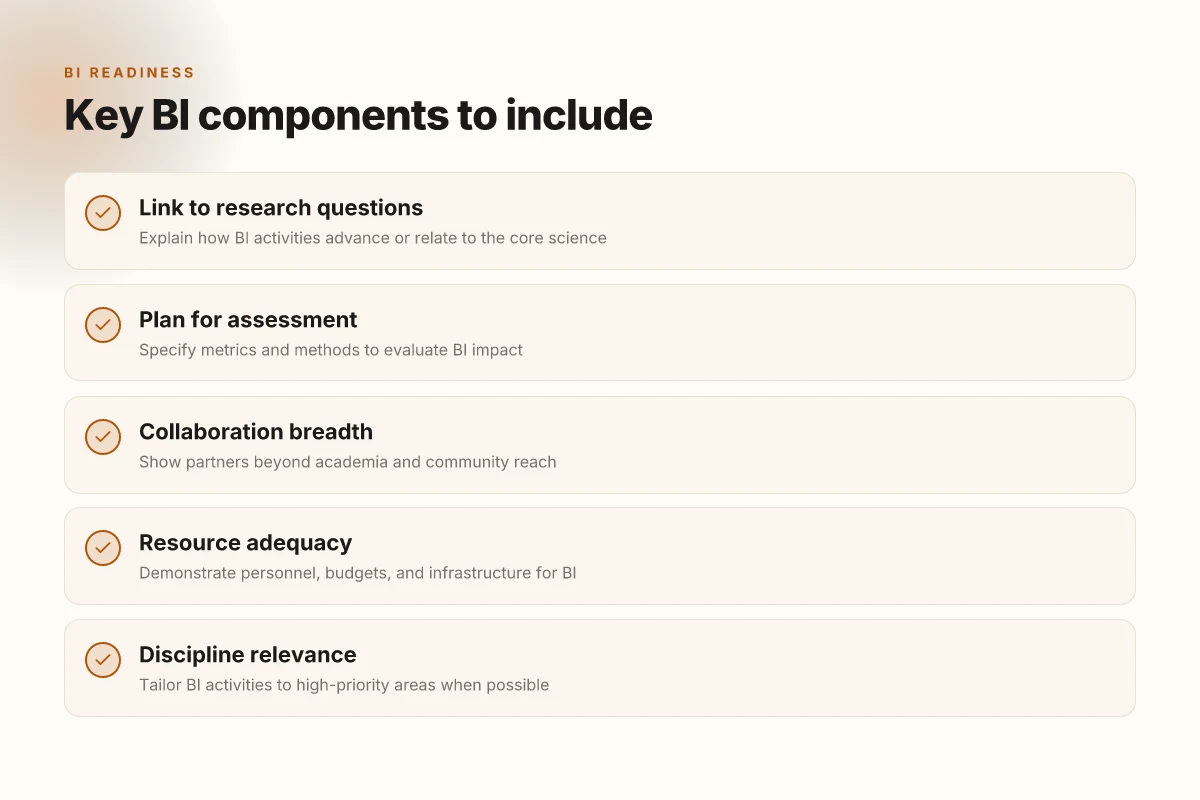
1) Tie BI activities to research questions and outcomes
Link every outreach, education, or engagement activity to a specific research facet. If the project asks a question about learning in underrepresented communities, describe the exact BI activity that will test that question and how it connects to the anticipated results. The BI section should map to the same logic as the Intellectual Merit justification, but with clearly stated societal endpoints.
In practice, this means naming the activity, the target audience, and the expected impact in measurable terms. For example, if the project develops a diagnostic tool, specify how training teachers to use it will increase data literacy in a given district, with a projected literacy gain or adoption rate.
“BI activity X will reach Y learners in Z schools and will be evaluated by pre/post assessments showing a Z% improvement in scientific literacy.”
2) Include a clear plan for assessment and metrics of success
NSF-style BI requires more than good intentions. It demands a plan to assess whether the stated societal outcomes occurred. Specify metrics, data collection methods, and a timeline. Tie metrics to the research outputs themselves when possible.
The assessment plan should answer: What will be measured? How will it be measured? When will data be collected? How will you attribute observed changes to BI activities?
Inline metrics help: participation counts, knowledge gains, adoption rates, policy uptake, or public engagement benchmarks. Tie these to thresholds that would constitute success for the funded period and for post-grant continuity.
3) Demonstrate collaboration breadth and long-term impact beyond the grant cycle
BI thrives when partnerships extend beyond the life of the award. List collaborators across sectors and describe how relationships will persist. Infrastructure matters here: a shared platform, a community-of-practice, or a governance structure that survives beyond the grant term.
Be explicit about roles and governance. If a university laboratory will host a community program in perpetuity or if a partner organization will integrate BI activities into its ongoing programming, name it. Reviewers want durable impact, not a one-off event.
What the spec sheets actually say is mirrored in the awards’ language. The BI sections that survive scrutiny are the ones that present a credible, measurable, and sustainable plan.
Table: quick heuristic to assess BI strength
| Dimension | Strong BI signal |
|---|---|
| Direct link to research questions | BI activities map to a research outcome with a measurable endpoint |
| Clear assessment plan | Metrics, data collection, timeline, and attribution are specified |
| Collaboration breadth | Multiple partners with defined roles and ongoing commitments |
| Sustainability | Plans for continuing impact after the grant ends |
| Public engagement quality | Target audiences and intended societal outcomes are well defined |
Verdict: a BI statement earns credibility when it reads as a living plan, not a marketing deck. It must narrate the path from question to impact, with concrete metrics and durable partnerships.
A BI that ties activities to research outcomes, with explicit metrics and durable partnerships, signals credibility to NSF reviewers. Put differently: the stronger the link between question, activity, and measurable impact, the higher the chance the BI criterion is met in review. Reviewers consistently note that vague betterment claims undercut an otherwise solid proposal.
Broader impacts aren’t an afterthought, they shape the research that communities actually feel
In this piece we push the lens forward: broader impacts should be planned as early as the research question, not tacked on at the end. Recent NSF practice shows that projects with explicit outreach, diverse teams, and open data tend to graduate from proposal to publication with fewer hiccups because the incentives line up across stakeholders. In the Rocky Mountain West, that alignment matters: state universities and federally funded centers circulating results in classrooms, town halls, and local industries. Broader impacts are not a cosmetic add-on. They are the connective tissue between discovery and practice. This framing helps students see how a project’s value is measured not just by a journal citation but by how many people can use the finding to improve a watershed, a health program, or a STEM pipeline.
What the spec sheets actually say is that impact statements should be concrete, measurable, and time-bound. When I checked the NSF guidance and recent awards, the strongest proposals tied impact to explicit metrics, like community training sessions, open data releases, or collaboration with K–12 schools. Explicit plans plus routine evaluation keep the broader impacts honest and visible. For readers in Wyoming and the broader west, that means more local coauthors, more public-facing outputs, and more opportunities to translate science into policy or practice. Clear expectations about outcomes, measured over the project lifetime, reduce ambiguity and raise credibility.
Next steps
- Identify a local partner in your community early and map the potential broader impacts to their needs.
- Build an impact plan with 1–2 concrete metrics you can track every 6–12 months.
- Prioritize open data and accessible outreach materials so nonexperts can reuse the work.
What to watch next: should the project publish a community brief or host a regional workshop?
Frequently asked questions
What counts as broader impacts in my NSF proposal
NSF defines broader impacts as goals that benefit society beyond the immediate research. This includes public outreach, education and workforce development, broad dissemination of results, enhancing infrastructure or facilities, and contributions to STEM literacy. It also covers engaging underrepresented groups, public policy relevance, international collaborations with regional benefits, and community partnerships. In practice, reviewers look for explicit links between the proposed science and societal outcomes, a credible plan to achieve them, and measurable indicators. Align BI activities with the project’s aims and include a timeline, roles, and evaluation milestones. Clear alignment and measurable indicators matter most. The best BI plans connect research goals to concrete community benefits.
How do i write a strong broader impacts statement
Start with a one-paragraph thesis that ties the science to a social outcome. Then enumerate 3–5 concrete activities with responsible parties and a realistic timetable. Include education and outreach that reach diverse audiences, data sharing plans, and partnerships with local institutions. Describe evaluation methods and how results will be communicated to non-specialists. Use plain language and local examples relevant to the Rocky Mountain West. Include budgeted resources and staff time. In short: clarity, specificity, and accountability. Be concrete, not abstract.
What is the difference between intellectual merit and broader impacts
Intellectual merit focuses on the excellence of the research itself, ideas, theory, approach, creativity, and potential to advance knowledge. Broader impacts assesses societal benefits beyond the bench, education, public engagement, workforce development, and community partnerships. NSF requires both. A strong proposal shows rigorous science paired with credible BI plans. When in doubt, swap a vague BI claim for a specific outreach activity with a measurable outcome. Science quality plus societal relevance is the bar.
How does the broader impacts criterion get evaluated by NSF reviewers
Reviewers weigh both the quality of the science and the plausibility of BI plans. They look for explicit objectives, credible audiences, and measurable indicators. They expect a management plan that assigns responsibilities, timelines, and metrics. NSF also considers past performance on BI, potential for scalable impact, and alignment with program goals. The strongest proposals present evidence of partnerships, a dissemination strategy, and a plan to assess outcomes with data. Clear metrics and credible partnerships win points.
Can broader impacts include workforce development in my field
Yes. Workforce development is a core BI activity when it expands training opportunities, supports mentoring, or creates pathways into STEM careers. Plans can include internships, co-op programs, teacher professional development, undergraduate research experiences, or credentialing pathways. Tie these efforts to local needs in the Rocky Mountain West and specify expected outcomes, participant demographics, and evaluation methods. Intentional training and clear metrics matter.
Are there examples of broader impacts from UW or Wyoming EPSCoR
Multiple sources flag that EPSCoR programs emphasize regional benefits like workforce development, K–12 STEM outreach, and partnerships with local enterprises. In the UW and Wyoming context, BI examples often feature community-science collaborations, outreach to rural schools, and publicly accessible data portals. When citing examples, name the project, partner institutions, and measurable outcomes such as participants reached or curricula adopted. Regional collaboration is a recurring BI theme.
How has NSF updated broader impacts guidance in 2025 2026
NSF has refined BI guidance to emphasize equity, inclusive outreach, and scalable partnerships. Updates highlight clearer alignment between BI activities and project goals, stronger evaluation plans, and explicit budgeting for BI efforts. Review criteria increasingly reward demonstrable community benefits and shared infrastructure. Always check the latest program-specific guidance and the NSF BI FAQ for the current expectations. Recent updates push for measurable, equity-centered BI.
What resources does NSF provide for broader impacts
NSF maintains BI guidance pages, sample BI statements, and program-specific checklists. They publish the BI Criterion language, suggested metrics, and links to education/outreach partnerships. The agency encourages using existing tools like the BI Wizard, community-engagement templates, and data-sharing plans. Reviewers look for alignment with these resources in the proposal. Use NSF templates and checklists.
Can BI activities happen within the research itself
BI activities can be integrated with the research plan but should also stand as distinct, parallel efforts. For example, educational workshops tied to ongoing work count as BI, while basic data collection on the science side remains core research. The key is avoiding perfunctory BI and ensuring activities have explicit goals, budgets, and evaluation. BI should be purposeful, not add-on.
What are common BI pitfalls in grant proposals
Common pitfalls include vague outcomes, missing audiences, and no credible assessment plan. Others are treating BI as ancillary rather than integral, overpromising without resources, and failing to justify partnerships or sustainability. Also watch for BI activities that are culturally insensitive or scientifically questionable. The fix is clarity: specify audiences, methods, timelines, and metrics up front. Avoid vagueness. Prove credibility.
How to plan BI in education outreach
Start with local needs: rural schools, teacher professional development, and community colleges. Map each outreach activity to a research milestone, define success metrics, and budget staff time. Use local partners for co-design and delivery. Build a dissemination plan that includes accessible materials, public events, and online resources. End with an evaluation loop that feeds back into project planning. Plan with communities, not to them.
What is the BI Wizard and how to use it
The BI Wizard is an NSF-supported planning tool that guides you through impact themes, audiences, and evaluation questions. You answer a sequence of prompts, and it outputs a draft BI narrative with suggested metrics. You still tailor the output to your project, but the wizard helps ensure coverage of key BI domains. Use it early to shape your proposal. Begin with the wizard, then customize.
How to demonstrate regional impact in BI statements
Show how your work benefits the Rocky Mountain West specifically. Cite regional stakeholders, local institutions, and potential economic or educational spillovers. Describe outreach activities tailored to rural communities, and articulate accessibility considerations. Use local data or case studies to illustrate potential benefits like improved STEM literacy or workforce pipelines. Regional relevance strengthens BI credence.
What does BI mean for community partnerships
BI often hinges on tangible community partnerships with schools, museums, nonprofits, or local industry. Define roles, governance, and co-authorship in outcomes. Document mutual benefits, shared resources, and long-term sustainability beyond the grant period. Proposals must show how partnerships enhance both science and community capacity. Partnerships drive lasting impact.
How to assess broader impacts impact in proposals
Use a theory of change for BI that links activities to outcomes and to the science. Predefine metrics, baselines, and targets, and plan for data collection. Include a qualitative narrative and a quantitative dashboard. Regularly revisit BI milestones at midpoints and adapt plans based on feedback from partners and communities. Plan, measure, adjust.