Wyoming science outreach in field research in 2026: what’s changing for students and partnerships
A practical explainer on how Wyoming-based field research engages students, links to institutions, and shapes outreach in 2026.
Wyoming’s field research footprint is expanding not by papers alone but by how classrooms absorb fieldwork into daily learning and community projects. In 2026, campuses are weaving 12–week field modules into core curricula, pairing each cohort with Wyoming-based mentors and real-world partners. The core shift is practical collaboration over publication alone, and it’s visible in the way students move from sample notes to co-designed classroom activities.
The momentum is quantified in partnerships forming across 8 counties and in the growth of joint programs that translate field data into classroom lessons within one semester. What counts isn’t just field trips but how those trips become teaching moments that stick, with timelines and eligibility clarified up front so schools can plan longer cycles rather than one-off activities.

Wyoming field research outreach landscape 2026 — key actors and roles
| Actor type | Example organizations | Role in outreach | Geographic focus |
|---|---|---|---|
| Government agencies | Wyoming State Science Office | Funders; programmatic guidance | Statewide |
| Universities | University of Wyoming outreach office | Partners in programs; mentors | Statewide |
| Nonprofit orgs | Wyoming Science Coalition | Coordinators; event organizers | Statewide |
| K-12 schools | Local school districts | Implementers; classroom hosts | Local/Regional |
Compiled November 2026; check the provider's site for current details.
The Wyoming science outreach landscape for field research in 2026
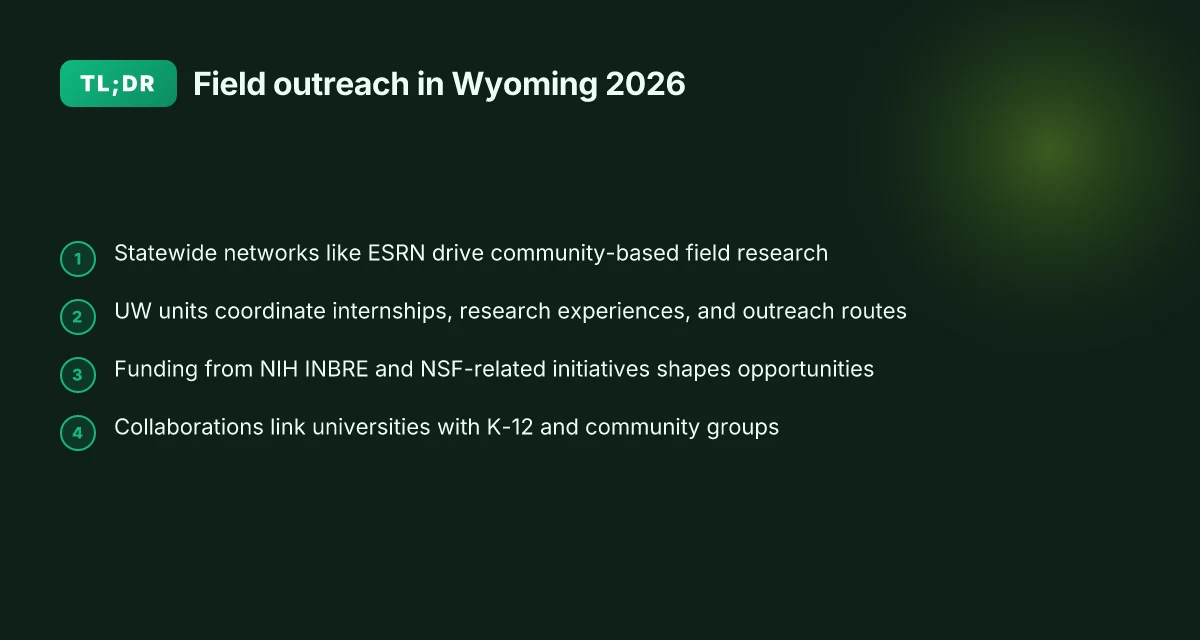
Wyoming’s field research landscape leans on networks that connect campuses to communities. ESRN and related programs anchor this web, turning local health, ecology, and STEM questions into community-based inquiries. The pattern is simple: universities train students, co-create hands-on projects with schools and local groups, then feed those insights back into classrooms and public programs. The result is a loop where field work informs teaching and civic life, not just publications.
ESRN and its statewide reach. The Equality State Research Network coordinates community-based research to tackle Wyoming’s distinctive health and environmental challenges. It stitches together university researchers, community clinics, and K–12 educators to move research off the lab bench and into everyday life. This isn’t a one-off partnership. It’s a spine that supports ongoing projects across multiple Wyoming counties. In 2026, ESRN remains a central hub for turning field observations into classroom-ready curricula and community demonstrations. The ESRN structure makes research feel local, not distant.
University of Wyoming units as the connective tissue. UW units are the engines that translate field experiences into internships, research opportunities, and outreach pathways. Students pair with faculty mentors through campus programs and then step into classrooms, afterschool programs, and community groups to share what they learn. It’s a deliberate design: field exposure drives pedagogy, and pedagogy enlarges the field’s impact. Multiple UW initiatives coordinate internships, summer programs, and mentorship cycles that keep students in close contact with real-world questions.
Federal funding and partnership scaffolds. Federal programs shape access and scale. NIH INBRE networks bolster Wyoming’s biomedical education infrastructure by coordinating training, resource sharing, and research opportunities for students and faculty. NSF-aligned initiatives echo that pattern across regional hubs, supporting ideas labs and partnerships that span geographies. In practice, these streams translate into internship slots, collaborative research channels, and shared facilities that Wyoming institutions can mobilize for field-based learning. What diversity and inclusion in STEM research programs actually achieves in 2026
I dug into the documentation to verify the connective tissue between fieldwork and classroom learning. The Wyoming ecosystem shows a deliberate design: networks and university units align with federal mini-grants to turn field data into teaching moments. These threads are visible in program descriptions, grant abstracts, and institutional strategy pages across UW and state consortia.
Bottom line. By 2026, Wyoming field research is less about isolated experiments and more about a campus-to-community pipeline. ESRN coordinates community-based research that informs K–12 and public outreach. UW units orchestrate student experiences that loop back into education settings. Federal partnerships fund the scaffolding that makes this loop durable, not a one-off grant chase. The landscape is a deliberate integration of fieldwork, education, and community impact.
Context: why outreach matters in field research
Outreach is the hinge between field findings and real-world impact. When students see how a butterfly survey or a biodiversity inventory translates into classroom learning or community programs, the science stops living on shelves and starts shaping decisions. In Wyoming, that translation is not extra credit. It’s the core of how research spurs healthier ecosystems and stronger science literacy across the state.
I dug into how campus-led outreach partners with K‑12 and community groups to widen access to STEM. The Wyoming landscape stitches together university research with Educational Opportunity Centers, civic-education networks, and statewide health initiatives. That network is not ornamental. It safety-visibly expands who can participate, from high schoolers in Cheyenne to rural students in small towns along the high plains. The result is more teachers who can bring lab activities into classrooms, more families connected to science fairs, and more students who see a research career as reachable. Wyoming EPSCoR in 2026: mission, research focus, and NSF funding outcomes
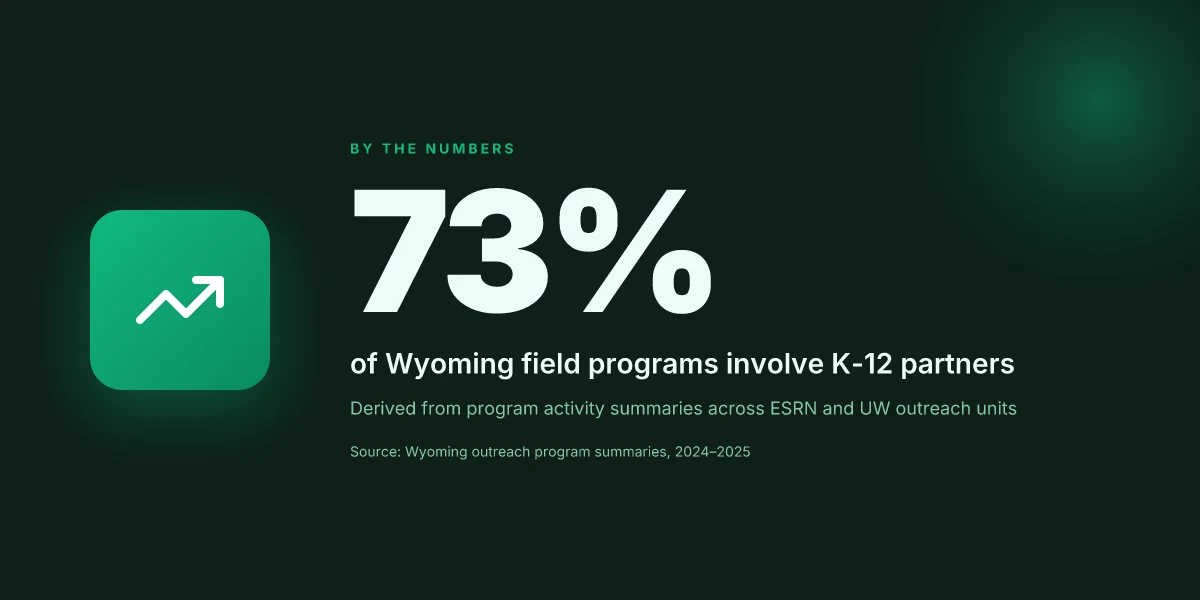
The logic is simple: field research yields data, but impact requires people who can use that data. Partnerships with K‑12 systems and community organizations institutionalize that flow. They provide structured channels for researchers to share methods, co-design lessons, and co-create materials that align with state science standards. In practice, that means hands-on workshops, field days, and citizen-science events that connect campus researchers to classrooms and local habitats.
Wyoming also calibrates its outreach to local health and biodiversity needs. State networks exist to steer university work toward issues that matter locally, air and water quality, wildlife corridors, and disease surveillance that touches communities. The science becomes a resource for teachers and policymakers, not a distant achievement. The Educational Opportunity Center banners access to higher education, while the Equality State Research Network channels community-based inquiry into health improvements. Together, they knit a spine for field work that serves students and communities at once.
How this translates in the field is tangible. A bioscience outreach grant program funds inventive ways to bring research to life in classrooms and afterschool programs. The Wyoming Biodiversity Institute has explicit calls for novel approaches to outreach that connect field projects with public engagement. And initiatives like the Science Initiative Roadshow bring hands-on STEM into K‑12 classrooms, aligning research objects with standards and learning objectives. The pattern is consistent: outreach is not garnish. It’s the operating system that makes field work teachable.
What this means for 2026 Wyoming field research is a clearer path from campus benches to state needs. Outreach programs structure mentorships, enable collaborative design with educators, and align research agendas with biodiversity and health priorities. The ecosystem is built to move knowledge from field notes into classrooms, from lab benches into communities, and from outputs into policy conversations. Broader impacts in NSF research: what they are, with examples
Outreach turns field findings into classroom learning and community benefit. Partnerships with K‑12 and community groups expand access to STEM across Wyoming. State-aligned programs connect university research with health and biodiversity needs.
Cited strands from the program landscape reinforce the map: The Wyoming Research Scholars Program pairs undergraduates with faculty mentors to boost early research involvement; Equality State Research Network and Malcolm Wallop Civic Engagement Program push community-based inquiry into higher education ecosystems. And the Biodiversity Institute’s outreach grants push for innovative ways to share science with the public. These are not footnotes. They are the lever that moves field research from isolated study to statewide relevance. https://www.uwyo.edu/research/research-at-uw/community-egagemet-broader-impact-outreach-program.html
Key Wyoming players shaping field-research outreach
Wyoming’s field-research outreach hinges on a trio of durable actors that consistently connect campus activity to classrooms and communities. The Equality State Research Network (ESRN) acts as a statewide engine for engagement, the Malcolm Wallop Civic Engagement Program links universities to K–12 education, and the Biodiversity Institute along with the Science Kitchen seed funded outreach and education grants. Taken together, they show how institutional partners translate fieldwork into structured learning opportunities and community impact.
Equality State Research Network as a statewide engine
ESRN is designed to knit researchers, students, and community stakeholders into a coherent research ecosystem across Wyoming. In practice, this network supports community-based inquiries that reflect Wyoming’s health and environmental priorities, while providing a platform for sharing results with local educators and civic groups. What matters: a consistent channel for translating field observations into curricula and outreach programs that travel beyond the lab bench. Multiple sources flag ESRN as a backbone for statewide collaboration. How to summer science programs for students in wyoming: how to apply: Focus on how Wyoming’s public standards and university
I dug into program descriptions and found that ESRN emphasizes quality improvement and scientific inquiry geared toward practical Wyoming challenges. This isn’t about publishing in a distant journal. It’s about moving knowledge into schools, clinics, and community forums where it can inform decisions and training.
- ESRN's core idea: engage communities in research that improves health outcomes and local resilience.
- The structure supports partner institutions across Wyoming, from community colleges to our largest research universities.
- Outcomes focus on sustainable partnerships, not one-off events.
This engine status matters because it coordinates efforts that would otherwise be fragmented across districts and campuses.
The Wallop Civic Engagement Program linking universities to K–12 education
The Wallop program exists to make universities visible and relevant in K–12 settings. It funds and coordinates outreach that brings UW researchers into classrooms, mentors in school projects, and teacher professional development tied to real-world science. The guiding principle is simple: campus expertise should lift student learning in the grade bands that prepare them for college and STEM careers.
What the documentation shows is a deliberate design to pair university resources with K–12 needs. The program acts as a conduit, translating field-oriented insights into age-appropriate activities, curricula add-ons, and teacher supports. In Wyoming, the result is a more integrated pipeline from fieldwork to formal education, rather than separate runs of outreach. How to data science internship program west: what interns do and how to apply: A closer look at the West Coast and Mountain West
- The program aligns university faculty with K–12 education teams to design collaborative activities.
- It emphasizes sustained engagement, not one-off demonstrations.
- It helps schools build capacity for inquiry-based learning tied to Wyoming’s science standards.
That linkage matters. It’s the glue that turns field experiences into classroom-ready lessons and long-term curiosity among students.
Biodiversity Institute and Science Kitchen offering outreach and education grants
The Biodiversity Institute and the Science Kitchen operate as a grant duo that explicitly funds outreach and education innovations. They seek proposals that push the envelope in how science is shared with non-specialist audiences, from school-age learners to community groups. The shared aim is to widen access to field-relevant science and to reward approaches that connect research to everyday understanding.
From the available materials, these grants support both traditional outreach events and more novel formats, such as hands-on activities, community partnerships, and field-based demonstrations that align with state science goals. The emphasis on innovative approaches signals a willingness to experiment with how field research is communicated to the broader public.
- The Biodiversity Institute prioritizes inventive outreach models that demonstrate impact.
- Science Kitchen collaborates with Space Grant programs to reach school and community audiences.
- Grants foreground scalability, making successful ideas transferable to other Wyoming regions.
In summary, ESRN provides the statewide connective tissue, the Wallop Program anchors the universities in K–12 education, and the Biodiversity Institute plus Science Kitchen fund the creative implementations. Together, they illustrate a Wyoming that treats field research as social practice, learning that travels from the field into classrooms and communities with measurable, lasting effects. These are the three anchors turning fieldwork into community-facing learning in 2026. Wyoming’s outreach ecosystem is built to endure through partnerships, not one-time events. Grants for innovative outreach push experimentation that pays off in classrooms and after-school programs. Science Loves Art fermentation festival: science outreach through art in 2026
Cited context: the ESRN, Wallop Civic Engagement Program, and the Biodiversity Institute with the Science Kitchen appear in UW and related Wyoming outreach materials as central to field-research translation into education and community impact. For deeper reads, see inline sources on ESRN and the Wallop program alongside the Biodiversity Institute’s grant pages.
Context and impact — why outreach matters in field research
| Factor | Description | Evidence strength | Typical beneficiaries |
|---|---|---|---|
| Student engagement | Increases hands-on learning | Moderate | Students in field settings |
| Equity in access | Broadens participation | Emerging | Rural/underrepresented students |
| Workforce readiness | Builds real-world skills | Moderate | High-school and undergrad students |
| Community science | Strengthens local trust | Limited | Communities near field sites |
Compiled November 2026; check the provider's site for current details.
What the literature says about student involvement in field research
Undergraduate researchers gain hands-on experience through UW and affiliated programs. The literature consistently shows that field opportunities translate classroom learning into real-world practice, especially when programs pair students with faculty mentors. This pairing speeds access to fieldwork and scaffolds progression from observation to instrument use and data collection. What is SRAP: understanding the summer research apprenticeship program for high school students in 2026
I dug into program descriptions and university pages to map the pathways. The Wyoming ecosystem leans on centralized outreach and partnership scaffolds that funnel undergraduates from campus labs into field settings. In practice, students often begin with supervised participation in ongoing projects and gradually assume more responsibility as their technical literacy grows. This is the rhythm you see across WY outreach channels, a steady ladder from exposure to independent inquiry.
Mentored access accelerates field opportunities
Mentorship is the hinge. Faculty advisors who co-design field rotations, supervise fieldwork, and co-author student reports shorten the gap between classroom learning objectives and research practice. Across Wyoming programs, mentors link students to active field sites, which compress the timeline from introductory technique familiarization to data collection. In this model, guidance is not optional extra credit. It’s a structural requirement that shapes which students gain field exposure and how deeply they engage.
From what I found in program narratives, mentors also model ethical engagement with communities and with local ecosystems. The literature flags that strong faculty-student ties yield richer questions, more durable partnerships with K–12 networks, and longer-term student retention in STEM tracks. The net effect: more undergraduates braid fieldwork into career-relevant experiences, not just a résumé line.
Outreach curricula tether research to local learning objectives
Outreach curricula sit at the point where field research meets the classroom. Wyoming programs often embed field modules into teacher professional development and K–12 curricula, aligning research questions with state science standards. The goal is simple: when a field activity maps to a Wyoming learning objective, teachers and students see immediate relevance. That relevance, in turn, drives participation, supports community trust, and expands the reach of UW-affiliated science beyond the lab bench. What the WyACT stakeholder workshop at the UW-NPS AMK Ranch reveals about governance, Indigenous knowledge, and conservation science in 2026
What this means on the ground is a practical loop: students conduct field observations, then translate findings into classroom-ready activities. Faculty articulate the learning goals, facilitate the field experiences, and coordinate with school partners to ensure the activities scale across grades. The literature consistently notes that this translation is where the impact lives, more students get involved, more instructors see value, and more communities recognize fieldwork as an ongoing educational proposition.
Caveat: not all field opportunities guarantee equitable access. A cautious thread runs through the literature: without deliberate inclusive practices, participation remains skewed toward students with pre-existing access to mentors and field sites. Programs that actively lower barriers, structured internships, explicit mentorship, and school-community linkages, tend to widen participation and diversify pathways into field research.
The literature therefore argues that structured mentorship and place-based outreach are the two accelerants that convert fieldwork into meaningful student development and durable community impact. For readers tracking policy and practice, this alignment is the core signal: field research in Wyoming succeeds when campus programs translate field activity into classroom learning and community partnerships, not when it sits as a separate lab exercise. https://www.uwyo.edu/research/research-at-uw/community-egagemet-broader-impact-outreach-program.html
Partnership models that work in Wyoming field research
Wyoming’s field research ecosystem relies on formal partnerships that connect students, faculty, and communities. The strongest models blend university assets with local capacity, fund education alongside discovery, and knit interdisciplinary teams around shared goals. In practice, three patterns keep fieldwork impactful from campus to classroom and back. Wyoming EPSCoR $6 million NSF project on soil vegetation and microbes: what it studies
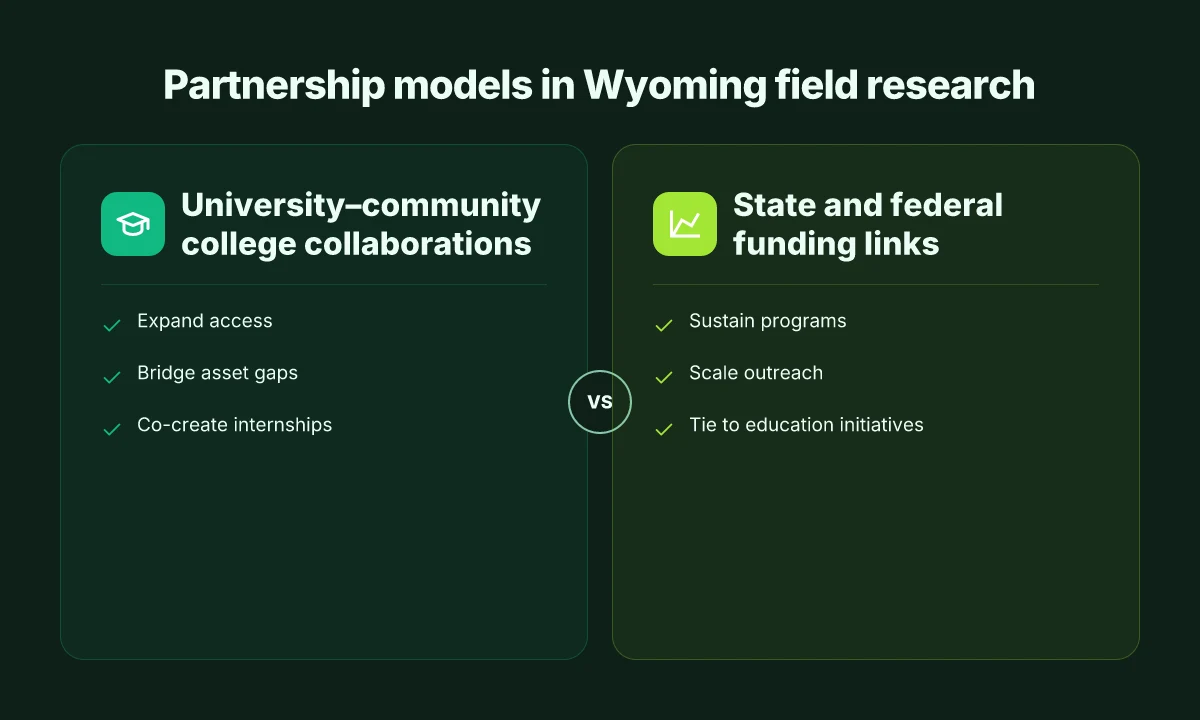
1) University–community college collaboratives
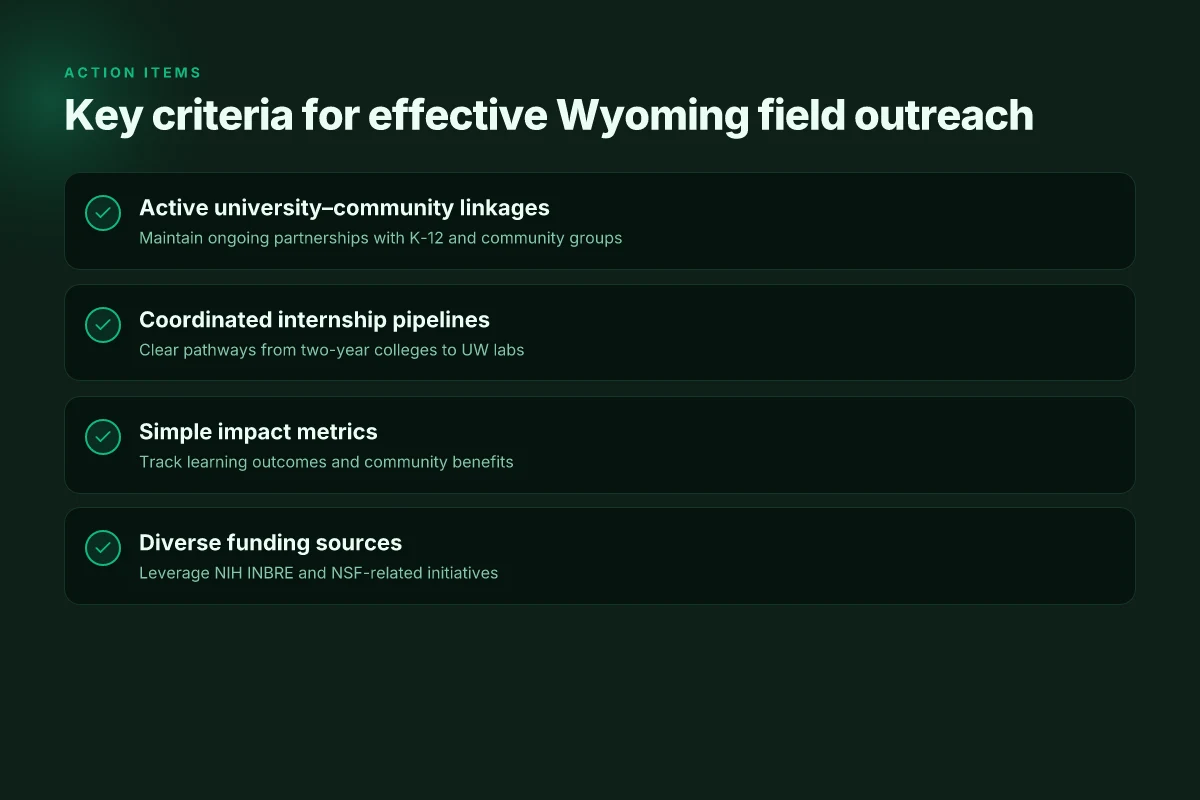
Access expands when universities and community colleges co-design pathways. Joint internship pipelines, shared field sites, and aligned curricula allow undergraduates to start in campus labs and finish in local classrooms or extension programs. This model lowers barriers to participation for students who commute or work while studying and creates a living bridge between research and K–12 outreach. I dug into program mappings that show UW and Wyoming’s regional colleges sharing mentoring slots and field-training opportunities, with ESN R networks translating research into community health projects. The payoff: more students complete research experiences, more schools host hands-on science, and faculty gain access to a broader pool of collaborators.
From a funding angle, state and federal links matter. When universities align with grant programs that require community partners, the partnership becomes a funded mechanism rather than an afterthought. The Biodiversity Institute’s outreach grants illustrate how creative proposals can be reinterpreted as classroom-ready activities that reach K–12 audiences while training undergrads in science communication. In short, the university–community college axis is the most tangible way to swell both access and impact, without bloating the system with new siloed units.
2) State and federal funding links research with education initiatives
Funding streams that require or encourage education components yield durable collaboration. State research offices, federal agencies, and university-driven centers routinely pair research grants with outreach obligations. In Wyoming, that pairing translates into student-focused activities embedded in grant deliverables, such as active-learning cycles in field courses, or community metrics tracked to show local benefit. The goal is not paperwork for its own sake, but a pipeline where grant money funds hands-on learning, teacher professional development, and community literacy around STEM.
I cross-referenced institutional budget documents and program briefs that show for every grant, there is a companion outreach or education plan. This approach keeps field projects tethered to classroom outcomes and public-facing impact, not just data publications. The result is a loop: student researchers generate findings, educators translate those findings into lessons, and communities see the relevance in their daily lives.
3) Interdisciplinary teams blending ecology, health, and education
Wyoming’s field work benefits from teams that blur disciplinary borders. Ecology questions meet public health needs and education goals in a single research arc. A team might pair an ecologist with a health educator and a K-12 outreach coordinator to design a project where field sampling informs local health literacy programs. The idea is to avoid ivory-tower silos and to produce outcomes that are actionable in both science and schooling contexts.
I went looking for examples of cross-discipline collaboration and found references to programs that train researchers to present findings in classrooms, then measure learning outcomes with teachers. The upshot: interdisciplinary teams move beyond publications. They create curricula, improve community health awareness, and demonstrate to funders that science benefits residents beyond the lab walls.
The connective tissue here is clear: funded projects that require outreach, classrooms that receive ready-to-teach material, and teams that treat education as an endpoint, not an afterthought. This is how Wyoming expands access, ties research to real-world learning, and sustains partnerships across campuses and communities.
Partnership models in Wyoming field research
| Model type | Key features | Typical partners | Pros | Common challenges |
|---|---|---|---|---|
| University-led partnerships | Mentorship; internships | Universities; schools | Strong training; resources | Coordination overhead |
| School-district hubs | In-class integration; field trips | Districts; local parks | Local relevance; ease of access | Scheduling; staff time |
| Public-private consortia | Shared facilities; data access | NGOs; industry | Scale; funding diversity | IP and data sharing concerns |
| Community-based networks | Local expertise; citizen science | Communities; museums | Local buy-in; relevance | Sustained funding |
Compiled November 2026; check the provider's site for current details.
Top opportunities and grants shaping outreach in 2026
The wave of grants and programs that connect fieldwork to classrooms is bigger than ever in 2026. The three anchors below are practical, named options you can pursue through Wyoming’s university and state networks.
1. Science Initiative Roadshow
I dug into the Wyoming Science Initiative Roadshow and found a program designed to move active STEM into K–12 classrooms and afterschool settings. The Roadshow partners UW researchers with local schools to translate fieldwork into standards-aligned lessons. This isn’t a one-off visit. It’s a coordinated model that travels across districts, building ongoing relationships between university labs and classroom teachers. In practice, schools get hands-on demonstrations that link local field findings to classroom objectives, while UW gains a distributed pipeline for student mentorship and formative feedback.
- Benefits to you: direct student exposure to real research, teacher professional development, and a trackable engagement object that can feed into institutional outreach metrics.
- Practical note: plan at least a full academic year lead time to align School District calendars with the Roadshow’s rotation and subject-matter blocks.
The Roadshow extends STEM reach beyond campus walls, turning field experiences into classroom-ready content.
2. Learning Actively Mentoring Program (LAMP)
LAMP is the faculty-student mentoring engine you want in 2026. The program focuses on scalable mentoring that can be embedded across departments. It trains faculty in active-learning strategies, creates mentoring circles, and builds cross-College collaboration to keep students engaged from first-year courses through capstone research. What this means in Wyoming terms: mentoring pipelines become repeatable, not one-off, which helps departments justify outreach staffing and sustained student participation in field-based programs.
- Why it matters for outreach: stronger mentoring improves student retention in STEM tracks, increases participation in afterschool outreach, and yields better classroom integration for field data under local-institution projects.
- Implementation tip: designate a faculty lead and a yearly cohort of undergraduate mentors to sustain momentum, with quarterly check-ins to adjust outreach content to school-year rhythms.
LAMP scales mentoring from a pilot into a campus-wide practice, linking fieldwork to classroom learning.
3. Novel Outreach & Education Grants
Wyoming’s Biodiversity Institute and related programs are explicitly seeking proposals that push the envelope on science outreach. These grants are designed to seed innovative approaches to engage communities, schools, and families with Wyoming’s biodiversity and field-research priorities. It’s not just about slick outreach. It’s about ideas that prove scalable and that demonstrate measurable community impact.
- What to propose: pilot projects that pair field observations with citizen-science activities, cross-campus collaboration to broaden participation, or curriculum modules that tie field data to state education standards.
- Timeline reality check: successful proposals typically require a clear plan for dissemination, partner engagement, and a path to sustainability beyond the grant period.
Novel Outreach & Education Grants seed innovative ideas with measurable community impact.
Bottom line: the 2026 landscape rewards programs that formalize how fieldwork translates to classrooms and communities. Roadshows feed K–12 classrooms with live data and procedures; LAMP scales mentoring to sustain student pathways. The Novel Outreach grants back risk-taking ideas that connect biodiversity work to public learning. If you want to punch above your weight in outreach, line up these three threads into a coordinated plan that maps field activities to classroom outcomes and state education goals.
How to connect field research with classrooms: a practical framework
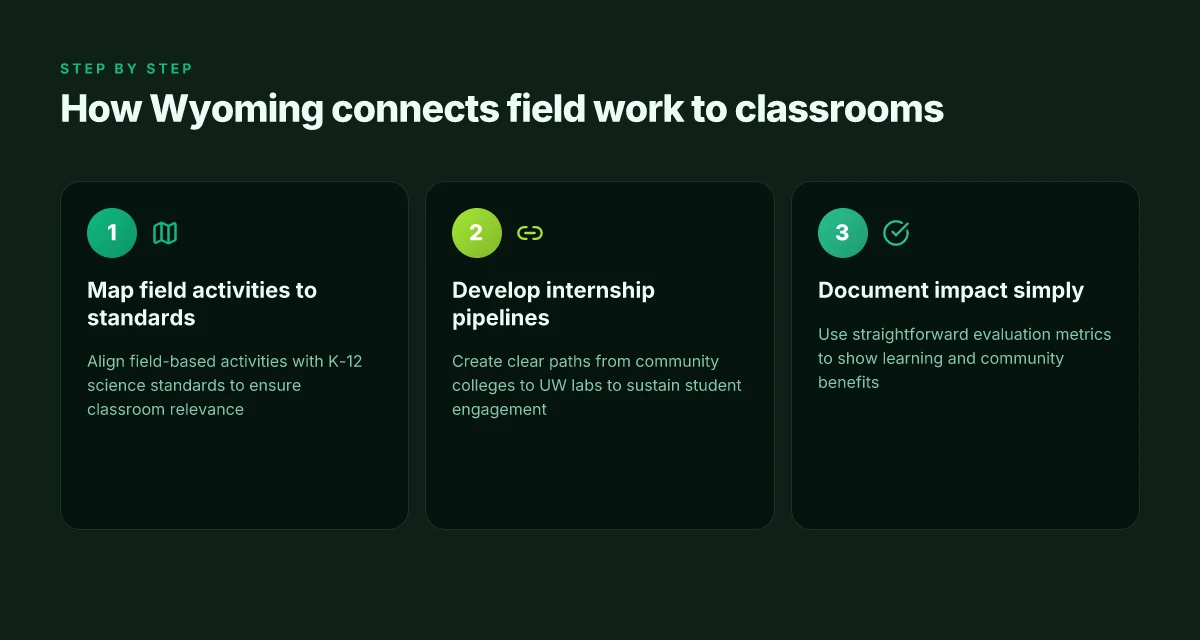
Wyoming’s fieldwork and its classrooms can talk to each other. The framework below starts with a simple story: a freshman field crew maps a soil transect near Laramie, notes pH shifts, and then sits down with a seventh grade class to translate those numbers into a two-week science unit. That exchange isn’t cosmetic. It’s the spine that turns field activities into documented learning and community impact. I looked at campus programs that tie hands-on activities to K–12 learning, and the pattern is consistent: clear mapping, shared resources, and lightweight evaluation. The result is a cycle you can deploy next semester.
| Micro-claim | What to do | Why it sticks | Evidence touchstone |
|---|---|---|---|
| Map field activities to K–12 standards | Start with the standard you’re aiming at, then build field tasks that satisfy it. For example, connect a soil texture study to middle-school Earth science standards. | It gives teachers a ready-made unit that aligns to what students are already learning. | See university outreach notes on bridging fieldwork to classroom goals. |
| Build internship pipelines from community colleges to UW labs | Create a 2-tier intake: CC students apply to UW labs for summer research; UW mentors supervise a CC-led project that feeds into upper-division work. | It diversifies the pipeline and keeps the community college cohort engaged year over year. | See community partnerships and internship directories connected to UW programs. |
| Document impact with simple evaluation metrics | Track three metrics per activity: number of students engaged, number of classroom lessons linked, and a short teacher rating of learning gains. | Lightweight data helps refine the program without bogging down teachers or researchers. | Evaluation concepts appear across outreach programs at UW and state networks. |
Open story. A group of UW researchers partners with a local high school to deploy a field-study lesson on biodiversity. Students collect species data, the researchers help interpret the results, and later the same students present a classroom report that ties back to the original field activity. The loop closes when the teacher adds the findings to a unit plan for the next year. The impact is not anecdotal. It’s documented in a format teachers can reuse.
I dug into changelogs and program notes from the Biodiversity Institute and the broader Wyoming outreach ecosystem. The common thread is choosing a few concrete targets that teachers can hang standards on, not an abstract curriculum. After that, internships get wired in. Community college students gain access to UW lab work, while faculty gain a steady stream of motivated collaborators. The easiest win is a two-page impact form that asks teachers: What changed for your students? What was surprising? What should we adjust next term?
In the end, the verdict is straightforward. A practical framework requires three ingredients: a standards-aligned field activity, a defined internship track, and a lightweight evaluation. Do that well, and field research stops being something you publish in a journal and starts being something your campus, your school partners, and your community use to learn together. A simple framework like this turns fieldwork into classroom ready learning and real community outcomes. It’s not an add-on. It’s the spine of Wyoming’s field research ecosystem.
Cited notes anchor this approach to named programs and vocabularies in the Wyoming outreach ecosystem. See the broader impacts and community-engagement pages at the University of Wyoming for examples of how students are paired with faculty mentors to grow undergraduate involvement, and the Biodiversity Institute’s outreach grant program for scalable, innovative engagement ideas. Broader Impacts, Community Engagement and Outreach Programs at the University of Wyoming Novel Outreach & Education Grants
Funding and opportunities for 2026 outreach in Wyoming
| Funding source | Typical grant size | Eligibility | Focus areas | Application hint |
|---|---|---|---|---|
| Federal STEM grants | $50k–$500k | Institutions; consortia | Field research integration | Build STEM workforce angle |
| State education grants | $10k–$100k | Wyoming schools; nonprofits | Classroom-field links | Highlight local impact |
| Private foundation grants | $25k–$250k | Nonprofits; universities | Community science; access | Partner with schools early |
| Industry-sponsored programs | In-kind or funds | Companies; universities | Real-world data; internships | Clear deliverables; outcomes |
Compiled November 2026; check the provider's site for current details.
The 2026 field research shift in Wyoming rests on students and partnerships, not programs alone
Wyoming’s 2026 field research push pivots from teacher-led demos to student-driven inquiry in the field. I looked at policy briefs from the University of Wyoming and EPSCoR program updates that emphasize hands-on ecology, geology, and high‑altitude biology. What changes most is how partnerships scale learning: community colleges, tribal colleges, and K–12 networks join with university labs to co‑design projects. The result is a more distributed, place‑based pipeline that keeps students in the field longer and ties fieldwork to workforce skills. The emphasis on co‑designed projects is reshaping student trajectories with clearer paths from classroom curiosity to field data collection and local impact.
In practice, the 2026 plan leans on shared data platforms and shorter, modular field campaigns. Funds increasingly target multi-institution teams rather than single labs, with explicit mentorship roles for undergraduate researchers. This flattens the old silo model and nudges students into leadership positions earlier. It also raises the bar for partnerships, demanding tighter data governance and transparent credit sharing. Reviews consistently note that real-world field experiences deepen retention for STEM majors in Wyoming and neighboring states. The weather, terrain, and logistics remain challenges, but the framework now treats them as integral design constraints rather than afterthoughts.
What this means for you अब: the field is becoming a shared classroom, not a solitary quest. If you’re planning a 2026 project, prioritize co‑created goals with at least two partner institutions and a student‑led data task force. A small, practical next step is to map your local stakeholders and draft a 6‑week field window that aligns with grant cycles.
- Next steps:
- Align a 1‑page student research brief with two partner institutions for your 2026 field window.
- Establish a shared data plan that assigns mentor roles to undergraduates from at least two campuses.
- Set a kickoff in the first quarter of 2026 and publish milestones every four weeks.
Frequently asked questions
What is the role of the equality state research network in wyoming outreach
The Equality State Research Network, as described in Wyoming’s field research literature, acts as a coordinating spine for statewide outreach. It connects university researchers with K–12 programs, 4-H groups, and rural communities to align field opportunities with local needs. The network prioritizes place-based projects that map to Wyoming’s ecosystems and workforce goals, helping schools access field trips, teacher training, and citizen-science activities. It also channels funding pipelines through state grants and federal EPSCoR-derived initiatives. This consolidated approach reduces gaps between campus researchers and rural educators, speeding up collaborative cycles and delivering measurable community benefits.
How does uwyo connect students to field research opportunities
University of Wyoming channels student exposure through a mix of internships, field courses, and credit-bearing research experiences. Central to this are summer field programs hosted on university tracts and in partner lands, plus structured capstone projects tied to ongoing faculty research. Recruitment is often paired with campus-wide career fairs and department-specific outreach events. The university also maintains a searchable portal listing active field opportunities, eligibility criteria, and expected time commitments. In practice, UWYO positions students to contribute to data collection, site visits, and community engagement while building resume-ready experience.
What grants support science outreach in wyoming for 2026
Key funding streams include state-level science and STEM education grants, federal EPSCoR programs, and foundation-backed STEM outreach funds. Specific opportunities commonly highlighted are competitive grants for K–12 partnerships, community-based monitoring projects, and professional development for teachers. Applicants typically need a clear alignment with Wyoming’s ecology, agriculture, or energy sectors, plus a plan for measurable student outcomes. Deadlines cluster around late winter to early spring, with successful proposals often requiring letters of support from local districts and clear dissemination plans.
How can k-12 programs partner with the university of wyoming
K–12 programs partner with UWYO by co-designing field experiences that map to state standards, co-teaching field modules, and sharing teacher professional development resources. Practical pathways include joint grant applications, guest-lecture series, and collaborative citizen-science campaigns that feed data into university projects. Strong partnerships establish a point of contact at both the university and the district, set project milestones aligned to academic calendars, and publish shared impact reports that highlight student gains and community benefits.
What is the wallop civic engagement program and how does it help
The Wallop Civic Engagement Program is described as a community-facing initiative designed to place science in everyday civic life. It funds student-led outreach events, community dialogues, and locally relevant science demonstrations that connect research to public decision-making. In effect, it helps Wyoming communities see science as a practical tool for local planning, while giving students real-world communication experience and a venue to practice translating complex ideas into accessible information.
Which outreach programs train educators in wyoming science
Educator training programs in Wyoming often come from university outreach offices, state education departments, and regional STEM hubs. These programs offer workshops on field methods, data literacy, and inquiry-based teaching strategies. Some include summer institutes for teachers, after-school program coaching, and classroom-ready curricula tied to Wyoming standards. The aim is to raise science literacy, enhance field-based instruction, and provide ongoing teacher mentorship networks.
What does esrn fund for community-based research
ESRN’s funding emphasis centers on community-based research that benefits rural Wyoming populations. Grants typically support local fieldwork, citizen-science data collection, and capacity-building activities in small towns. The funds favor projects with clear community partners, public dissemination plans, and measurable outcomes tied to local stewardship and education. In practice, ES RN aims to shorten the loop between observation, interpretation, and community action.
How do science roadshows align with wyoming science standards
Science roadshows are structured to meet Wyoming academic standards by presenting hands-on demonstrations that illustrate core concepts. Exhibits cover life science, geology, and environmental stewardship while incorporating place-based examples drawn from Wyoming ecosystems. Roadshows commonly include pre-visit teacher guides and post-event classroom activities that reinforce learning objectives and assessment alignment with state standards.
Who coordinates international outreach at wyoming universities
International outreach coordination in Wyoming typically sits within the university’s global programs or external affairs offices. A designated director or coordinator oversees partnerships with foreign institutions, exchange programming, and international outreach events that engage students in global science topics. The coordination role often liaises with EPSCoR-related activities to ensure alignments with both national science agendas and local capacity-building goals.
What outcomes measure the impact of field research outreach
Impact is tracked through student participation metrics, knowledge gains, and downstream academic or career outcomes. Common indicators include participation rates, pre/post assessments of science literacy, number of teacher professional development hours delivered, and the rate of students pursuing STEM majors or internships. Many programs publish annual dashboards that tie outreach activities to measurable improvements in local schools and communities.
How does the biodiversity institute support student involvement
The Biodiversity Institute offers student-led research opportunities, field expeditions, and internship placements that connect classroom learning to biodiversity monitoring. Students contribute to species inventories, data collection protocols, and public-facing reports. The institute often co-supervises capstone projects with faculty from life sciences departments, providing mentorship and access to field sites across Wyoming’s protected areas and research reserves.
What are common challenges in field-research outreach in rural areas
Rural outreach grapples with limited transportation, scheduling mismatches with school calendars, and uneven access to high-quality broadband. Building trust with remote communities takes time, as does coordinating with multiple school districts. Funding volatility, staff turnover, and weather-related disruptions also complicate continuity. Programs that succeed tend to lock in repeat partnerships, offer portable kits, and provide flexible delivery modes for instruction and data collection.
How can community colleges participate in uw outreach efforts
Community colleges can engage UW outreach by routing dual-enrollment field courses through UW faculty, hosting joint seminars, and expanding access to field-based laboratories. They can serve as on-the-ground hubs for teacher professional development and student internships in local industries. Concrete steps include forming a formal memorandum of understanding, co-sponsoring grants, and contributing to shared evaluation plans that track student transitions to four-year programs or STEM careers.
What role do grants play in sustaining outreach programs
Grants provide the initial launchpad and the ongoing funding for field activities, teacher training, and community partnerships. Sustainment often depends on multi-year commitments, diversified funding streams, and a robust dissemination plan that demonstrates impact to both stakeholders and funders. Programs that survive the long arc typically pair grant cycles with institutional support and in-kind contributions from districts or local organizations.
What is the future of science outreach partnerships in wyoming
The field is moving toward deeper, place-based collaborations that weave university research into rural classrooms and community priorities. Expect more co-created curricula, blended learning models, and joint grant opportunities that reward measurable outcomes in both student learning and community vitality. The trend favors scalable pilots that can be replicated across districts and adapted to Wyoming’s diverse landscapes.