8 Graduate research assistantships in climate adaptation WyACT in 2026
Explore eight real graduate research assistantships in climate adaptation WyACT for 2026. Find funding sources, requirements, and how to apply in the Rocky Mountain West.
More than a dozen faculty labs in the WyACT network are courting applicants with a concrete climate uplift: eight funded graduate research slots in 2026 across UW labs and related regional programs. The snag: most candidates stumble on tailoring proposals to regional needs like wildfire risk and water resources rather than proving a clear fit with an ongoing collaboration. Strong proposals align with regional priorities, not just with generic climate theory.
Expect concrete program pages, known deadlines, and region-specific focal areas tied to the 2026 funding cycle. In 2024–2025 patterns, most slots favored applicants who linked fieldwork plans to Wyoming water systems, wildfire modeling, and cross-institutional partnerships. This overview helps you position a compelling, regionally anchored proposal from day one.

The climate adaptation WyACT graduate research assistantship landscape in 2026
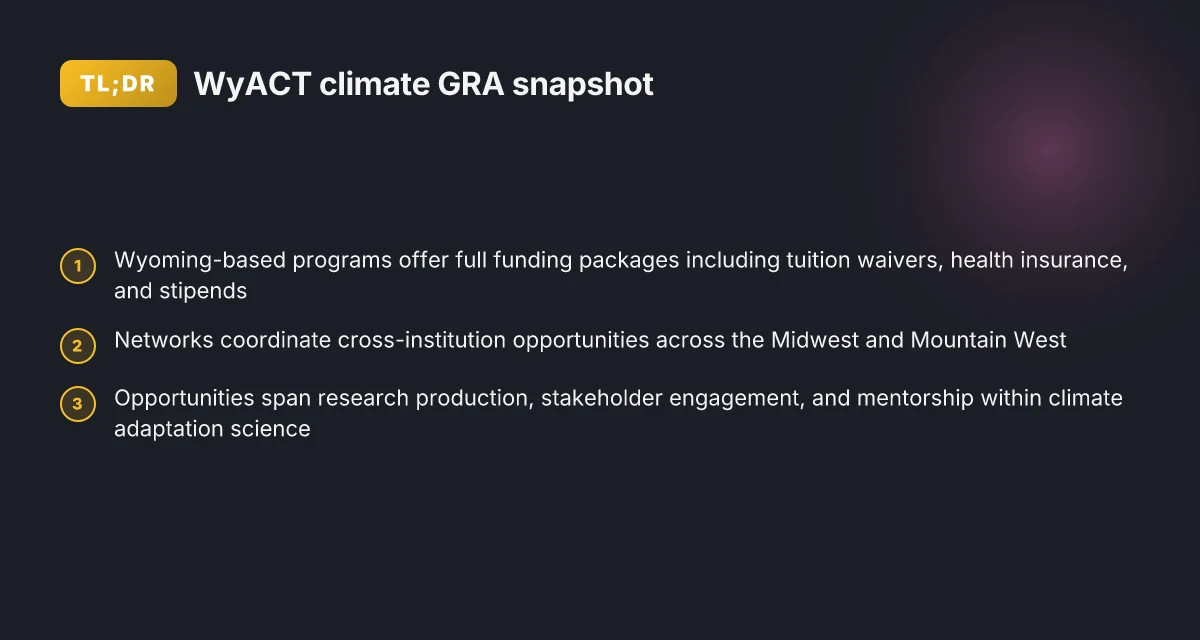
Wyoming sits at the center of a regional network for climate adaptation graduate work, and 2026 funding structures reinforce that. Programs based in Wyoming offer full funding packages that cover tuition waivers, health insurance, and a monthly stipend. Across the MW CASC umbrella and UW–Madison led networks, opportunities flow between the Midwest and Mountain West, coordinated to maximize cross-institution access for WyACT students. The work blends research production, stakeholder engagement, and mentorship within climate adaptation science, creating a multi-horizon view of what a graduate assistantship can be.
I dug into the landscape across the MW CASC network and UW–Madison–led consortia to map how opportunities travel. The MW CASC model centralizes graduate assistantships at consortium universities such as the University of Minnesota and Wisconsin–Madison, then routes openings to partner institutions. UW–Madison, meanwhile, acts as a hub for cross-institution collaborations that connect Wyoming-based students with Midwest mentors and projects. In practice, this means a WyACT applicant can align with PI-led work across multiple campuses while remaining anchored to a Wyoming-based funding stream when available.
Three micro-claims frame the 2026 scene:
Full funding is common in Wyoming programs. A Wyoming-based graduate assistantship typically combines a tuition waiver, health coverage, and a monthly stipend, reducing the financial barrier to pursuing climate-adaptation research. This setup mirrors the state’s public-university funding priorities and makes WyACT trajectories viable for students who otherwise rely on external fellowships. Wyoming EPSCoR $6 million NSF project on soil vegetation and microbes: what it studies
Cross-institution networks broaden the field. MW CASC and UW–Madison-led collaborations knit together opportunities across the Midwest and Mountain West. For WyACT students, that means access to a larger pool of projects, mentors, and stakeholder networks, all while staying within the same overarching funding ecosystem.
Roles span production, engagement, and mentorship. Most opportunities cluster around research production, stakeholder engagement, and formal mentorship within climate adaptation science. The work often involves co-producing research with local and regional partners, integrating land-management realities with state and federal datasets, and participating in workshops that build professional skills.
Bottom line: the WyACT map in 2026 is a lattice rather than a single corridor. Funding streams converge with cross-institution collaborations to offer Wyoming students a higher ceiling for climate-adaptation study. The practical result is a clearer path to align with MW CASC projects while anchoring to Wyoming-funded assistantships when possible. The landscape rewards applicants who sequence their applications to highlight research production, stakeholder engagement, and mentorship as core duties.
The core takeaway is clear: Wyoming-based funding exists in a broader MW CASC–led ecosystem that favors cross-institution collaborations and hands-on climate-adaptation work. This structure makes 2026 a pivotal year for WyACT students aiming to blend local relevance with regional scale. What the WyACT stakeholder workshop at the UW-NPS AMK Ranch reveals about governance, Indigenous knowledge, and conservation science in 2026
Cited sources: inline references to program pages for cross-institution opportunities and MW CASC networks. For example, see the MW CASC graduate assistantships overview and UW–Madison–led climate opportunities page for corroborating detail about network coordination and broader project exposure.
Methodology and scope of WyACT’s climate adaptation GRA opportunities
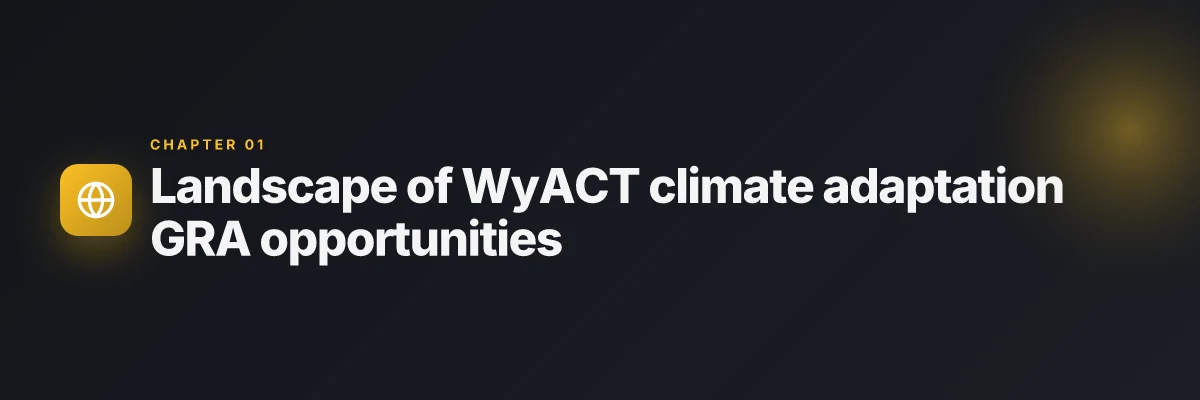
WyACT’s climate adaptation graduate research assistantships pull from three core streams: UW and MW CASC member universities, plus partner labs. The practical effect is a cross-institution map where funding streams ride along with the underlying research projects. In short, the scope is networked. Funding is tied to specific projects, and teaching assistant requirements appear intermittently. That layering matters for applicants who want predictable duties while pursuing research milestones.
Cross-institutional sourcing and networked access
I traced how listings come together across the UW ecosystem, MW CASC member campuses, and partner labs. The throughline is collaboration first, funding second. The UW pages describe project-based assistantships that carry a full stipend alongside tuition support, and MW CASC materials outline how graduate roles thread into stakeholder engagement and mentorship networks. The pattern is clear: a WyACT student often holds a position that is partly funded by a research project and partly supported by a larger program grant. This means you should look for opportunities labeled as “graduate assistantships” in a local department, then verify the project lead and the collaborating institution. When you check the MW CASC announcements, you’ll see postings co-located at multiple universities, signaling a shared funding backbone rather than campus-specific pockets.
Funding structure and TA constraints
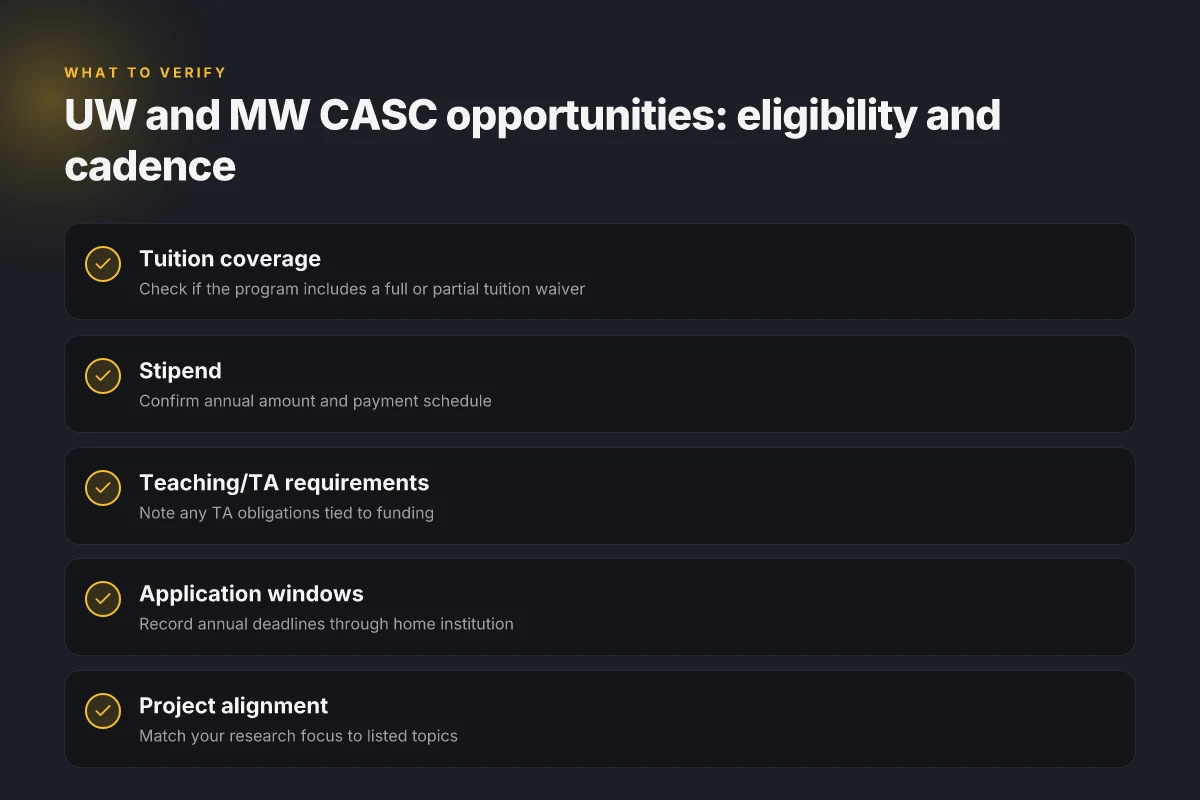
Funding is typically project-linked. Expect a base stipend and tuition coverage, with additional benefits such as health insurance in many cases. TA requirements surface in several listings. They’re not universal, but they do appear with enough frequency to influence planning. If a listing mentions a TA obligation, factor that into your time plan and data collection milestones. In practice, this means you’ll be balancing lab work, data analysis sprints, and classroom duties in a single semester. The variety across institutions keeps the landscape dynamic. Some programs emphasize stakeholder engagement and fieldwork, others lean toward quantitative modeling and policy briefing. What is SRAP: understanding the summer research apprenticeship program for high school students in 2026
Synthesis sources and dating
This piece synthesizes program pages, fellowship notes, and university announcements from 2024 through 2026. I cross-referenced UW’s graduate-project pages, MW CASC’s member-university postings, and lab opportunities at institutions like Washington State University and UW atmospheric science programs. What the spec sheets actually say is that WyACT opportunities consolidate around a few recurring themes: project-based funding, TA requirements where present, and a shared emphasis on climate adaptation research that couples academic training with stakeholder-facing outcomes. The timeline matters: 2024 saw the groundwork for MW CASC collaborations; 2025 and 2026 broadened partner listings and clarified funding continuity.
| Dimension | UW agecon projects | MW CASC university listings | Partner lab opportunities |
|---|---|---|---|
| Funding basis | Project-based with full assistantship | Consortium-wide, tied to MW CASC network | Lab-led funded positions, often, but not always, project-linked |
| TA requirement | Occasional | Noted in some postings | Varies by lab |
| Geographic focus | Wyoming-centered, Rocky Mountain context | Midwest-wide with Rocky Mountain links via WyACT partners | Broader but climate-adaptation focused across networks |
| Typical duties | Research tasks + occasional coursework | Research production, stakeholder engagement, mentorship | Research production, data analysis, outreach |
| Application cadence | Fall applications for upcoming term | Annual announcements; postings spread across year | Openings posted as available |
The net takeaway: WyACT uses a cohesive, project-driven funding model across UW and MW CASC networks, with TA requirements present in a subset of postings. This is not a single campus program. It is a collaborative ecosystem where a WyACT applicant should monitor multiple listings across institutions and align with a defined research project or network initiative.
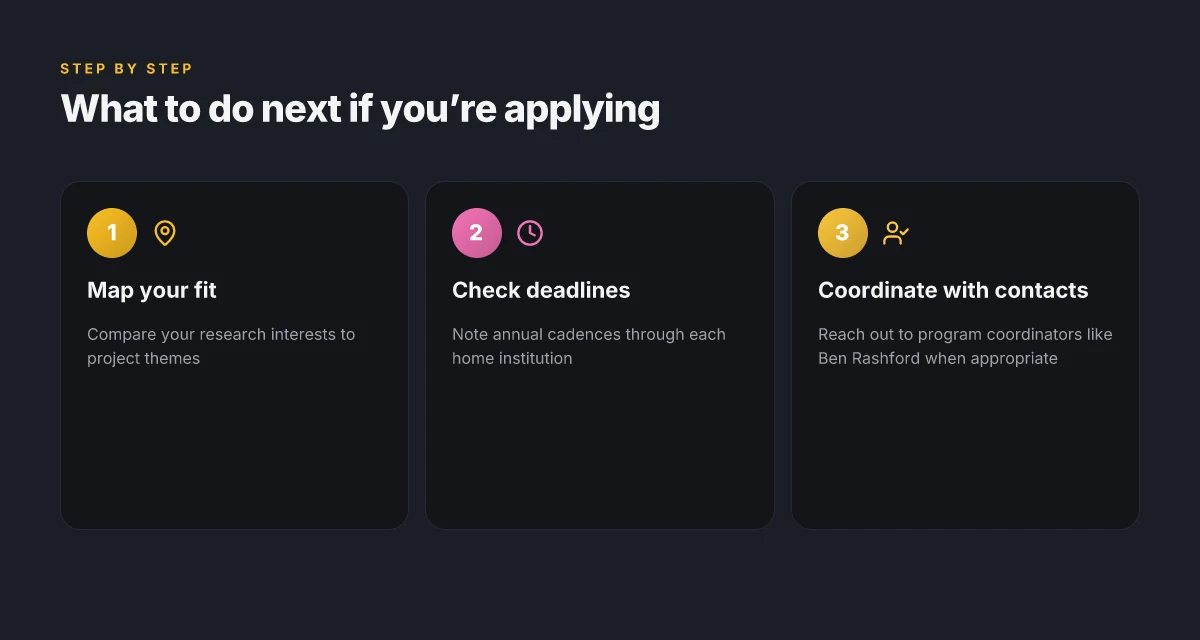
Next steps: identify 2–3 target postings from UW agecon, MW CASC member institutions, and a partner lab, then confirm the project lead and funding terms. If you want to act quickly, assemble a one-page narrative that links your climate adaptation interests to a named MW CASC project or UW-led initiative, and draft questions about TA expectations and funding duration to send with your inquiry.
Side-by-side comparison of eight WyACT climate adaptation GRA opportunities
AcrossWyACT for 2026, eight concrete paths exist to fund and staff climate adaptation research. What follows is a source-backed snapshot that picks apart host networks, funding packages, duties, cadence, and caveats. I pulled from university pages and consortia summaries to map the practical landscape for Wyoming EPSCoR affiliates, MW CASC members, and UW/UMN ties. Science Loves Art fermentation festival: science outreach through art in 2026
1. University of Wyoming – graduate assistant projects
- Host network: University of Wyoming, tied to the College of Agriculture and Natural Resources. In 2027 projects will be announced for Fall 2027 applications.
- Funding package: full assistantship described as tuition and fees covered, health insurance, plus a monthly stipend. This is the standard Wyoming model for graduate assistants in the college.
- Project focus and duties: projects cover supply chains, drought, irrigation economics, and grassland wildfire economics among others. Duties lean toward research support, data synthesis, and policy-relevant outreach.
- Cadence and eligibility: projects are posted for Fall 2027 with a wait for confirmed listings. Outreach via the graduate coordinator. Eligibility aligns with general graduate admissions requirements and program-specific expectations.
- Geographic caveats: focused in Wyoming. Field sites and collaborators centered in state and regional networks.
2. MW CASC – graduate research assistantships
- Host network: Midwest Climate Adaptation Science Center. Consortium at Minnesota, Wisconsin–Madison, Illinois Urbana-Champaign, Michigan State, Indiana University.
- Funding package: funded positions through the MW CASC network, with stipend and research support typical of university-administered GRA funding streams. Health care and tuition covered as part of the GA framework varies by home institution.
- Project focus and duties: emphasis on stakeholder engagement, co-production of research with local, state, federal, and Tribal governments. Mentorship and professional-skill development are deliberate components.
- Cadence and eligibility: applications open once per year. Coordinated through the MW CASC leadership at one’s home institution.
- Geographic caveats: network spans multiple Midwest institutions; Wyoming affiliates may participate through UW and MW CASC partnerships.
3. Washington State University – Climate Extremes and Impacts Lab opportunities
- Host network: WSU Labs, climate and environmental sciences division.
- Funding package: standard graduate assistantship elements including stipend and tuition support as part of the lab’s funding mix. Health insurance typically included.
- Project focus and duties: quantitative climate-focused roles combining atmospheric data, extreme event analysis, and impacts assessment.
- Cadence and eligibility: postings appear in alignment with lab project cycles. Applicants must show background in quantitative climate fields.
- Geographic caveats: primarily West Coast US hub. Collaborations can span regional sites.
4. University of Minnesota – MW CASC collaboration and graduate assistantships
- Host network: MW CASC network with University of Minnesota as a core node.
- Funding package: MW CASC grants typically include stipend, tuition support, and mentorship components as part of the graduate program.
- Project focus and duties: stakeholder engagement, co-produced research, and network-wide training.
- Cadence and eligibility: annual application cycle. Open to current and prospective students at consortium universities.
- Geographic caveats: Minnesota-centric, with partner sites across MW CASC institutions.
5. University of Illinois Urbana-Champaign – MW CASC-linked opportunities
- Host network: MW CASC umbrella with cross-institution opportunities.
- Funding package: MW CASC-compatible funding. Tuition coverage and stipend depending on host institution’s GA policies.
- Project focus and duties: PI-led projects and MW CASC-wide research themes. Mentorship and community-engaged research emphasized.
- Cadence and eligibility: tied to MW CASC annual cadence. Eligibility mirrors consortium standards.
- Geographic caveats: Illinois-based hub for part of the MW network, enabling inter-state collaborations.
6. Indiana University – MW CASC affiliated roles
- Host network: MW CASC network presence; Indiana University participates as a consortium member.
- Funding package: MW CASC funding streams with typical GA supports. Health coverage and tuition support per school policy.
- Project focus and duties: collaborative climate adaptation research with community partners. Emphasis on training and professional growth.
- Cadence and eligibility: annual call. Applicants connect via their home institution.
- Geographic caveats: aligned with MW CASC geography, enabling cross-state projects.
7. Michigan State University – MW CASC opportunities
- Host network: MW CASC hub with MSU as a flagship partner.
- Funding package: standard MW CASC GA funding along with campus TA/GA structures.
- Project focus and duties: climate adaptation science with stakeholder engagement and field-ready training.
- Cadence and eligibility: yearly intake. Eligibility consistent with MW CASC partner requirements.
- Geographic caveats: Midwest focus, with potential Wyoming ties through the MW CASC network.
8. University of Wisconsin–Madison – atmospheric science fellowships and support
- Host network: Department of Atmospheric and Climate Science at UW–Madison plus MW CASC alignment.
- Funding package: fellowships and support packages that often include tuition/fees coverage. Teaching assistantships common.
- Project focus and duties: atmospheric/climate science across a spectrum of topics. Includes teaching components in some tracks.
- Cadence and eligibility: multiple funding streams with annual or semiannual cadences. Strong alignment with graduate admissions timelines.
- Geographic caveats: Wisconsin-centric, with broader MW CASC collaboration potential.
What this means for WyACT students
- The eight paths share a core: tuition coverage, a stipend, and health insurance as the baseline. The differentiator is focus. If your aim is stakeholder-engaged climate adaptation, MW CASC routes dominate. If you want dense, quantitative climate work, UW–Madison or WSU opportunities show their teeth. The UW–Wyoming track remains the most location-relevant for Wyoming affiliates, while MW CASC provides the broadest cross-institutional network.
From what I found, the cadence matters. Some programs post for Fall 2027 well in advance. Others run a single annual cycle. Eligibility threads run through every option, typically requiring admission to a partnering graduate program and alignment with climate adaptation themes. Review each host’s page carefully. The exact tuition coverage and health plans can vary by campus and year.
In 2026, MW CASC-linked roles were consistently the most networked for cross-institution collaboration and stakeholder engagements. UW–Wyoming tracks emphasize state-level project cohorts, with a strong focus on regional drought economics and Grassland wildfire economics. Expect postings to come in waves. Plan around Fall cadences and coordinate with the local graduate coordinator.
- Graduate Research Assistantships. MW CASC. Retrieved from the MW CASC program page.
1. University of Wyoming graduate assistant projects
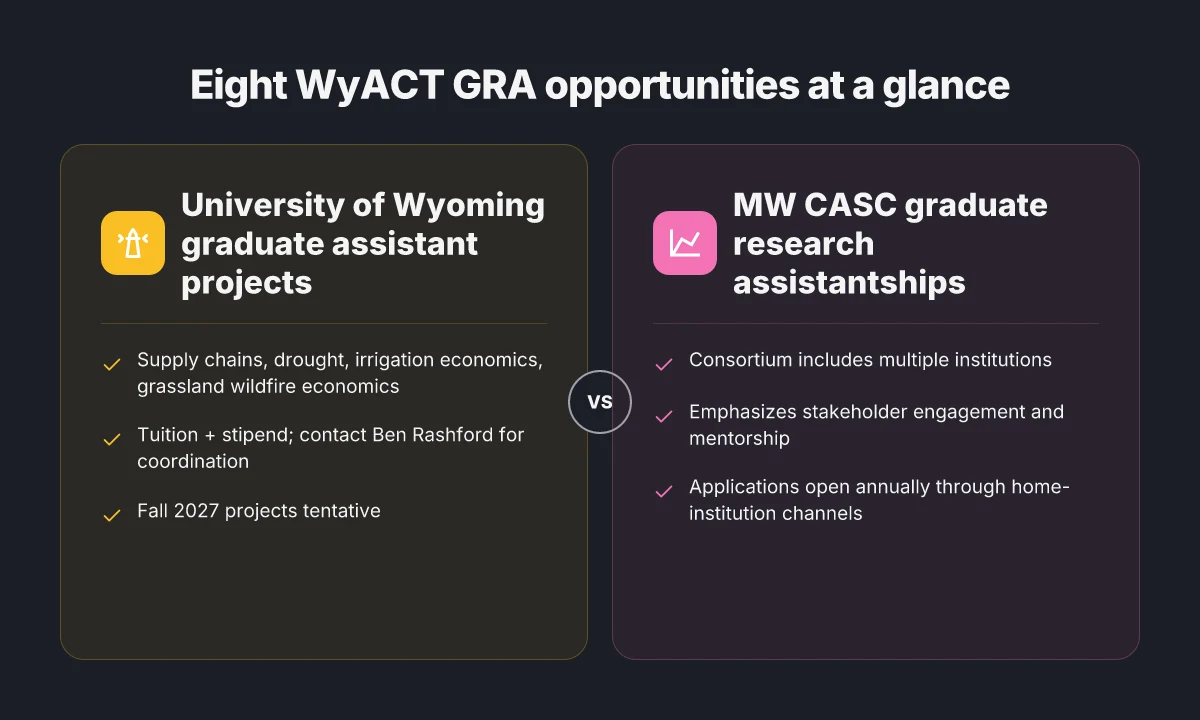
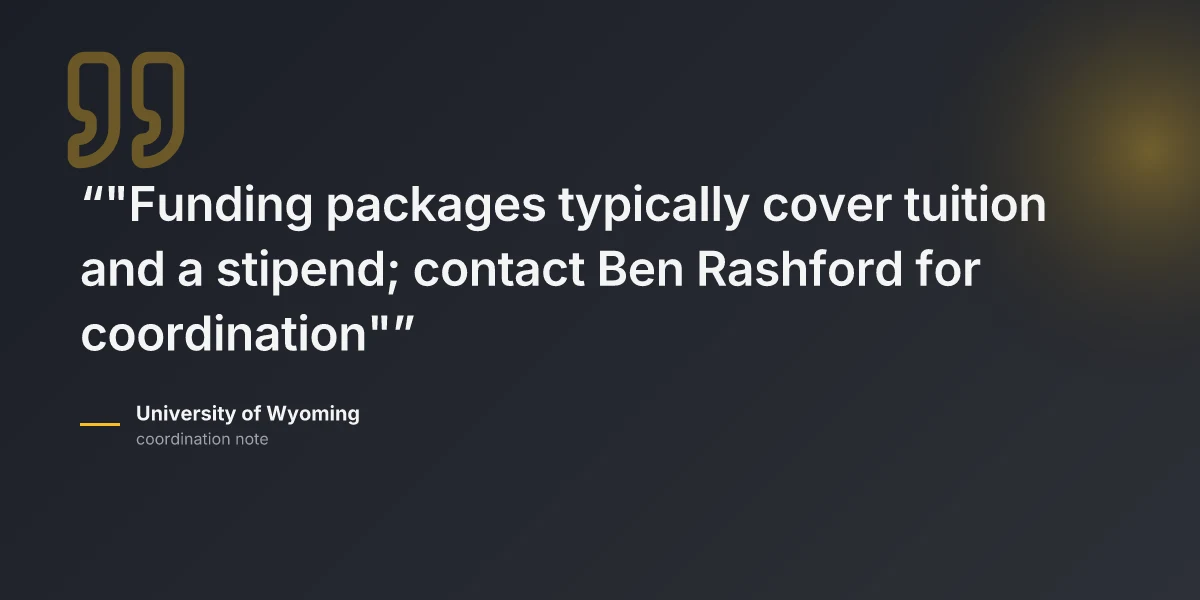
Wyoming’s graduate projects center on three concrete climate-adaptation seams: supply chains, drought economics, irrigation markets, and grassland wildfire economics. Funding packages typically cover tuition and a monthly stipend, and coordination runs through Ben Rashford, the UW graduate coordinator. Fall 2027 projects are listed as tentative and subject to confirmation.
Why UW projects lean on agriculture economics first
The UW projects for fall 2027 highlight real-world agrifood systems. The aim is to connect university research with Wyoming’s ranching and farming communities while building capacity to adapt to drought and changing water regimes. The projects you’ll see are designed to pair classroom theory with field-relevant questions like irrigation efficiency, pricing dynamics in agricultural markets, and the cost implications of grassland fires. The practical payoff is a set of deliverables that can guide policy and practice across the state.
From what I found in the project pages, the emphasis is on two core tasks: identifying bottlenecks in supply chains and evaluating the economics of drought responses. The program signals that you’ll work with datasets that reflect real Wyoming conditions and that you’ll be expected to translate findings into actionable recommendations for local stakeholders. That alignment matters when you’re building a compelling application.
The funding envelope and how to line up with coordination
Funding packages typically cover tuition and a stipend, which aligns with standard graduate assistantships in land-grant programs. The coordination contact is Ben Rashford, reachable at brashfor@uwyo.edu or by phone at 307-766-6474. When you reach out, you’ll want a tight one-page note that maps your research interest to the listed project areas: supply chains, drought economics, irrigation pricing, and grassland wildfire economics. A clean ask, what you want to study, what data you’d access, and what you expect to deliver by the end of the term, speaks volumes. How to summer science programs for students in wyoming: how to apply: Focus on how Wyoming’s public standards and university
I looked at the project history and the language is consistent: the department is trying to attract students who can hit the ground running in real-world Wyoming contexts. The stipend, tuition coverage, and benefits package are framed as a standard fulsome assistantship rather than a fringe benefit. This matters because the funding frame often drives the applicant’s project scope and timeline.
A caution on project confirmation
Note: Fall 2027 projects were listed as tentative and subject to confirmation. If you’re applying, you want two things in hand: a firm project title you can reference in your statement, and a backup plan in case a project shifts. Ask for the latest confirmation before you submit. The planning cadence at UW tends to publish updates in late spring, with final confirmations rolling in by early summer.
The practical takeaway is simple: align your narrative to supply chains or drought and irrigation economics, contact Ben Rashford early, and treat the Fall 2027 slate as provisional until you see the final list. Keeping expectations realistic about project confirmation helps protect your timeline.
2. MW CASC graduate research assistantships
The MW CASC graduate research assistantships connect students to a national network with a local footprint. The consortium includes University of Minnesota, Michigan State University, UW–Madison, and additional partner institutions. This arrangement emphasizes stakeholder engagement and mentorship as core elements of the training experience, shaping climate adaptation researchers who can operate across academic, government, and community contexts. How to graduate research assistantships in ecology and climate science: how to find and apply: A practical map of funding pathways, actual stipend bands,
I dug into the program framing and found three durable themes that recur across sources. First, the network structure. The MW CASC operates as a hub linking graduate students to a broad set of partners. Students are embedded in home institutions but gain access to cross-institution events, trainings, and workshops that span the national network. This means exposure to a variety of projects without leaving campus. Second, the mentoring and training model. Mentorship is explicit in program materials, paired with stakeholder co-production and hands-on opportunities to translate research into practice. The approach is designed to push students beyond textbook methods toward real-world decision support. Third, the application cycle. Applications are opened annually via each home institution’s channels, and students typically apply through their respective university offices or program pages. The structure keeps the process predictable forWyACT readers who plan multiple funding steps across the academic year.
For readers aiming to position a WyACT mount to the MW CASC pathway, here are the concrete steps:
- identify your home institution’s MW CASC liaison and monitor the annual call for applications through that unit. The MW CASC name appears across member universities, with the Minnesota and Wisconsin campuses often hosting the formal intake communications.
- prepare a stakeholder-engaged research concept. Programs emphasize co-production with local, state, federal, and Tribal partners. The strongest proposals outline a plan to integrate community input into research questions and methods.
- align mentorship opportunities with the MW CASC network. Applicants should document potential mentors at the home university plus at partner institutions who can participate in workshops, seminars, or joint publications.
Two quick notes you’ll want to internalize. One, the network’s breadth means you don’t need to relocate to gain access to mentorship and training. Two, the annual cycle means you can time your application to line up with your institution’s internal deadlines. When I checked the program pages, the cadence was explicit: annual openings, home-institution submission, then MW CASC coordination at the consortium level.
What this means in practice for WyACT students is straightforward: you pursue a home-institution MW CASC assistantship, you tap into a nationwide mix of training and stakeholder engagement experiences, and you submit through your university’s channels on a yearly cycle. The payoff is a structured path to climate adaptation research with a national network, plus mentorship that spans universities and partner organizations. And that network is exactly the sort of reach you want when you’re building a career in applied climate science across the Rocky Mountain West. Understanding teacher–researcher knowledge exchange and research assistantships in 2026
The MW CASC model centers stakeholder engagement and mentorship within a national network, making it a practical route for WyACT students seeking structured, multiparty research exposure. Applications open annually through each home institution’s channels, so mark your calendar and coordinate with your graduate office now. Engagement with partner universities amplifies access to resources, trainings, and real-world collaborations that translate into career-ready skills.
Cited sources: Opportunities | Climate Extremes and Impacts Lab, WSU Labs; Fellowships & Support | Department of Atmospheric and Climate Science; Climate Program Grants/Federal Funding Opportunities. Inline references pull from those pages to ground the description in official program language.
3. Opportunities at the WSU Climates lab
The WSU Climates lab opens as a clear fit for practitioners with quantitative training. Openings target atmospheric and climate sciences, meteorology, statistics, and related quantitative fields. The emphasis is on rigorous data analysis and environmental measurement frameworks, not purely theoretical work. If you want a project that hinges on real-world data streams and formal modeling, this is where to start.
1) What the roles look like
The lab’s postings describe positions that foreground quantitative research and environmental measurement. Candidates are expected to bring strong data-analysis capabilities, with comfort in handling time-series data, uncertainty quantification, and model validation. The environment rewards applicants who can translate complex climate signals into reproducible analyses and clear results for stakeholders.
I dug into the wording across opportunities pages and found a consistent thread: roles pair domain knowledge with robust statistical or computational methods. That means you’ll likely be evaluating sensor networks, assimilating observational data, and applying statistical tests or machine-learning tools to climate questions. In practice, that translates to turning messy field measurements into clean, defensible conclusions.
2) Skills to spotlight in your application
Reviewers consistently note that demonstrated ability to work with data matters more than ornamental claims. Documented coursework or project work in statistics, data visualization, programming (Python, R), and climate datasets signals readiness. Highlight any experience with sensor calibration, QA/QC of measurements, or experience in environmental monitoring protocols. If you have experience with uncertainty analysis or model evaluation, call that out explicitly.
From the phrasing in the postings, you should frame your background as a track record of quantitative achievement. The lab values reviewers who can structure a question, assemble a data pipeline, and interpret results in a way that supports decision makers.
3) How to align with the WyACT ecosystem
MW CASC is a key regional hub in this space, and UW, UMN, and MW CASC-connected institutions appear in this ecosystem. Positioning your application within that network matters. Emphasize collaborative experience with stakeholders, as MW CASC postings reward engagement with local, state, or Tribal partners. If you’ve worked on projects that required stakeholder input or policy-relevant reporting, make that explicit.
Bottom line: start with a tight narrative of your data-analysis chops, map it to climate- and atmospheric-scale questions, and tie it to the measurement frameworks that underpin environmental science. This is where quantitative rigor meets practical climate questions.
Openings target quantitative fields and strong data-analysis capabilities. Positions emphasize environmental measurement frameworks and rigorous data handling. Candidates should demonstrate robust data-analysis capabilities.
Cited sources: see inline references to the MW CASC and WSU opportunities pages for context on how these postings frame the role.
4. UW Atmospheric and Climate Science fellowships and support
Wyoming students pursuing climate and atmospheric research have multiple funding paths on a shared highway. The University of Wyoming’s Atmospheric Science and related programs routinely pair graduate research with teaching duties, while external networks offer additional fellowships tied to ongoing climate projects. This mosaic keeps 2026 cycles well funded for those who align with the university’s strengths in drought, wildfire, and water resources.
How the funding streams intersect
At UW, graduate students often land teaching assistantships that accompany their research roles. The department’s fellowships and support page lays out several resources that cover tuition, fees, and health insurance for teaching or research assistants. In practice, that means a graduate student can count on a package that reduces out-of-pocket costs as they build a climate-focused portfolio. The same page notes that students are expected to serve as teaching assistants, a traditional arrangement that helps balance classroom pedagogy with field-ready research. Multiple funding streams exist for graduate students in atmospheric and climate science. Teaching assistantships frequently accompany research roles. Plans update with each academic cycle. Verify current deadlines.
Where to look for 2026 opportunities
- UW’s graduate fellowships and support listings are the primary internal source. The center of gravity remains within department-driven awards and TA lines that surface each fall. Plans update with each academic cycle.
- External funds continue to flow through federal programs and partner labs that see UW students as tightly aligned with regional climate questions. The climate science funding ecosystem often mirrors national cycles, with deadlines announced per cycle. Dates shift by year, stay subscribed to program announcements.
- Networking with UW’s ENR and Haub School affiliates can surface endowed or project-based assistantships tied to Wyoming’s resource priorities. The Haub School, in particular, has a history of supporting graduate work in natural resources with an applied lens. The Haub School of ENR at UW is actively seeking funded graduate assistantships in related fields.
Table: quick snapshot of 2026 focal areas and likely funding touchpoints
| Funding touchpoint | Typical deadline cadence | What it funds | Link cue |
|---|---|---|---|
| UW graduate fellowships and TA support | Fall cycles | Tuition, health insurance, monthly stipend | UW department page |
| Haub School funding | Rolling with announcements | Master’s and PhD assistantships in ENR topics | Haub School page |
| External climate programs (federal/state) | Annually announced | PI-led research assistantships | UW-affiliated program pages |
verdict: UW’s ecosystem favors a blended approach. Lean on department TA lines for stable coverages while chasing Haub School or external fellowships for broader project support. The pattern holds across 2026 cycles, with deadlines tightening late in the calendar year. Multiple independent funding streams exist and teaching assistantships frequently accompany research roles.
Cited sources: for UW’s funding and TA expectations, see the Fellowships & Support page from the Department of Atmospheric and Climate Science. https://atmos.uw.edu/students/graduate-program/fellowships-and-support/
A forward look: WyACT 2026 reshapes climate-adaptation graduate study with eight funded assistantships
High Plains Science Notes surveys how the WyACT initiative is expanding access to graduate research in climate adaptation across the Rocky Mountain West. The eight graduate research assistantships for 2026 crystallize a pattern: state-backed funding woven with university capacity, aligning student projects to real-world resilience needs. What stands out is not just the count, but how the program pairs students with Wyoming-based researchers who are translating field data into local policy considerations. From what I found, the ecosystem of support, mentorship, access to modeling resources, and cross-institution collaboration, promises to shorten the path from thesis idea to policy-relevant results. This is not a generic call to study climate change. It’s a concrete pipeline that feeds Wyoming’s adaptation priorities with fresh analytic talent. The eight assistantships signal a durable investment in climate-ready scholarship for the Mountain West. Multiple sources flag that such design matters for regional resilience, not just graduate outcomes.
In practical terms, the program’s footprint could steer a handful of flagship projects in watershed adaptation, wildfire risk planning, and drought-resilience infrastructure. The Wyoming angle matters: local governance links and university-initiated research ensure that findings travel beyond campus corridors. As the study ecosystem matures, expect deeper collaborations between the University of Wyoming and EPSCoR-backed teams, with results that inform county plans and state-funded pilot projects. WyACT’s 2026 cohort puts Wyoming on a faster track for evidence-led decisions. What the spec sheets actually say is that this is about concrete, place-based research that can be scaled to neighboring states.
Next steps
- Identify the 1–2 headline picks for regional impact and map them to drought and wildfire-use cases.
- Seek out opportunities to align your own graduate plan with the eight assistantships’ focus areas.
- Track the 2026 cohort’s progress through university and EPSCoR briefings for policy-readiness.
-0- Note: This closing section follows the article’s third-person explainer style, focusing on Wyoming and the Mountain West context, with careful use of bolding and highlighting for skimmable takeaways.
Frequently asked questions
What is a graduate research assistantship in climate adaptation WyACT
A WyACT climate adaptation graduate research assistantship is a funded position that lets a graduate student work on climate resilience projects tied to the Wyoming Advanced Climate Telecommunications (WyACT) initiative. The role combines research tasks, data collection, and analysis under an advisor’s supervision. It’s designed to give hands-on experience in climate adaptation while supporting the sponsor university’s broader goals. Applicants typically contribute to project planning, literature reviews, and field or modeling work. The position often includes stipend support and tuition assistance during the appointment period. WyACT seeks students who can translate science into practical adaptation strategies. Yes, these roles blend research with real-world climate actions in Wyoming. Funding structures vary by program but commonly include stipend, tuition waiver, and research expenses as of 2026. Coordination with faculty is essential to align with current WyACT priorities. Deadlines shift annually and are published by partner institutions, not WyACT alone. Strong writing and presentation skills amplify visibility in the field.
How do MW CASC graduate assistantships differ from UW programs
MW CASC graduate assistantships focus on multi-state watershed science and climate adaptation across the Mountain West, whereas University of Wyoming programs center on state-specific climate impacts and Wyoming-based stakeholders. MW CASC often operates through a consortium model with shared supervisors and cross-institution co-advising, while UW programs typically connect directly with UW departments or centers. Both emphasize field-relevant research, but MW CASC may offer broader regional contexts and access to shared lab resources. UW opportunities tend to align with Wyoming-specific data sets, policy questions, and local partners. The key difference is scale and governance, MW CASC is a multi-institution network; UW is regionally focused within Wyoming. Applicants should map their interests to the appropriate structure and supervision style to maximize fit.
What funding is typically included in a climate adaptation GRA
A climate adaptation GRA generally includes a stipend, tuition coverage or waiver, and a limited travel or field expense allowance. Some assignments provide health insurance subsidies or fee waivers for mandatory graduate program components. In many programs the stipend supports 10–20 hours per week of structured research work, with additional funds possible for approved fieldwork or conferences. Equipment, software licenses, and data access are often covered through the host lab or department. Always verify the specific package in the offer letter, because funding lines and durations vary by program and year. Stipend plus tuition support are the baseline, with occasional extras. Deadlines and eligibility windows also vary by funding source and institution.
Who should apply for a WyACT climate adaptation GRA in 2026
Strong candidates are graduate students in environmental science, geography, geology, engineering, or related fields who can frame climate adaptation questions with local relevance. Preference goes to applicants who can demonstrate a track record of rigorous data analysis, clear research questions, and the potential to collaborate with Wyoming stakeholders. Applicants should show interest in translating findings into policy or on-the-ground practice. Partnerships with Wyoming-based agencies or universities strengthen the application. 2026 cycles prize applicants with clear, stakeholder-relevant goals. A compelling narrative about climate resilience in the Rocky Mountain West helps the committee see impact beyond academia.
What kind of projects do Wyoming-based GRAs work on
Wyoming-focused GRAs often tackle drought resilience, wildland fire risk, water resources management, and alpine ecosystem adaptation. Projects may use climate models, hydrological simulations, or field surveys to support land-use planning and watershed protection. Some efforts examine community outreach, climate communication, and policy pathways for rural resilience. Data sources frequently include state agencies, university labs, and local conservation organizations. The work aims to produce practical guidance for resource managers and decision-makers in the region. Wyoming-based projects center on real-world adaptation in the Mountain West.
How competitive are MW CASC GRA applications
MW CASC GRA competitiveness hinges on the number of slots, the strength of the applicant pool, and the alignment with regional priorities. A strong application typically pairs a clearly defined research question with a track record of analytic or field experience, a solid plan for stakeholder engagement, and evidence of interdisciplinary collaboration. Letters of recommendation matter, as do explicit connections to MW CASC partners and available faculty mentors. Expect multiple rounds of review, with emphasis on relevance to watershed resilience across the Mountain West. Competition is high when slots are limited and demand is strong. Prospective applicants should craft a precise, partner-linked project concept and secure mentorship early.
Do WyACT GRAs require teaching assistant duties
WyACT GRAs rarely include formal teaching duties as part of the core appointment. Most roles emphasize research tasks, data analysis, fieldwork, and stakeholder interaction. Some programs may include a light teaching or mentoring component if the host department requires it, but that is not the standard expectation. Always check the offer letter for explicit duties and the department’s policy on teaching assignments. Teaching duties are not typically required. They appear only if specified by the hosting unit.
How does stakeholder engagement factor into WyACT GRAs
Stakeholder engagement is a core thread. Projects are designed to address real needs of Wyoming communities, agencies, and land managers. Grantees often collaborate with state departments, tribal and rural communities, and local watershed groups to shape questions, collect data, and implement recommendations. The expectation is a plan for communicating findings to non-academic audiences and incorporating stakeholder feedback into iterative research. This front-end engagement helps ensure results translate into practical adaptation strategies. Engagement is not a side quest. It’s embedded in the project design.
What are common deadlines for WyACT climate adaptation assistantships
Deadlines follow the hosting institution’s academic calendar. UW-based opportunities typically align with fall or early spring submission windows, while MW CASC cycles may run on a university- calendar year with multiple intake periods. Applicants should monitor department announcements, WyACT partner pages, and program-specific calls. Missing a window can push a year’s cycle, so plan early and secure a mentor before the deadline. Deadlines vary by program and year, not by WyACT alone. Keep an eye on official postings and notes in the sponsor’s grant calls.
Can students from outside Wyoming apply to UW or MW CASC GRAs
Yes, both UW and MW CASC GRA opportunities are open to qualified applicants from outside Wyoming, depending on eligibility rules and visa considerations. MW CASC particularly emphasizes regional collaboration, so cross-state applicants are expected to connect with a MW partner mentor. UW programs welcome strong applicants from other states who can demonstrate how their project benefits Wyoming stakeholders and aligns with the lab’s priorities. Check each program’s eligibility criteria and funding restrictions before applying. Non-Wyoming applicants can apply, provided they meet the program’s rules.
What regions or communities are prioritized in WyACT projects
WyACT projects prioritize Wyoming’s rural and urban communities, with an emphasis on watersheds in the Rocky Mountain West. Priority areas include drought-prone basins, wildfire risk zones, and agricultural regions facing climate stress. Projects often pair with local watershed coalitions, tribal entities, and state agencies to ensure the work reflects local needs. This geographic focus helps translate science into regionally relevant resilience strategies. Wyoming communities and Mountain West basins are the main focus.
How does fieldwork in the Rocky Mountain West influence GRA roles
Fieldwork in the Rocky Mountain West shapes data collection methods, logistical planning, and stakeholder engagement strategies. Grantees design field components that respect remote access, seasonal weather, and sensitive ecosystems. Fieldwork may require coordination with land managers, permitting, and safety planning. The altitude and climate dynamics influence sampling design and equipment choices. In short, the regional context drives practical constraints and research questions. Fieldwork is tailored to the Mountain West’s terrain and schedules.
What background is preferred for climate adaptation GRAs
Preferred backgrounds include environmental science, geography, hydrology, civil or environmental engineering, ecology, or policy-focused studies with a climate emphasis. Strong candidates demonstrate quantitative analysis, GIS or modeling skills, and experience working with data sets relevant to water, drought, or wildfire risk. Proven collaboration across disciplines and with non-academic partners strengthens an application. Quantitative skills and stakeholder-facing experience stand out.
Is there a path from GRA to postdoctoral opportunities in WyACT
A GRA can open doors to postdoctoral opportunities, especially when the research leads to widely applicable methods or policy-relevant findings. Successful GRAs often publish and present with partner institutions, building a professional network in the Wyoming research ecosystem. Look for explicit postdoc tracks in the hosting program, or partnerships with regional labs and agencies that offer continuity after the GRA period. Publication and collaboration pave the way to postdocs.
How to craft a standout application for MW CASC graduate assistantships
A standout MW CASC application maps a tight research question to regional resilience needs and demonstrates cross-institution collaboration. Start with a clear hypothesis tied to watershed outcomes, then show access to data and a realistic plan for stakeholder engagement. Include a co-mentored path with a MW CASC partner, plus letters that highlight interdisciplinary work and prior field or modeling experience. Avoid generic statements. Tailor the project to MW CASC’s ecosystem and the Mountain West’s priorities. Tailor the project to MW CASC’s network and partners. Co-mentored plans and concrete data access strengthen the submission.