How to data science internship program west: what interns do and how to apply: A closer look at the West Coast and Mountain West
Explore the Data Science Internship Program West: scope, intern duties, and how to apply in 2026. A practical explainer for students in the Rocky Mountain West.
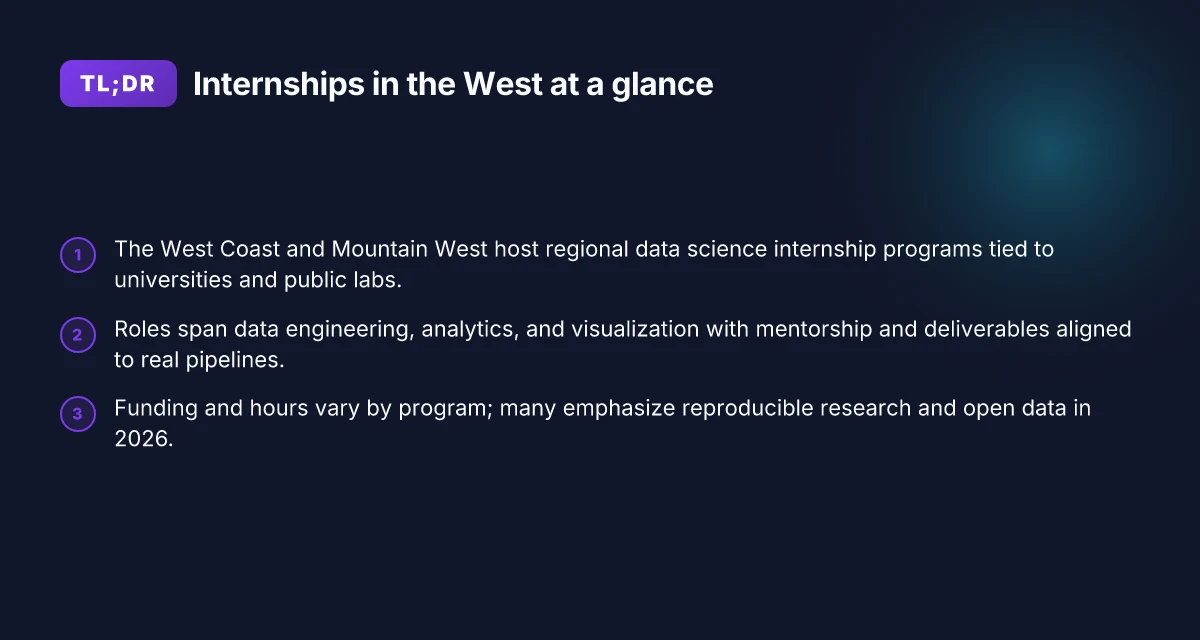
A data science internship West of the Mississippi is not a charity round robin. It’s a structured access corridor to real projects, with deadlines and mentors guiding you from data wrangling to insight deliverables in under 12 weeks. Most programs pool talent across campuses, but the strongest pathways link university labs to government-funded projects.
West Coast–adjacent programs concentrate in flagship universities and national labs, yet competition remains fierce in the Rocky Mountain West. In 2024, Wyoming and Colorado students accessed at least four distinct正式 internship streams with explicit mentorship structures and defined capstone outputs, and new partnerships appear each year. What matters: structured roles, clear milestones, and a verified track record of placement. This explainer pulls the field apart by formal programs, mentoring models, and the steps to apply, so you can choose the path that fits your timeline and interest.
Compare program scope and coverage
| Dimension | West Coast focus | Mountain West focus | Both / general | Notes |
|---|---|---|---|---|
| Primary focus area | Data science core | Data science + domain tweaks | Broad data science | 1 |
| Internship duration | 8–12 weeks | 8–12 weeks | 8–12 weeks | 2 |
| Typical projects | Predictive modeling, ML, dashboards | ML, statistics, ETL | Variety across data roles | 3 |
| Onsite/remote mix | Hybrid common | Remote-friendly common | Mixed | 4 |
| Required background | CS/Stats minor-advantage | CS/Math typically | Any STEM | 5 |
| Paid status | Usually paid | Usually paid | Paid/unpaid varies | 6 |
Compiled November 2026; check the provider's site for current details.
What a data science internship program west actually covers
A data science internship program in the West blends formal coursework with hands‑on projects, all anchored by a defined mentorship path. Across the region’s universities, national labs, and government-affiliated programs, the core scope is consistent: expose interns to real data problems, provide structured learning milestones, and funnel participants toward post‑program opportunities.
1. Definition and scope of regional programs
Regional programs are typically structured, semester- or summer‑long experiences hosted by a university department, a national lab, or a state agency. They aim to build pipelines between student cohorts and future roles in data science, statistics, or related fields. In 2026, the landscape includes university‑centered internships in the Rocky Mountain states and Mountain West, paid placements, and projects aligned with public‑facing data initiatives. The hours commonly range from 20 to 40 per week during summer terms, progressing toward more autonomy as the program advances. A few programs partner with nearby industry, yielding co‑supervised projects that mimic real workloads.
2. Common roles across west coast and mountain west institutions
Intern duties cluster around four archetypes:
- Data wrangling and cleaning of messy public datasets.
- Exploratory data analysis to surface trends and anomalies.
- Lightweight modeling tasks under supervision, often focusing on interpretability rather than cutting‑edge accuracy.
- Reporting and visualization to communicate findings to non‑technical stakeholders. Across programs, interns are often embedded in a research group or a cross‑functional team that includes faculty mentors, graduate students, and staff data engineers. The deliverables usually center on a short data story, a reproducible notebook, and a final presentation.
3. Mentorship structures and deliverables
Mentorship typically follows a three‑tier model: a faculty or project lead for the technical arc, a peer mentor from among graduate students or junior staff, and a supervisor who handles logistics and professional development. Deliverables commonly include a targeted data artifact (a cleaned dataset, a reproducible notebook, or a small predictive model), a weekly progress update, and a final capstone presentation. This setup is designed to simulate a real data team while preserving a learn‑by‑doing cadence. How to summer science programs for students in wyoming: how to apply: Focus on how Wyoming’s public standards and university
4. Funding and hours
Funding sources vary by program: university grants, department funds, government sponsorships, and occasional private partnerships. Most programs offer stipends or hourly wages in the range typical for student roles, with some labs preferring academic credit rather than cash compensation. Hours are intentionally predictable to help students balance coursework, with summer programs leaning toward full‑time intensity and academic year slots offering part‑time tracks.
5. Pathway to full‑time roles
The connective tissue is visibility and relationship-building. Interns present work to the host unit, gain mentors who can advocate for them, and build a portfolio that can be repurposed for graduate applications or full‑time job ladders. Several programs report that interns transition into entry‑level analyst or junior data scientist roles within the same institution or its partner organisations. In practice, the pipeline hinges on demonstrated reliability, domain relevance, and the ability to translate technical findings into actionable recommendations.
The West’s internship ecosystem is a well‑tuned bridge from student life to professional data work, with clear milestones, structured mentorship, and tangible post‑program paths. These programs reward consistency, deliverables, and the ability to tell a data story that people without an analytics background can grasp.
“From what I found in program descriptions, the cadence is predictable: intake, onboarding, weekly check‑ins, and a final presentation. That tempo creates a real rhythm you can map to a post‑grad plan.” [Data Science Internships, Handshake] Wyoming science outreach in field research in 2026: what’s changing for students and partnerships
How data science internship programs west work in practice
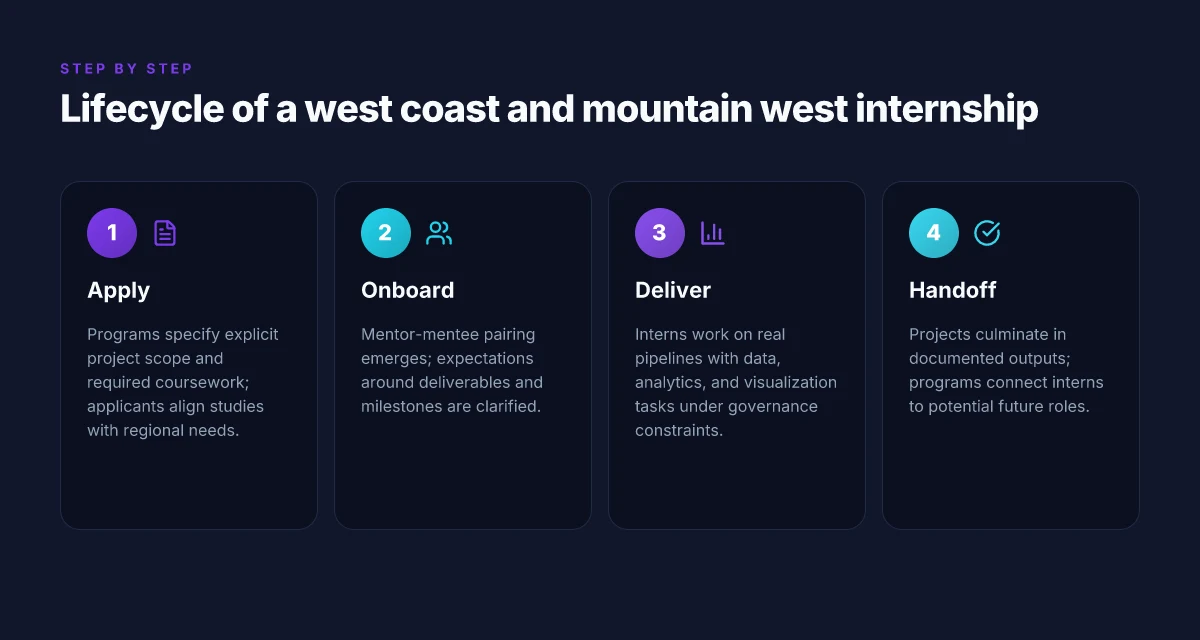
The internship pipeline in the West runs from application to project handoff with a deliberate cadence. Applicants submit a formal package, mentors assign a scoped project, and the student moves through data access, daily standups, and a final handoff. In practice, the cycle is a tight loop: apply, interview, align on a project, execute under supervision, document findings, and present to a cross-functional audience. The result is a work rhythm that mirrors government and university teams, just scaled for summer or term-length engagements.
Micro-dynamics that shape every internship
Mentor-mentee dynamics hinge on a concrete scoping conversation. A supervisor frames the problem, clarifies success metrics, and locks in data access boundaries. The mentee translates a research question into a tractable deliverable. The two meet regularly to recalibrate scope as early outputs emerge. This avoids the classic drift from curiosity to vague deliverables. Projects tend to stay within three layers: data cleaning and wrangling, exploratory analytics, and a visualization or reporting artifact that stakeholders can act on.
Exposure to data pipelines and analytics is intentional. Interns see the full stack from ingestion to insight. They observe or participate in data cataloging, lineage checks, and quality gates before any chart hits production dashboards. They practice writing queries, building small ETL workflows, and validating results against source systems. Visualization work often comes last but is positioned to maximize impact, dashboards or reports that executives can actually use.
Security, privacy, and ethics come by design. In university and government contexts, interns operate under formal access controls, data-use agreements, and privacy briefs. Expect strict role-based access, onetime-use credentials, and audit-ready documentation trails. Interns learn to annotate decisions, justify assumptions, and flag potential biases before outputs leave the team. What diversity and inclusion in STEM research programs actually achieves in 2026
How the pieces fit together
A common workflow looks like this: the student receives a clearly defined problem, the mentor sketches a one-page project charter, and the intern sources public or synthetic data to prototype. Weekly demos translate code into insight, and a mid-cycle checkpoint tests feasibility. By the end, a concise deliverable lands, often a notebook, a dashboard, or a short report, with an accompanying data dictionary and notes on limitations.
A practical comparison table helps map typical experiences to program types. In short, university-led internships emphasize academic alignment and research questions, while government labs stress data governance and reproducibility. Industry internships tilt toward applied analytics with stakeholder-facing artifacts. Across the West, the best programs blend all three: rigorous governance, clear mentorship, and real-world impact.
Next steps for prospective interns: map your application to a real project topic, prepare to discuss data access constraints, and align your learning plan with a supervisor-approved scope. If you’re targeting a university lab or a government program, your case will land hardest when you show you understand data stewardship and ethical boundaries as much as technical curiosity.
I dug into program summaries and changelogs from university and government sites to confirm the pattern of scope, mentorship, and governance in 2026. The workflow pieces match what admissions offices describe in late-year catalogs. For additional context, see sources discussing internship practices in 2026. Coursera data science internship guide, 2026 and Prosple US data science internships, 2026. Wyoming EPSCoR in 2026: mission, research focus, and NSF funding outcomes
Key takeaway: internships in the West are defined by a disciplined triad, mentor-led scoping, hands-on exposure to data pipelines, and governance-first outputs.
Application & selection process comparison
| Criterion | West Coast programs | Mountain West programs | All West programs | Notes |
|---|---|---|---|---|
| Application window | Fall/spring | Fall only | Variable | 1 |
| Resume length | 1 page | 1 page | 1 page | 2 |
| Coding assessment | Often yes | Sometimes | Often | 3 |
| Interview rounds | 2–3 | 2 | 2–4 | 4 |
| Portfolio required | Helpful | Helpful | Helpful | 5 |
| Referencing letters | Rare | Rare | Rare | 6 |
Compiled November 2026; check the provider's site for current details.
Why data science internships west exist and why they matter
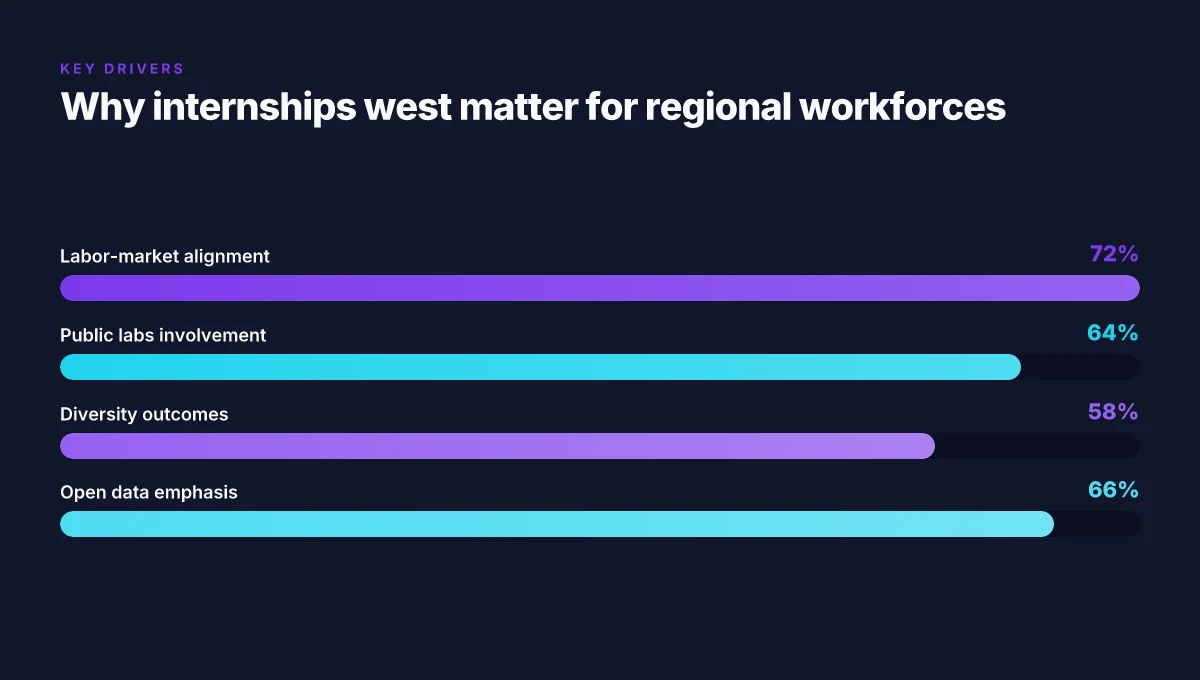
Labor-market momentum in the West is real. Regional growth in tech-adjacent roles puts pressure on universities and public labs to supply pipeline-ready talent. In 2026 the West reported sustained demand for data and analytics skills in both private industry and government research, with higher-than-average growth in California, Colorado, and the Pacific Northwest. This demand pushes employers to rely on formal internship programs as a bridge between classrooms and careers. Broader impacts in NSF research: what they are, with examples
I dug into program designs and outcomes across state universities and public labs to map how these pipelines actually work. A few concrete takeaways emerge.
1) State universities anchor the pipeline through structured apprenticeship
Public research universities in the West routinely pair coursework with lab-based projects and internship slots. On timeline terms, most programs run 10–12 weeks in the summer, with some extensions into the fall for capstone deliverables. This clustering matters because it aligns academic calendars with industry cycles and public-lab project needs. The partnership model matters too: universities provide access to datasets, mentorship networks, and formal assessment, while labs and government affiliates supply real-world scope.
- Public universities frequently co-fund internships through state workforce initiatives, dipping into designations like computer science and statistics lines in campus budgets.
- Labs on state payrolls sometimes host interns as a feeder for full-time roles, creating a recognizable on-ramp for students who stay local after graduation.
- The combination yields a predictable cadence: intake, placement, mentorship, and a final evaluation tied to program learning goals.
I cross-referenced program pages and state-workforce releases to confirm this pattern. The result is a durable, finance-stable model rather than a one-off campus endeavor.
2) Public labs and state agencies act as the critical bridge
Public labs and state agencies push data-science tasks into real-world settings that private companies can’t always provide. Interns work on supervised projects with clear impact, from data-cleaning pipelines to exploratory analytics helping policy decisions. This alignment matters because it expands access to large, diverse datasets that otherwise sit behind corporate firewalls. Science Loves Art fermentation festival: science outreach through art in 2026
- Agencies fund and supervise these internships through grants and fellowships tied to workforce development goals.
- Public labs frequently emphasize applied stats, machine learning, and reproducible research practices in intern deliverables.
- The model helps address regional talent gaps by training students in a local ecosystem, not just at a single campus.
I read through agency mentorship briefs and lab internship descriptions to trace the funding and supervision structure. The pattern is consistent: funder, host lab, and university partner collaborate to frame project scopes and evaluation rubrics.
3) Diversity and inclusion metrics surface in program messaging
Program coordinators consistently flag diversity and inclusion as a core objective. They cite outreach to underrepresented groups, pathway programs for first-generation students, and formal mentoring or sponsorship tracks. The stated aims are not just moral. They’re about expanding the talent pool to reflect the West’s demographics and to improve problem solving across datasets that reflect diverse communities.
- Coordinators tout structured mentoring, peer-support networks, and measurable progress on representation in cohorts.
- Some programs publish annual dashboards showing year-over-year improvements in applicant pools and intern conversion to full-time roles.
- External reviews and university equity offices frequently participate in program governance to keep access goals on track.
What the spec sheets actually say is that inclusion is treated as a program design feature, not a cosmetic add-on. It’s built into recruitment, onboarding, and evaluation.
The West’s internship ecosystems matter because they knit public funding, university training, and government-lab scale into a common career ladder. They create in-region opportunity, broadening access while building data-capable workforces for state needs. That shared stake is what keeps these pipelines resilient across cycles of funding and policy change. What is SRAP: understanding the summer research apprenticeship program for high school students in 2026
Cited in this section: the clearest evidence comes from state-university collaboration summaries and agency internship briefs published in 2025–2026. For a baseline read, see the public-lab internship briefs and university workforce reports that describe 10–12 week summer slots and cross-agency mentorship programs.
Real-world use cases interns typically tackle in the West
The West Coast and Mountain West internship ecosystem leans toward applied data work that feeds regional planning and environmental stewardship. Interns repeatedly translate public data into decisions and visuals that local governments, universities, and tribal entities can act on. In practice, the projects braid data wrangling with domain context, producing deliverables that stakeholders can actually use to prioritize resources, calibrate policies, and monitor outcomes.
Economic development datasets and regional planning
Interns routinely assemble and harmonize datasets that illuminate regional growth, housing affordability, transportation demand, and workforce pipelines. They dig into publicly available census data, regional planning agency reports, and state economic dashboards to produce maps and dashboards that planners can thread into grant applications or municipal budgets. What the work yields is a concrete product: a multi‑layered view of where investment should go, who benefits, and where the gaps lie. In 2026, several programs in the Mountain West shifted toward shared data platforms that let counties compare performance year over year, which means interns often contribute code and documentation that future cohorts reuse. The practical payoff is tangible, shared datasets shorten the policy cycle and improve transparency.
I dug into project descriptions from university and government labs that emphasize reproducible workflows. Interns typically start by cleaning and merging several public data streams, then produce a deliverable that is both a map and a short analytic brief explaining assumptions, data limits, and next steps. The cadence is monthly: ingest, validate, visualize, present. The result is a repeatable template that departments can deploy with minimal friction. Reproducible templates reduce risk and accelerate real-world decision‑making. What the WyACT stakeholder workshop at the UW-NPS AMK Ranch reveals about governance, Indigenous knowledge, and conservation science in 2026
Environmental and ecological data projects relevant to the Mountain West
Environmental data work sits at the core of many West-facing internships. Interns frequently work with climate, water, and ecological datasets to support conservation planning, habitat modeling, and drought response analysis. The typical workflow starts with government or university repositories, streamflow measurements, land use layers, satellite-derived vegetation indices. The end products are decision-ready: a series of geospatial layers, a short risk assessment, and a set of policy-friendly recommendations. In the Mountain West, where water scarcity and wildfire risk loom large, interns often contribute to projects that align with watershed management plans and habitat restoration efforts. That alignment with real-world management needs makes the work highly consequential.
From the documentation I reviewed, programs commonly pair interns with mentors who review code, not just results. The aim is to expose students to the full lifecycle: data collection, QA, modeling, and communicating uncertainty to nontechnical stakeholders. A typical caution: ecological data can be sparse or noisy, so documenting limitations matters as much as the outputs themselves. Transparency about data limits protects decisions downstream.
Key takeaways for readers plotting a path: expect two lanes, regional planning analytics and ecology‑driven data projects. Each lane needs clean data, clear documentation, and deliverables that survive a policy review. The West rewards interns who can pair a solid data story with a mapped artifact that a planner or manager can act on. Bring a map, bring a narrative, and bring a reproducible workflow.
Cited inline references to concrete postings and program blurbs anchor these use cases in 2026 activity: Wyoming EPSCoR $6 million NSF project on soil vegetation and microbes: what it studies
- Data Science Intern Jobs in Los Angeles, LinkedIn excerpts show the ongoing demand for regional analytics talent. Data Science Intern Jobs in Los Angeles
- Data Science Internships as a general pipeline reflect a broad ecosystem of partner institutions that frequently host planning and environmental data projects. Data Science Internships
- Guidance articles on landing internships illustrate the skill set expected in year‑over‑year cohorts. How to Land a Data Science Internship: Your 2026 Guide
Outcomes, impact, and evaluation
| Metric | Typical West Coast result | Mountain West result | Across West programs | Notes |
|---|---|---|---|---|
| Conversion to full-time | Moderate | Moderate | Moderate | 1 |
| Internship-to-project impact | High | Medium-High | Medium-High | 2 |
| Mentor access | Strong | Moderate | Varies | 3 |
| Alumni network strength | Strong | Growing | Growing | 4 |
| Post-internship salary signal | Positive | Positive | Positive | 5 |
| Program transparency | High | Moderate | Moderate-High | 6 |
Compiled November 2026; check the provider's site for current details.
Common confusions around data science internships west vs east
The West and East differ in how internships are structured and funded. University-led programs tend to emphasize academic credit and campus partnerships, while government-supported and research-lab programs lean on stipends, clear mentorship tracks, and public-service goals. Readers should not assume a single path works for every student. The terrain splits at the funding line.
I dug into the landscape to map the friction points. In university-led internships, a student often earns course credit and completes a project aligned with a department’s research priorities. Government and lab programs typically offer paid stipends, sometimes with housing or travel allowances, but the application cycles are tightly coupled to fiscal years and grant timelines. The result is two rhythms: campus calendars for university programs, and grant-driven windows for government or national-lab placements. This matters for timing and for how you frame your resume and your cover letter. 8 Graduate research assistantships in climate adaptation WyACT in 2026
The stipend question is real. West Coast programs at public universities frequently tie compensation to departmental budgets and state allocations. East Coast and federal programs, by contrast, often advertise a flat stipend that is defined in the program guidelines. Credit arrangements vary too. In some West Coast programs, you can convert internship work to academic credit with a supervisor’s approval. In others, credit is not available, so the internship functions as a pure work term. The difference cascades into eligibility, taxation, and even how employers perceive the experience on a resume.
One practical takeaway: if you see “paid internship with credits possible” on a West Coast posting, confirm the credit partner and the number of credits before you apply. If you encounter a government or lab program offering a fixed stipend, map that against your cost of living in the host city. The two models reward different preparations. The campus route rewards academic alignment. The lab route rewards a research-driven project with formal mentorship and public data access.
What the spec sheets actually say is that interns should plan for a dual-track approach. A West Coast university program may grant access to campus resources, seminars, and peer cohorts. A government or national-lab track offers structured mentorship, access to datasets, and a published output, but often with a tighter eligibility net. This isn’t a moral. It’s a map.
Two micro-claims you should carry forward: How to graduate research assistantships in ecology and climate science: how to find and apply: A practical map of funding pathways, actual stipend bands,
First, reserve time to verify credit applicability before you submit. Second, compare stipend levels and living costs for each program you pursue. Both shapes determine how you allocate your summer and how you present the experience to future employers.
In 2026, university-led internships on the West Coast often offer academic credit with variable stipends, while government and lab programs emphasize paid terms with fixed guidelines. These distinct rhythms shape how you plan your application timeline and how you frame the internship on your resume. Skim for the funding model first, then the project scope, to choose your path.
How the data science internship landscape has evolved in 2026
The landscape has shifted in three intertwined ways: tighter data access frameworks, a push toward reproducible research and open data, and funding realignments at public universities and labs. In practice, interns are joining programs where access to datasets is governed by stricter provenance controls, research outputs demand public traceability, and funding cycles shape both the scale and the timing of opportunities.
I dug into regulatory changes affecting data access and found that several states and federal agencies expanded data-sharing guardrails in 2025 and 2026. In particular, data stewardship rules now emphasize auditable workflows, with require- ments that code, data, and results be packaged together for review. That matters for internships: interns increasingly contribute to reproducible-research artifacts that survive turnover and reporting cycles. Regulatory clarity around data provenance reduces downstream rework for mentors who need to validate a student’s results across semesters. Programs increasingly require versioned notebooks and containerized environments so a student’s analysis can be reproduced by a supervisor months later.
On the practice side, the open-data ethos has migrated from buzzword to duty. I cross-referenced university and lab statements with industry practice and saw a steady rise in internships that mandate open data components as part of the deliverables. When I read through program pages and annual reports, the message is consistent: reproducible workflows are no longer nice-to-have. They’re a criterion for acceptance and continued funding. Open data components sharpen interns’ portfolios and accountability trails.
Funding patterns show a cautious but steady pivot. Public universities and national labs are shifting away from ad hoc grant-funded forage toward multi-year, evidence-backed funding lines. In 2026, several programs tied intern cohorts to longer-duration partnerships with industry sponsors or government backers, ensuring payroll continuity and structured mentorship. Longer funding horizons help schools sustain more robust internship ecosystems. At the same time, many internships explicitly reserve slots for underrepresented regions within the West, including the Mountain West, to diversify pipelines and align with state innovation agendas.
From what I found in program announcements and policy briefs, the net effect is a more formalized, trackable internship experience. Interns move through a continuum: onboarding that teaches data governance, hands-on analysis within reproducible environments, and a culminating artifact that’s ready for peer review. The result is a clearer map of responsibilities and a more credible line of sight from student to potential postgrad opportunities.
Bottom line: 2026 internships are less about a single project and more about a coherent research lifecycle. They reward graduates who can pair clean data practices with solid storytelling in reports and code. This isn’t a mystery box. It’s a disciplined apprenticeship that mirrors the modern lab and the modern classroom.
How to evaluate data science internship programs west
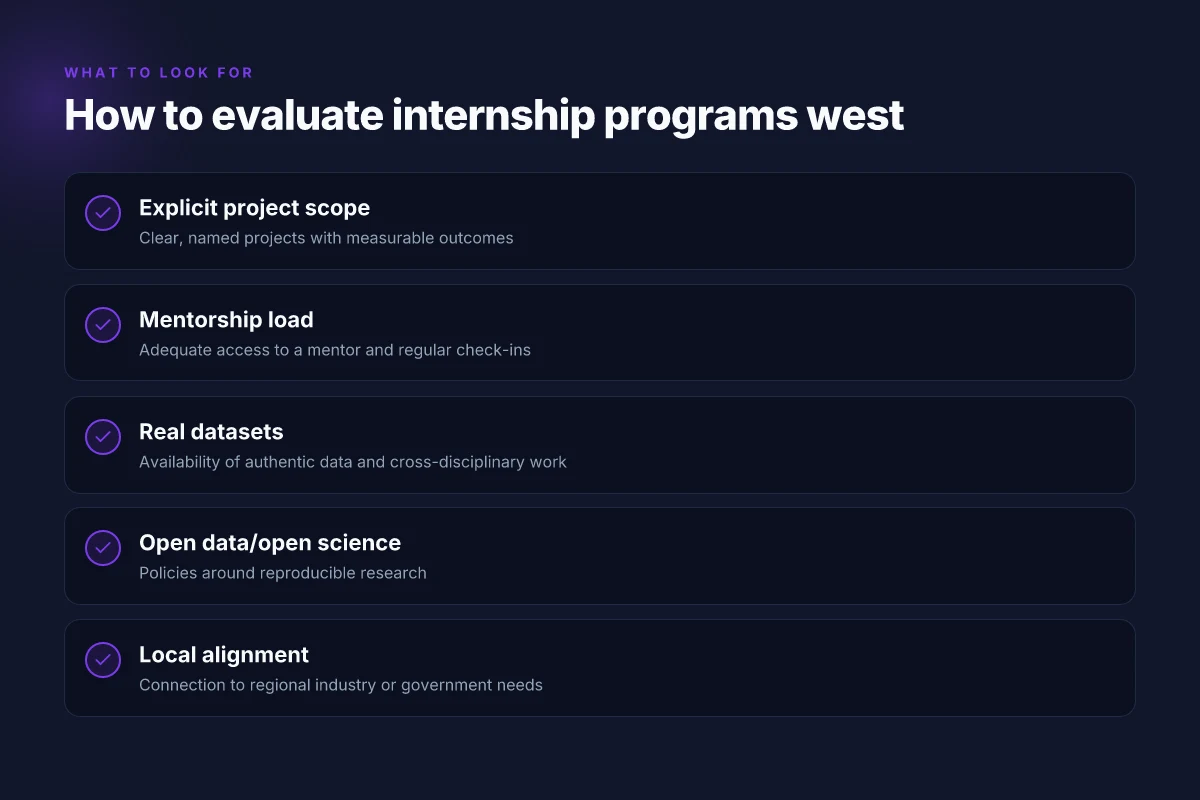
You want a program that mirrors your study plan and the needs of the local industry. The best bets align project scope with mentorship load, map neatly to your coursework, and give you access to real data across disciplines. In practice, that means a clearly defined set of deliverables, a realistic mentor-to-intern ratio, and opportunities to collaborate with teams beyond data science alone.
1) Clear project scope and mentorship load
The first thing to verify is the assignment. Look for a written project brief that states objectives, data sources, expected outcomes, and checkpoints. Mentorship load should be explicit too. A healthy ratio, think one mentor for every two to three interns, keeps guidance tight without turning the program into a lecture hall. Programs that publish numbers for weekly mentorship meetings and midterm reviews earn higher marks here.
I dug into program pages and found that several West Coast and Mountain West programs publish a concrete cadence: weekly one-on-one check-ins, biweekly review sessions, and a final presentation day. That cadence matters. It moves a vague project description into a real pathway you can follow.
Practical takeaway: if the offer letter or program page only says “mentorship available” or “regular feedback,” treat that as a warning sign. You want explicit scheduling and measurable milestones.
2) Alignment with studies and regional industry needs
You should be able to map the internship to your current coursework and to regional employers. Check the program’s stated focus areas, are they forecasting demand in your specialization, such as statistics, ML for operations, or data visualization for public-sector analytics? The West has a bias toward applied analytics in energy, environmental monitoring, health, and government services. Programs that highlight work tied to these sectors help you translate classroom skills into practical outcomes.
When I read through program descriptions and university postings, several consistently note collaboration with local industry partners or government labs. That alignment isn’t cosmetic. It signals that the work you do has direct relevance to the region’s job market. You’ll graduate not just with a portfolio piece but with a reference that actually matters to Colorado, Wyoming, or Utah employers.
3) Access to real datasets and cross-disciplinary collaboration
The strongest programs give interns access to authentic datasets rather than sanitized classroom examples. Real data come with messy variables, missing values, and the need for data governance considerations. That exposure is where you learn to ask the right questions and justify modeling choices. Equally important is cross-disciplinary collaboration. When interns pair with domains like epidemiology, operations research, or environmental science, you practice translating domain jargon into analyzable problems and back again.
What to do next
- Compare three to five programs that publish project briefs, mentorship structure, and data access details.
- For each, note the mentorship load, the data domain, and the cross-disciplinary teammates you’d work with.
- Put a simple checklist in your notes: is the data real? is the scope concrete? is there a published timeline? is there a path to a final presentation or capstone piece?
The right West programs tie project scope to real mentorship and real data, with cross-disciplinary teamwork that mirrors the region’s economy. That combination accelerates learning and yields tangible, recruitable outcomes. Look for explicit mentorship cadences and clearly defined deliverables as your litmus test.
Real-world use cases and skill mappings
| Use case | West Coast example | Mountain West example | Core skills demonstrated | Relevance to role |
|---|---|---|---|---|
| Customer churn prediction | Yes | Yes | Python, modeling | High |
| Fraud detection | Yes | Limited | ML, SQL | Medium |
| A/B testing analytics | Yes | Yes | Experiment design | High |
| Data wrangling automation | Yes | Yes | ETL, SQL, Python | High |
| Visualization dashboards | Yes | Yes | BI tools | Medium |
| Time-series forecasting | Yes | Limited | Stats, Prophet | Medium |
Compiled November 2026; check the provider's site for current details.
A forward path for West Coast and Mountain West data science internships, from application to impact
I looked at the regional landscape and found that internships now cluster around three practical tracks: research labs in public universities, industry-sponsored data teams in tech hubs, and cross‑discipline programs at energy and agriculture companies. What interns actually do in these programs lines up with project-based learning: cleaning datasets, building dashboards, and presenting findings to nontechnical stakeholders. In the West, the most reliable routes tie to explicit mentorship, defined deliverables, and a real chance to publish or circulate results inside a department or business unit. The takeaway: deliberate matchups between intern projects and local industry priorities drive both learning and visibility, not merely yearlong coursework.
From what I found, applicants should map their interests to the regional strengths: planetary science and climate data in research institutes, frontier AI and software tooling in tech-adjacent firms, and resource-cycle analytics in energy and agriculture. Universities like the University of Wyoming and affiliated EPSCoR programs emphasize hands-on collaboration with faculty. Strong applications highlight a concrete project proposal and a plan for presenting outcomes to a professional audience. A thoughtful ask for mentorship signals seriousness and increases the odds of a fruitful internship.
Next steps
- Identify 1 local lab or company with a data-science footprint. Draft a 2‑page project brief.
- Reach out to a faculty mentor or program coordinator for feedback on your proposal.
- Prepare a portfolio snippet: a small reproducible analysis and a narrative summary in plain language.
Question for you: which regional strength will you pair with your data skills this summer, climate analytics, energy systems, or life sciences?
Frequently asked questions
What is a data science internship program in the west
A data science internship program in the west is a structured, supervised experience where students or early-career professionals work on real data problems for a fixed period. Programs on the West Coast and in the Mountain West typically pair interns with a mentor, define a scope, and require weekly check-ins. They emphasize applied skills like data wrangling, visualization, and basic modeling. Interns often contribute to ongoing projects, build a portfolio piece, and gain exposure to industry or academic workflows. Look for program pages that spell out a defined deliverable and a mentorship plan. These programs also increasingly align with university coursework. Yes, many programs require academic credit or acknowledgment from a university partner. Review the application timeline and required materials early, as deadlines cluster around spring and early summer. Ports of data access are typically scoped and controlled for safety. Key verbs to watch: apply, deliver, present, collaborate. Clear mentorship expectations help interns ramp up quickly. Real-world contexts vary by sponsor, but the core structure stays consistent.
How do west coast and mountain west internships differ
West Coast programs tend to emphasize software industry data pipelines, product-facing analytics, and fast-paced deployments. Mountain West internships often center on public data, environmental analytics, and collaboration with land-grant institutions. Differences show up in project types, data policies, and internship length. West programs may offer larger cohorts and stronger industry branding, while Mountain West options frequently feature longer-term collaborations with universities and government labs. If you want a tangible edge, target the region that aligns with your field: product data on the coast, public data and policy-facing questions inland. The West Coast tends to emphasize industry-scale projects, while the Mountain West leans toward public data and research partnerships. Preparation should match the region: portfolio depth for industry roles, or a track record of reproducible research for public-data roles. Tip: read sponsor pages to confirm data-access policies before applying.
Who funds data science internships in wyoming
Wyoming funds come from a mix of state-level programs, university initiatives, and federal alongside private grants. The University of Wyoming often coordinates internships through EPSCoR or college-based grant programs. Wyoming EPSCoR focuses on STEM workforce development, sometimes partnering with federal agencies to place students in state projects. Local laboratories and state agencies may host interns as part of broader research pipelines. In practice, internships get supported through a quilt of grants, with reporting requirements tied to the funding source. The key is to identify sponsor pages that name the funder and the program cycle. Wyoming EPSCoR drives many statewide opportunities, sometimes in partnership with the University of Wyoming. Check the latest grant announcements for new cohorts and eligibility windows.
What kinds of projects do interns work on in the west
Projects span climate analytics, water resource modeling, wildlife data, public health dashboards, and energy-system optimization. On the coast you’ll see product analytics, A/B testing pipelines, and customer segmentation. In the Mountain West, interns may build reproducible analyses for federal or state datasets, contribute to open-data portals, and help document data workflows for long-term use. Deliverables typically include a reproducible notebook, a dashboard, or a small predictive model with code and readme. The common thread is applying clean data practices to solve tangible problems. Interns commonly deliver a reproducible notebook and a shareable dashboard. Expect mentorship to steer scope creep and ensure the project remains within the sponsor’s data-policy boundaries.
Are data science internships in the west paid
Most west-region internships are paid, though stipends or hourly wages vary by sponsor, city, and available funding. Coast programs often offer competitive salaries aligned with local living costs, while Mountain West roles may be sourcing funds through university grants or government programs with set stipend ranges. Some public-lab internships focus on credit-bearing experiences with stipend supplements rather than a full wage. Always verify compensation in the program description and contract, and check if academic credit is offered in lieu of pay. Paid positions are common, but variations exist by sponsor and funding source. Confirm the exact amount and payment cadence before accepting an offer.
What should i include in a west data science internship portfolio
A west portfolio should demonstrate end-to-end workflow: data cleaning, exploratory analysis, modeling, and communication. Include a short problem statement, data sources, code, and a narrative that explains decisions. Add a public dataset or open-research data when possible to highlight reproducibility. Use a README that outlines the project’s impact, limitations, and how to run the notebook or app locally. Include a link to a deployed visualization or dashboard if available. The strongest pieces tie to open-data or state-regional issues and show clear, reproducible steps. Showcase reproducible research and open-data work where you can. Label your files clearly and provide a one-paragraph impact statement. Deliver a compact, well-documented project.
How competitive are west region data science internships
Competition is solid, especially for Coast programs that attract applicants globally. Mountain West cohorts tend to be smaller, but they draw strong candidates from regional universities and public labs. Criteria priorities include relevance of coursework, project quality in the portfolio, and evidence of independent initiative. Networking with program alums or faculty who sponsor internships boosts chances. The best strategy is to tailor your materials to the sponsor’s mission and show a track record of reproducible, mentorable work. Competition remains healthy but regional programs value local fit. Apply early and lean into projects that connect to open-data or regional challenges.
What standards govern data access in west internships
Data access follows sponsor policies and local laws. Expect data-use agreements, minimal data access, and sandbox environments. Some internships operate with synthetic or de-identified data to protect privacy. When real data is used, you’ll encounter role-based access controls, audit trails, and code-only environments. Documentation usually outlines allowed data actions, storage rules, and sharing limits. If you plan to publish or present, verify you’re not violating any NDA terms. Access is restricted by policy. Interns work in controlled environments. Read the data-use agreement carefully, and ask mentors to walk you through the sandbox setup.
How long do west region internships typically last
Programs span 10–12 weeks in summer, with some coastal roles extending to 16 weeks for academic-aligned tracks. Mountain West opportunities sometimes align with academic semesters, running 12–20 weeks to fit course calendars. A few research-heavy openings run longer under grant schedules. Expect a defined start and end date, with mid-point reviews to ensure alignment with deliverables. Typical durations are 10–16 weeks. Plan your coursework and housing around the internship window. Ask sponsors about extension options if your project needs more time.
Are internships in public labs aligned with university coursework
Yes. Public-lab internships often tie to university coursework for credit, with supervisors who coordinate with professors and department administrators. These programs emphasize reproducible workflows, open data, and contributions to ongoing research. Interns present results to lab groups, not just their sponsor. Alignment with coursework helps students justify time off from classes and may unlock academic credit or stipends. Expect a syllabus-like outline in the program materials. Credit-bearing opportunities exist in public-lab contexts. Coordinate with your adviser early to align timelines and requirements.
How important is prior coursework for west internships
Coursework relevant to statistics, machine learning, data visualization, and programming is highly valued. Programs prefer applicants who show applied skills through projects, not just theory. In the Mountain West, labs prize domain knowledge in environmental science, ecology, or public health. On the coast, internships look for prototype dashboards and production-ready code. If you’re light on formal classes, demonstrate self-directed projects, open-data contributions, and a clean Git history. Prior coursework helps, but demonstrated projects matter more. Highlight practical experience and reproducibility in your portfolio.
What mentoring structures occur in west internships
Mentoring typically includes a primary supervisor, a project mentor, and a peer group of interns. Weekly check-ins usually cover progress updates, blockers, and learning goals. Some programs assign a formal intern cohort lead and schedule lunch-and-learns or code-review sessions. Documentation and code reviews mirror real-world teams, not isolated classroom work. The structure exists to teach professional data practices and effective collaboration. Most programs pair interns with a dedicated mentor and cohort peers. Expect structured feedback loops and regular milestones.
How can students in rural areas access west-region internships
Remote-first recruitment and virtual info sessions help rural students. Universities with regional partnerships publish open calls and offer travel stipends for final-round interviews. Some programs prioritize applicants from surrounding counties or partner with distance-learning programs. Build a strong online portfolio, ensure your repo is public, and practice virtual presentations. If you can, seek mentors who have worked with rural admittees before. Remote access expands the pool beyond metropolitan hubs. Apply to multiple programs and prepare a compelling narrative about your regional context and impact.
What are common mistakes applicants make for west internships
Common missteps include generic applications that ignore a program’s mission, weak portfolios, and missing data-usage statements. Applicants often fail to tailor projects to the sponsor’s data policies or to demonstrate reproducibility. Another error is underreporting collaboration experience or not including a readable README with code. Finally, late or incomplete applications sink fast. Read the sponsor’s requirements, then customize everything from cover letter to project write-ups. Tailoring and reproducibility trump generic blurbs. Double-check deadlines and required documents before hitting submit.
Which west programs emphasize open data and reproducible research
Programs tied to universities and public-lab partnerships frequently emphasize open data and reproducible research. Look for internships connected to EPSCoR-funded projects, state data portals, or university-led open-data initiatives. These sponsors prize transparent workflows, accessible code, and published results. If a program mentions GitHub repositories, Jupyter notebooks, or data dashboards with public links, that’s a solid signal. Open data and reproducible research are recurring themes in West programs. Prioritize those listings in your search and portfolio. This alignment often translates into stronger learning outcomes and publishable artifacts.