Where Is My VPN Located? How to Check Your VPN Server Location
Find out where your VPN appears to be located, how to verify it, and what to check if the location looks wrong.
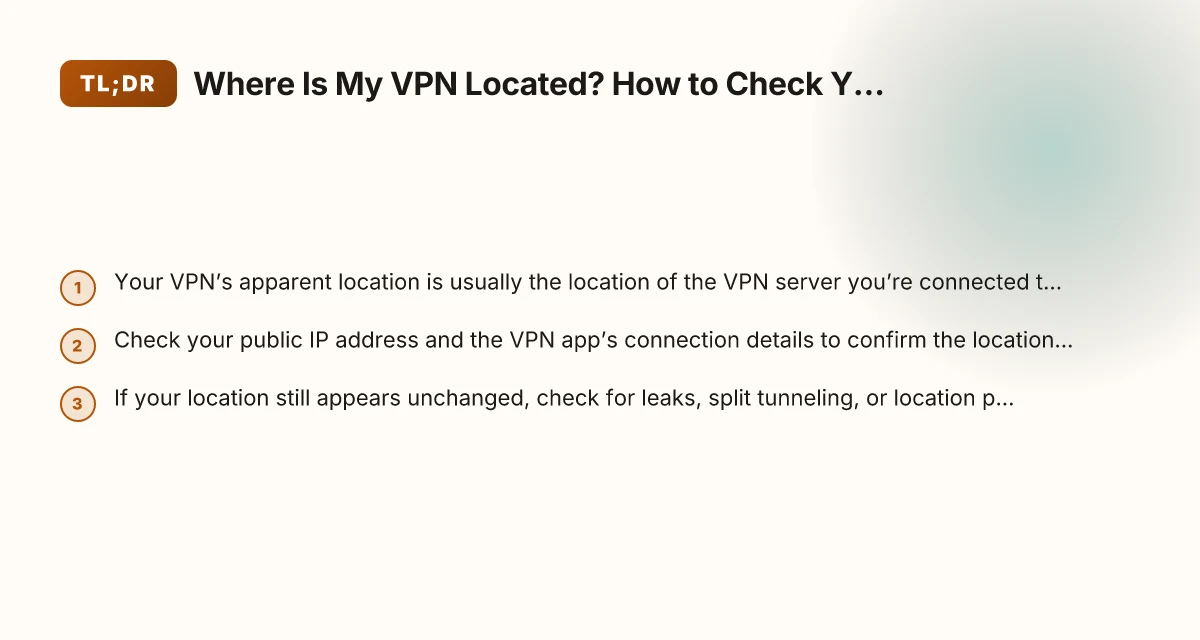
If you’re wondering, “where is my VPN located?”, it’s generally located wherever the VPN server you selected is based. When you connect, websites usually see the server’s public IP address and may associate it with that server’s city or country. They do not automatically see your actual location through your IP address, though other signals, such as GPS access or account information, can still reveal it.

Editor's pick: NordVPN — fast, secure VPN — Strong encryption, a no-logs policy and apps for every device. 30-day money-back guarantee. Get NordVPN →
How to check the location your VPN shows
| Check | What to do | What it tells you | Limitation |
|---|---|---|---|
| VPN app | Check the connected server or location | Which server you selected | May not match the public IP location |
| IP lookup site | Check your public IP and its reported location | Where your connection appears to originate | Databases can report different locations |
| Search engine | Search for your location or local results | What location-based results may assume | Results can be personalized |
| Map service | Check the location it estimates | How the service interprets your connection | Estimate may be imprecise |
| DNS leak test | Check which DNS servers appear | Whether DNS requests may reveal another location | Does not confirm every privacy setting |
| WebRTC leak test | Check for exposed IP details | Whether browser connections may reveal an IP | Results depend on browser and setup |
Compiled November 2026; check the provider's site for current details.
| VPN | Obfuscation | From / month | Plan | Free plan | Refund | Alipay | UnionPay | Crypto | Website opens in China | Trustpilot | |
|---|---|---|---|---|---|---|---|---|---|---|---|
 ZoogVPN | Turn on manually Shadow | $2.49/mo | 27 months: $59.99 | Yes | 7 days | ✓ | ✓ | ✓ | ✓ | Official site blocked; our special link opens (4.4 s) | 4.2/5 (195 reviews) |
 NordVPN | Turn on manually Obfuscated Servers / NordWhisper | $3.49/mo | 27 months: $94.23 | No | 30 days | ? | ✗ | ✓ | ✓ | ✗ Blocked | 4.2/5 (51,628 reviews) |
 ExpressVPN | ✓ On by default all servers | $3.00/mo | 28 months: $84 | No | 30 days | ✗ | ✗ | ✓ | ✗ | ✗ Blocked | 4.4/5 (29,706 reviews) |
 Surfshark | ✓ On by default Camouflage, with OpenVPN | See site | See site | No | 30 days | ✗ | ✗ | ✗ | ✓ | ✗ Blocked | 4.3/5 (31,823 reviews) |
 Proton VPN | Turn on manually Stealth, free plan too | $2.99/mo | 12 months: $35.88 | Yes | 30 days | ✗ | ✗ | ✗ | ✓ | ✗ Blocked | 2.1/5 (1,040 reviews) |
 Astrill VPN | Turn on manually StealthVPN / OpenWeb | $12.50/mo | 24 months: $300 | No | See site | ✗ | ✗ | ✗ | ✓ | ✗ Blocked | 1.3/5 (110 reviews) |
 Private Internet Access | Turn on manually Shadowsocks, OpenVPN only | $2.03/mo | 40 months: $81.2 | No | 30 days | ✗ | ✗ | ✗ | ✗ | ✗ Blocked | 4.2/5 (11,033 reviews) |
 CyberGhost | Turn on manually selected servers | $2.19/mo | 28 months: $61.32 | No | 45 days | ✗ | ✗ | ✗ | ✓ | ✗ Blocked | 4.0/5 (24,178 reviews) |
 PureVPN | Turn on manually switch to OpenVPN | $1.69/mo | 60 months: $101.55 | No | 31 days | ? | ? | ✗ | ✓ | ✗ Blocked | 4.4/5 (17,994 reviews) |
 AdGuard VPN | ✓ On by default TrustTunnel | $2.99/mo | 24 months: $71.76 | Yes | 30 days | ✓ | ✗ | ✓ | ✓ | Official site blocked; our special link opens (3.7 s) | 4.3/5 (290 reviews) |
 Mullvad | Turn on manually QUIC / Shadowsocks / LWO | $5.61/mo | €5/mo | No | 14 days | ✗ | ✗ | ✗ | ✓ | ✗ Blocked | 3.2/5 (192 reviews) |
 Windscribe | Turn on manually Stealth / WStunnel | $5.75/mo | 12 months: $69 | Yes | See site | ✗ | ✗ | ✗ | ✓ | ✗ Blocked | 4.7/5 (13,355 reviews) |
 StrongVPN | Turn on manually Scramble, OpenVPN TCP | See site | See site | No | 30 days | ✓ | ✗ | ✗ | ✗ | ✗ Blocked | 4.4/5 (2,695 reviews) |
 LightXtreme 闪连 | Not listed | $7.08/mo | 12 months: $84.99 | Yes | 30 days | ✓ | ✓ | ✓ | ✓ | ✓ Yes (3.5 s) | No page |
Prices checked 2026-11-10 on each vendor's pricing page (cheapest long plan, USD). Check the vendor's checkout for the final price.
Obfuscation checked 2026-11-14 on each vendor's site and help center: "on by default" = nothing to set; "turn on manually" = switch protocol or mode in settings; "not listed" = the vendor describes no obfuscation.
Payment methods checked 2026-11-10 on each vendor's payment pages: all 14 take cards and PayPal; ✗ = not listed, ? = the vendor's own pages disagree.
China access: whether the official website opens from mainland China networks (tests the website only, not the VPN connection). Last checked 2026-11-18 01:02 Beijing time.
Trustpilot score and review count checked 2026-11-10.
What “VPN location” means
A VPN, or virtual private network, routes your internet traffic through a server operated by your VPN provider. Your VPN location usually means the location associated with that server’s IP address.
For example, if you’re physically in Toronto but connect to a VPN server in London, websites may see an IP address registered or geolocated in the United Kingdom. Your device itself has not moved. Only the route and apparent public IP address have changed.
There can be a few different locations involved:
- Your physical location: Where you and your device actually are.
- The VPN server location: The country or city shown in the VPN app.
- The IP address location: The location a website’s IP lookup service associates with your public IP.
- The server’s physical location: Where the server hardware is actually hosted, which may not always match the advertised location.
These locations do not always line up perfectly. IP geolocation databases can be outdated or imprecise, and some providers offer virtual locations: an IP address associated with one country while the server infrastructure is physically elsewhere. IPsec VPN: How It Works, Benefits, and When to Use It
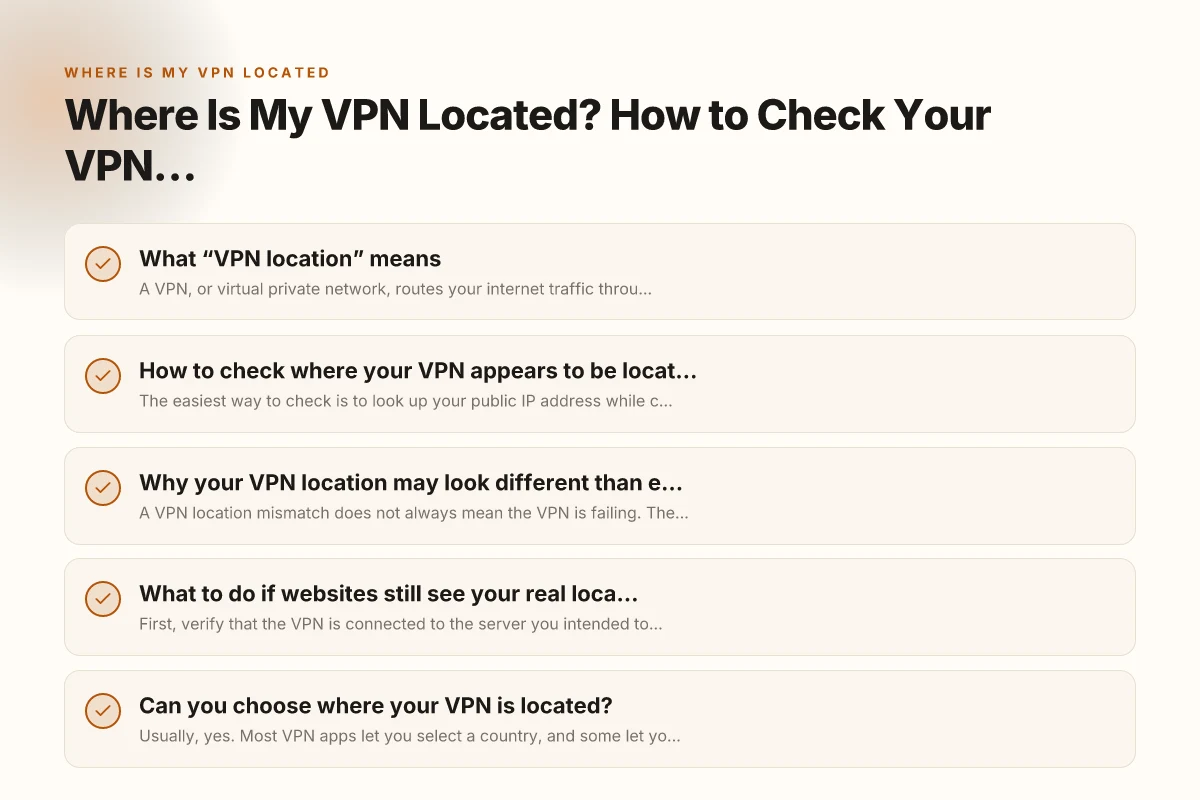
How to check where your VPN appears to be located
The easiest way to check is to look up your public IP address while connected to the VPN.
- Open your VPN app and connect to a country or city.
- Visit an IP-checking website or search for “what is my IP.”
- Note the public IP address and the country or city shown.
- Compare that result with the location displayed in your VPN app.
The result shows how an IP lookup service identifies your connection. It is a useful check, but not definitive proof of where the VPN server hardware is located. Different websites may use different geolocation databases, so they can show different cities or even, occasionally, different countries.
You can also check the VPN app’s connection details. Depending on the provider, it may display the selected server, server name, country, city, or assigned IP address. If you need a more reliable picture, compare the app’s information with results from more than one IP lookup service.
| What you check | What it can tell you | What it cannot always confirm |
|---|---|---|
| VPN app | The server or location you selected | The exact physical location of the hardware |
| Public IP lookup | How a website may identify your IP | Your precise location or the server’s exact address |
| GPS or device location | Your device’s location, if permission is granted | Which VPN server your traffic uses |
| Provider documentation | Whether a location is virtual or how servers are assigned | Independent verification of every server |
Why your VPN location may look different than expected Big IP VPN Download: How to Find and Install a Safe VPN
| Possible reason | What you may see | What to check | What it means |
|---|---|---|---|
| IP geolocation database | A nearby or incorrect city | Compare more than one IP lookup | Databases may differ |
| Server location | A city different from the one selected | Check the VPN app’s server details | The server may be elsewhere |
| Virtual server location | A location that does not match the hardware location | Check the provider’s server information | The IP can represent a virtual location |
| DNS leak | Local or unexpected DNS details | Run a DNS leak test | DNS requests may not follow the VPN |
| WebRTC leak | An IP that differs from the VPN IP | Run a WebRTC leak test | Browser activity may expose IP details |
| GPS access | Your device’s actual location | Review app and browser permissions | VPNs do not change GPS location |
Compiled November 2026; check the provider's site for current details.
Why your VPN location may look different than expected
A VPN location mismatch does not always mean the VPN is failing. The most common explanation is that IP geolocation data is approximate. A lookup site might place an IP in a nearby city, the regional hub where the provider registers it, or another location in the same country.
Other possible reasons include:
- Virtual server locations: The provider advertises an IP location in one country, but the server hardware is hosted elsewhere.
- Outdated databases: A geolocation provider may not have updated its records after an IP address changed hands.
- A different server selected: The VPN may have automatically connected you to a recommended or nearby server.
- A stale website session: A site may remember your previous location through cookies or account settings.
- Location permissions: An app or website may use your device’s GPS location if you granted access.
- Split tunneling: Some apps or websites may bypass the VPN and use your regular internet connection.
A website can also infer location from information other than your IP address. Searches, billing details, saved addresses, and location permissions may affect what it displays. A VPN changes your network route. It does not erase all other location signals. Urban VPN Extension for Edge: Setup, Features, and Safety
What to do if websites still see your real location
First, verify that the VPN is connected to the server you intended to use. Then check your public IP again. If it still shows your usual internet provider or home region, try these steps:
- Reconnect to the VPN. Disconnect, select the desired location, and connect again.
- Check split tunneling. Make sure the browser or app you’re testing is set to use the VPN.
- Review location permissions. In your browser or device settings, deny location access to sites that do not need it.
- Clear site data or use a private window. This can help rule out saved cookies and previous sessions.
- Check for DNS or WebRTC leaks. Leak-test tools can indicate whether requests are revealing information outside the VPN tunnel. Results vary by browser and setup, so follow your VPN provider’s guidance.
- Try another server. A different server in the same country may have a more accurate or consistent IP location.
- Contact your VPN provider. Ask whether the location is virtual and whether the IP address may be incorrectly geolocated.
A location test is only a snapshot. Recheck after changing servers or network settings, and remember that websites can combine multiple signals when estimating where you are.
Can you choose where your VPN is located?
Usually, yes. Most VPN apps let you select a country, and some let you choose a city or a specific server. The available choices depend on the provider and your subscription.
Choosing a server in a particular country generally changes the apparent location of your public IP address. It may also affect speed: a closer server often provides a faster connection, although network congestion, routing, and server capacity matter too. Urban VPN Proxy: What It Does, How to Use It, and What to Consider
Before choosing, consider what you need:
- For a nearby connection, select a server close to your physical location.
- For a particular country’s IP address, choose a server listed in that country and verify the result.
- For a specific city, check whether the provider offers city-level servers and whether the city is a virtual location.
- For privacy, review the provider’s policies and security features rather than relying on location alone.
Options when websites still see your real location
| Option | What to do | Can help with | Does not change |
|---|---|---|---|
| Confirm VPN connection | Reconnect to a server | A dropped or inactive VPN connection | GPS location |
| Choose another server | Select a different VPN location | A server with an unexpected IP location | IP database inaccuracies |
| Check DNS leaks | Run a DNS leak test | DNS requests that may reveal your location | GPS or account details |
| Check WebRTC leaks | Run a WebRTC leak test | Browser IP exposure | Location shared through other signals |
| Review permissions | Restrict location access in apps and browsers | GPS-based location access | Your public IP |
| Review account settings | Check saved address and profile details | Location tied to an account | Your network connection |
| Recheck location | Test with another IP lookup site | Conflicting geolocation results | Differences between databases |
Compiled November 2026; check the provider's site for current details.
Recommendation
To find where your VPN appears to be located, connect to a server, check your public IP with more than one lookup service, and compare the results with your VPN app. Treat the displayed city as an estimate, not a guarantee of the server’s physical location. If your real IP or device location still appears, check split tunneling and location permissions, then ask your provider about leaks or virtual server locations. Urban VPN Extension Edge Download: A Safe Installation Guide