
What Is a Proxy Server? How It Works, Types, and When to Use One
Learn what a proxy server does, how it routes requests, and how to choose the right type for privacy, access, or performance.
A proxy server is an intermediary between your device and the internet. Instead of connecting directly to a website, your device sends its request to the proxy, which forwards it and returns the website’s response. Depending on how it is configured, a proxy can help control network access, route traffic, or hide your device’s IP address from the sites you visit.
Proxies are used by individuals, businesses, schools, and network administrators. They can be useful, but they are not all the same, and using one does not automatically make your online activity private or secure.

Editor's pick: NordVPN — fast, secure VPN — Strong encryption, a no-logs policy and apps for every device. 30-day money-back guarantee. Get NordVPN →
Compare common proxy server types by their typical use and trade-offs
| Proxy type | How it works | Common use | Main advantage | Key limitation |
|---|---|---|---|---|
| Forward proxy | Sits between a user and the internet | Access control; filtering | Centralizes outbound traffic | Requires client or network setup |
| Reverse proxy | Sits in front of servers | Load balancing; protection | Hides and shields origin servers | Requires server-side configuration |
| HTTP proxy | Handles web traffic using HTTP | Web browsing; filtering | Works with web requests | Not designed for every protocol |
| HTTPS proxy | Tunnels or handles encrypted web traffic | Secure web access | Supports encrypted connections | Visibility into content may be limited |
| SOCKS proxy | Relays traffic at a lower network level | Apps; varied traffic | Supports multiple traffic types | May not provide encryption |
| Transparent proxy | Intercepts traffic without manual client settings | Network monitoring; filtering | Little user configuration | Users may not know it is in use |
| Residential proxy | Uses an IP address associated with a residential connection | Location-based access; testing | Traffic can resemble household browsing | Quality and trust vary by provider |
| Datacenter proxy | Uses an IP address hosted in a data center | High-volume tasks; testing | Often fast and easy to scale | Sites may identify data-center IPs |
Compiled November 2026; check the provider's site for current details.
How a proxy server works
When you open a website, your browser normally sends a request directly to that site. With a proxy, the request takes an extra step:
- Your device sends the request to the proxy server.
- The proxy forwards the request to the destination website.
- The website sends its response back to the proxy.
- The proxy relays the response to your device.
The website generally sees the proxy’s IP address rather than your device’s IP address. However, the proxy itself may be able to see information about your connection. What it can observe depends on the proxy type, encryption, and configuration.
A proxy may also apply rules along the way. For example, an organization might block certain websites, require users to authenticate, or record traffic for security and troubleshooting.
Common types of proxy servers
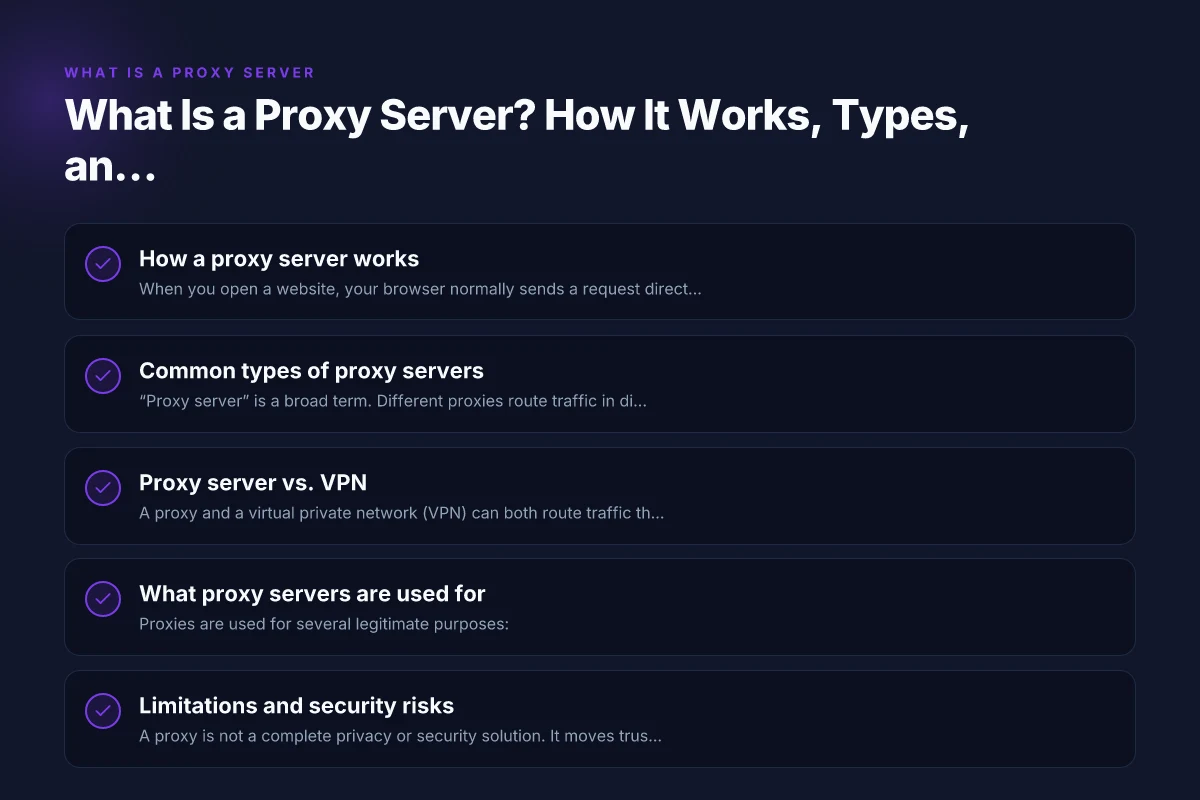
“Proxy server” is a broad term. Different proxies route traffic in different ways and are suited to different tasks. Free VPN Extension for Microsoft Edge: What to Know Before Installing
- Forward proxy: Sits between a user or internal network and the internet. It can filter, monitor, or route users’ outgoing requests.
- Reverse proxy: Sits in front of one or more web servers. It can distribute incoming requests, help protect the servers, and manage encrypted connections.
- Transparent proxy: Intercepts traffic without requiring users to configure their devices in the usual way. It is often used for network filtering or caching.
- Anonymous proxy: Hides the user’s IP address from the destination but may still identify itself as a proxy.
- Residential or data-center proxy: Describes the source of the proxy’s IP address. Residential addresses are associated with internet service providers, while data-center addresses come from hosting infrastructure.
These labels can overlap. A proxy may be, for example, a forward proxy that uses data-center IP addresses.
Proxy server vs. VPN for choosing how to route your traffic
| Comparison point | Proxy server | VPN |
|---|---|---|
| Traffic coverage | Often one app or configured traffic | Usually device-wide or app-wide |
| IP address | Can replace the visible IP | Replaces the visible IP |
| Encryption | Not guaranteed | Typically encrypts the tunnel |
| Setup | May be configured per app or network | Usually requires a VPN app or profile |
| Performance impact | Depends on proxy and traffic | Depends on provider, encryption, and route |
| Privacy protection | Depends on proxy type and provider | Depends on VPN provider and policy |
| Best suited to | Filtering, access control, or specific tasks | Protecting traffic across a connection |
| Does it ensure anonymity? | No | No |
Compiled November 2026; check the provider's site for current details.
Proxy server vs. VPN
A proxy and a virtual private network (VPN) can both route traffic through another server, but they do not necessarily protect the same traffic or provide the same safeguards. GlobalProtect VPN Not Connecting: Causes and Fixes
| Feature | Proxy server | VPN |
|---|---|---|
| Typical coverage | Often one app or a specific kind of traffic | Usually all supported device traffic |
| Changes the visible IP address | Often, for the traffic it handles | Usually, for traffic routed through the VPN |
| Encrypts the connection | Not always; depends on the setup | Typically encrypts traffic between the device and VPN server |
| Common uses | Filtering, routing, caching, or accessing a service | Protecting traffic on untrusted networks and routing a device’s connection |
A proxy that handles HTTPS traffic does not automatically mean the proxy can read the contents of every connection. HTTPS encrypts data between your browser and the website, although the proxy may still see connection details such as the destination domain in some configurations. A proxy that performs HTTPS inspection can see more, but this requires special setup and trust in the party managing it.
What proxy servers are used for
Proxies are used for several legitimate purposes:
- Managing organizational networks: Businesses and schools may use forward proxies to apply access rules, monitor network health, or help enforce security policies.
- Filtering content: Administrators can block known malicious sites or restrict access to certain categories of websites.
- Improving performance: A proxy cache can store copies of frequently requested content and serve them quickly when appropriate. Caching is less useful for content that changes often or is personalized.
- Protecting web infrastructure: Reverse proxies can help distribute requests across servers, absorb some unwanted traffic, and prevent direct exposure of an origin server.
- Routing requests: Developers and organizations may use proxies to test applications or manage how requests reach external services.
- Changing the IP address visible to a website: A proxy can present its own IP address to a destination, though this alone does not ensure privacy or bypass every access restriction.
Use a proxy only in ways that comply with the relevant website’s terms, local laws, and your organization’s policies.
Limitations and security risks
A proxy is not a complete privacy or security solution. It moves trust from your internet provider or direct network path to the proxy operator. If the service is unreliable or dishonest, it may log connection data, inject unwanted content, or expose information sent without encryption. WatchGuard SSLVPN: How It Works and How to Set It Up Securely
Keep these limitations in mind:
- The proxy may keep logs. Check the provider’s privacy policy and understand what data it collects and how long it retains it.
- Unencrypted traffic can be exposed. A proxy does not automatically encrypt your connection. Avoid entering sensitive information on sites that do not use HTTPS.
- Your identity may still be exposed. Browser settings, cookies, account logins, and other identifying details can reveal who you are even when a site sees a different IP address.
- Some traffic may bypass the proxy. If only one browser or application is configured to use it, other apps may connect directly.
- Free services can carry extra risks. A free proxy may have weak security, intrusive advertising, unclear logging practices, or limited reliability.
For sensitive work, do not assume that a proxy is safe simply because it changes your IP address. Review its security features, ownership, logging practices, and configuration before relying on it.
Choose a proxy by matching your goal to its capabilities and risks
| Goal or requirement | Proxy option to consider | What to check | Main benefit | Main risk or limitation |
|---|---|---|---|---|
| Filter or control workplace browsing | Forward proxy | Access rules and logging | Centralized policy enforcement | Can monitor user activity |
| Protect and distribute server traffic | Reverse proxy | Security features and configuration | Helps shield origin servers | Misconfiguration can expose services |
| Browse through a specific app | HTTP or HTTPS proxy | App compatibility and encryption support | Routes selected web traffic | May not cover other apps |
| Route varied app traffic | SOCKS proxy | Protocol support and provider trust | Flexible traffic relay | Encryption may be absent |
| Avoid manual device settings | Transparent proxy | Network disclosure and policies | No client setup needed | Traffic may be intercepted without clear notice |
| Test location-dependent services | Residential proxy | IP sourcing and provider practices | Residential-looking IP address | Provider quality and legitimacy vary |
| Run high-volume testing | Datacenter proxy | Allowed use, capacity, and IP reputation | Scalable traffic handling | IPs may be easier to detect or block |
| Protect all traffic on a connection | VPN rather than proxy | Provider privacy policy and supported devices | Encrypted connection-wide routing | Provider still requires trust |
Compiled November 2026; check the provider's site for current details. NordVPN Windows VPN: Setup, Features, and How to Choose
How to choose a proxy
Start with the problem you need to solve. A business managing employee web access has different requirements from a website handling heavy incoming traffic. Identify which apps or devices need the proxy, whether encryption is required, and who will operate and support the service.
Before choosing one, consider:
- Purpose: Do you need filtering, caching, IP routing, or protection for a web server?
- Coverage: Will it handle one application, a browser, or an entire network?
- Security: Does it support secure connections, authentication, and appropriate access controls?
- Privacy: What data does the operator collect, and does it clearly explain its retention policy?
- Reliability: Is the service consistently available, and is there support if something goes wrong?
- Compliance: Does its use meet applicable laws, contracts, and organizational rules?
Recommendation
Choose a proxy only when its specific function matches your needs. For basic website filtering or routing, a reputable forward proxy may be appropriate. For managing incoming requests to a website, consider a reverse proxy. If your main goal is to protect a device’s traffic on public Wi-Fi, a properly configured VPN is often a better fit. In every case, prioritize a provider you trust and remember that a proxy is one part of a broader security and privacy plan.