OpenVPN Connect for Windows: How to Install and Connect
Install OpenVPN Connect on Windows, import a VPN profile, connect securely, and troubleshoot common issues.
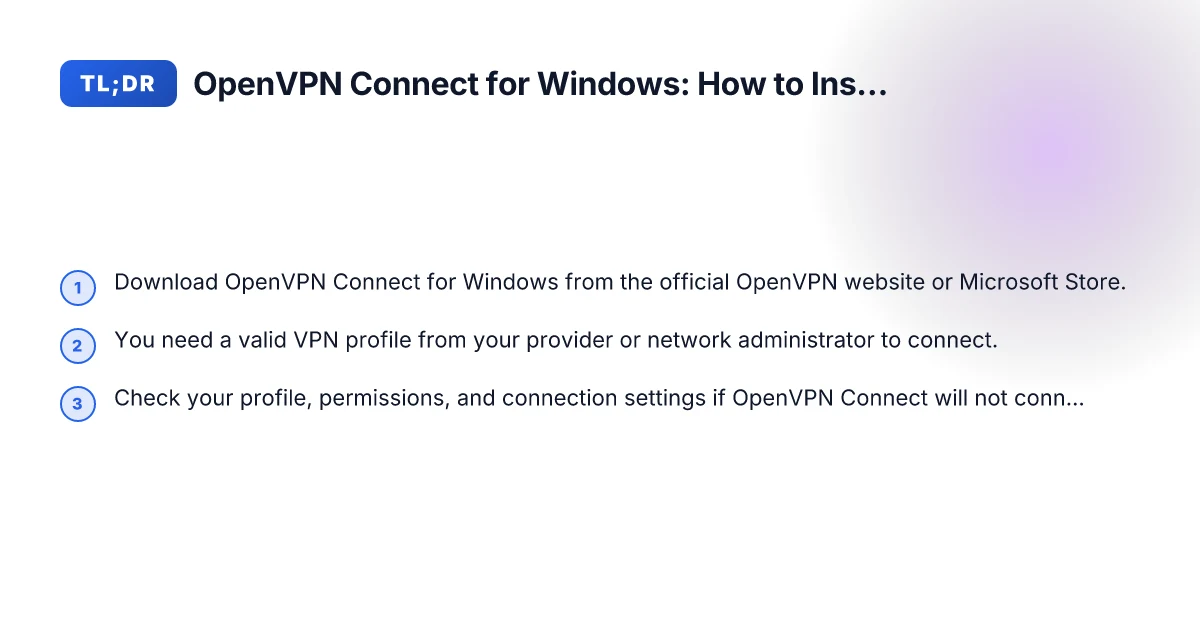
OpenVPN Connect for Windows is the official client for connecting to VPN servers that support OpenVPN. To use it, install the app, import a VPN profile supplied by your VPN provider or organization, and select Connect. The app does not provide a VPN service or server access by itself: you must have a profile and any required login details.

Editor's pick: NordVPN — fast, secure VPN — Strong encryption, a no-logs policy and apps for every device. 30-day money-back guarantee. Get NordVPN →
Compare OpenVPN profile import methods
| Method | What you need | How to import | Best for | Common check |
|---|---|---|---|---|
| Open a `.ovpn` file | Profile file | Open it with OpenVPN Connect | A single profile | Confirm the file is from a trusted source |
| Import from local storage | Profile file saved on the PC | Choose the file in the import dialog | Files already downloaded | Check the selected file path |
| Import by URL | Profile URL | Enter the URL in the app | Profiles hosted online | Verify the URL and network access |
| Scan a QR code | QR code for a profile | Scan it in the app | Profiles shared as QR codes | Use a code from a trusted provider |
| Import from a provider | Provider-issued profile or setup details | Follow the provider’s instructions | Provider-managed VPN access | Confirm the profile matches your account |
| Import more than one profile | Separate profile files | Import each profile individually | Switching between VPN services | Select the intended profile before connecting |
Compiled November 2026; check the provider's site for current details.
| VPN | Obfuscation | From / month | Plan | Free plan | Refund | Alipay | UnionPay | Crypto | Website opens in China | Trustpilot | |
|---|---|---|---|---|---|---|---|---|---|---|---|
 ZoogVPN | Turn on manually Shadow | $2.49/mo | 27 months: $59.99 | Yes | 7 days | ✓ | ✓ | ✓ | ✓ | Official site blocked; our special link opens (4.4 s) | 4.2/5 (195 reviews) |
 NordVPN | Turn on manually Obfuscated Servers / NordWhisper | $3.49/mo | 27 months: $94.23 | No | 30 days | ? | ✗ | ✓ | ✓ | ✗ Blocked | 4.2/5 (51,628 reviews) |
 ExpressVPN | ✓ On by default all servers | $3.00/mo | 28 months: $84 | No | 30 days | ✗ | ✗ | ✓ | ✗ | ✗ Blocked | 4.4/5 (29,706 reviews) |
 Surfshark | ✓ On by default Camouflage, with OpenVPN | See site | See site | No | 30 days | ✗ | ✗ | ✗ | ✓ | ✗ Blocked | 4.3/5 (31,823 reviews) |
 Proton VPN | Turn on manually Stealth, free plan too | $2.99/mo | 12 months: $35.88 | Yes | 30 days | ✗ | ✗ | ✗ | ✓ | ✗ Blocked | 2.1/5 (1,040 reviews) |
 Astrill VPN | Turn on manually StealthVPN / OpenWeb | $12.50/mo | 24 months: $300 | No | See site | ✗ | ✗ | ✗ | ✓ | ✗ Blocked | 1.3/5 (110 reviews) |
 Private Internet Access | Turn on manually Shadowsocks, OpenVPN only | $2.03/mo | 40 months: $81.2 | No | 30 days | ✗ | ✗ | ✗ | ✗ | ✗ Blocked | 4.2/5 (11,033 reviews) |
 CyberGhost | Turn on manually selected servers | $2.19/mo | 28 months: $61.32 | No | 45 days | ✗ | ✗ | ✗ | ✓ | ✗ Blocked | 4.0/5 (24,178 reviews) |
 PureVPN | Turn on manually switch to OpenVPN | $1.69/mo | 60 months: $101.55 | No | 31 days | ? | ? | ✗ | ✓ | ✗ Blocked | 4.4/5 (17,994 reviews) |
 AdGuard VPN | ✓ On by default TrustTunnel | $2.99/mo | 24 months: $71.76 | Yes | 30 days | ✓ | ✗ | ✓ | ✓ | Official site blocked; our special link opens (3.7 s) | 4.3/5 (290 reviews) |
 Mullvad | Turn on manually QUIC / Shadowsocks / LWO | $5.61/mo | €5/mo | No | 14 days | ✗ | ✗ | ✗ | ✓ | ✗ Blocked | 3.2/5 (192 reviews) |
 Windscribe | Turn on manually Stealth / WStunnel | $5.75/mo | 12 months: $69 | Yes | See site | ✗ | ✗ | ✗ | ✓ | ✗ Blocked | 4.7/5 (13,355 reviews) |
 StrongVPN | Turn on manually Scramble, OpenVPN TCP | See site | See site | No | 30 days | ✓ | ✗ | ✗ | ✗ | ✗ Blocked | 4.4/5 (2,695 reviews) |
 LightXtreme 闪连 | Not listed | $7.08/mo | 12 months: $84.99 | Yes | 30 days | ✓ | ✓ | ✓ | ✓ | ✓ Yes (3.5 s) | No page |
Prices checked 2026-11-10 on each vendor's pricing page (cheapest long plan, USD). Check the vendor's checkout for the final price.
Obfuscation checked 2026-11-14 on each vendor's site and help center: "on by default" = nothing to set; "turn on manually" = switch protocol or mode in settings; "not listed" = the vendor describes no obfuscation.
Payment methods checked 2026-11-10 on each vendor's payment pages: all 14 take cards and PayPal; ✗ = not listed, ? = the vendor's own pages disagree.
China access: whether the official website opens from mainland China networks (tests the website only, not the VPN connection). Last checked 2026-11-18 01:02 Beijing time.
Trustpilot score and review count checked 2026-11-10.
What you need before getting started
Before installing OpenVPN Connect, make sure you have access to the information required by your VPN service. This usually includes an OpenVPN profile file, commonly ending in .ovpn, or a profile download link. Your provider or administrator may also give you a username and password, a certificate, or a one-time verification code.
Use a profile only from a source you trust. It contains connection settings that tell the client which VPN server to reach and how to authenticate. If the profile comes from an employer, school, or VPN provider, contact that organization if you are unsure which file or connection method to use.
You will also need:
- A Windows computer with permission to install applications.
- An active internet connection.
- The current OpenVPN Connect app for Windows.
- VPN account credentials or other authentication details, if required.
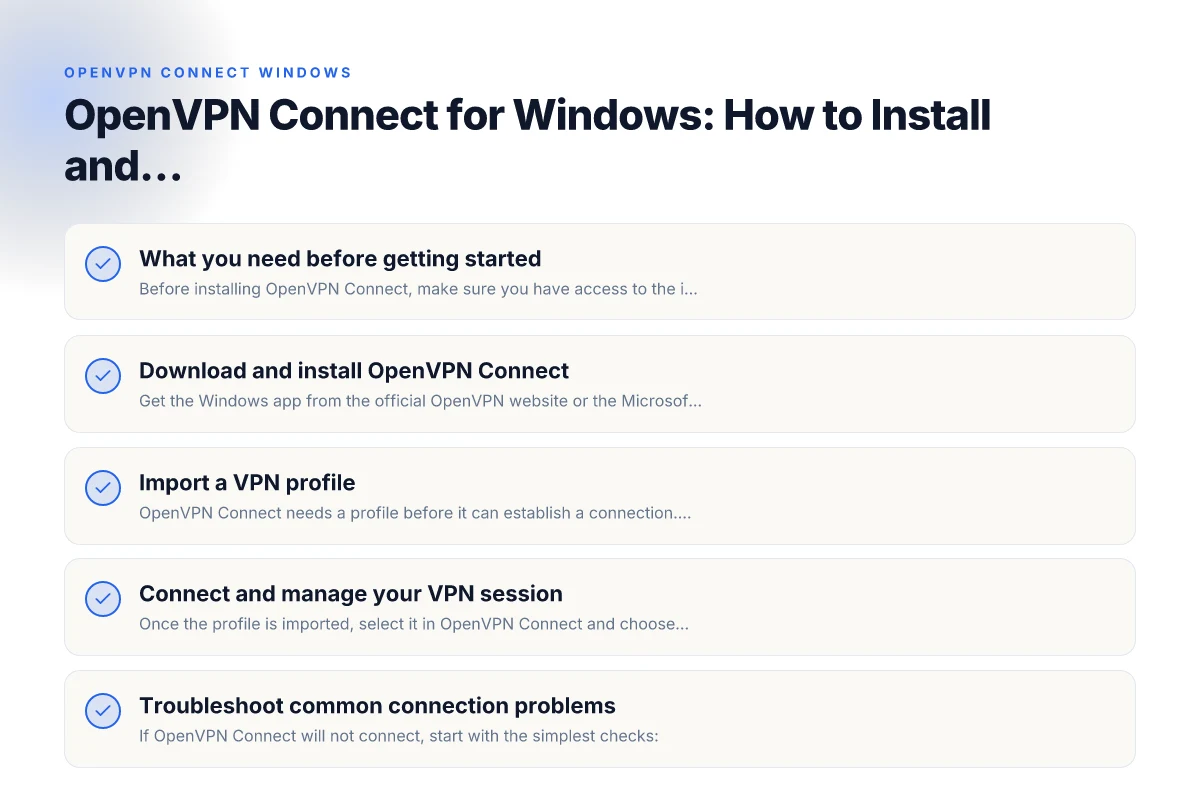
Download and install OpenVPN Connect
Get the Windows app from the official OpenVPN website or the Microsoft Store. Avoid third-party download sites, which may distribute outdated or modified installers. If you are setting up a work or school VPN, follow your organization’s instructions. It may require a particular app version or a managed installation. Proton VPN Free: What You Get and Whether It’s Worth Using
If you download an installer from OpenVPN, open the downloaded file and follow the setup prompts. Windows may ask you to approve the installation or allow the app to make changes. Review the publisher information before proceeding. When setup finishes, launch OpenVPN Connect from the Start menu.
The Microsoft Store version can be installed through the Store’s usual process. Either installation route can provide the Windows client, but use the source recommended by your provider or administrator if they specify one.
After installation, check for updates when prompted. Current software can include security fixes, compatibility improvements, and changes needed to support newer Windows versions.
Choose a troubleshooting check for your connection problem VPN Extension Free Edge Download: A Safe Setup Guide
| Symptom | First check | Next action | Who may help |
|---|---|---|---|
| Profile will not import | File format and file location | Re-download or request a fresh profile | VPN provider |
| Connection fails | Internet access | Retry after confirming the network works | Network administrator |
| Login is rejected | Username and password | Check credentials or reset them | VPN provider |
| Certificate or profile warning | Profile source and validity | Request an updated profile | VPN provider |
| Connection stalls | Network restrictions | Try another permitted network | Network administrator |
| Connected but no access | Profile and access permissions | Check the requested resource and provider settings | VPN provider |
| App will not open | App installation | Restart Windows, then reinstall if needed | OpenVPN support |
Compiled November 2026; check the provider's site for current details.
Import a VPN profile
OpenVPN Connect needs a profile before it can establish a connection. The exact import options can vary slightly by app version, but the general process is straightforward:
- Open OpenVPN Connect.
- Choose the option to add or import a profile.
- Select the
.ovpnfile on your computer, or use the provider’s profile URL if instructed. - Review the profile name and any sign-in prompts.
- Save the profile in the app.
If you received a profile as an email attachment or download, save it somewhere you can locate, such as your Downloads folder. Do not edit the file unless your provider or administrator tells you to. A small change to a server address, certificate, or security setting can prevent the connection from working.
Some providers use a sign-in portal or a configuration link rather than a file. In that case, follow their setup instructions and verify that the link is legitimate before entering account details. For a company VPN, the profile may be delivered through a device-management system instead of being imported manually. VPN for Edge Free Download: Safe Ways to Add a VPN to Microsoft Edge
Connect and manage your VPN session
Once the profile is imported, select it in OpenVPN Connect and choose Connect. Enter your VPN credentials if the app requests them. Depending on the provider, you may also need to approve a sign-in notification or provide a multi-factor authentication code.
When the connection succeeds, the app should show a connected status. You can then use internet or organization resources according to the VPN’s configuration. Some profiles route all internet traffic through the VPN, while others route only specific work or private-network traffic through it.
| Option | What it does | When to use it |
|---|---|---|
| Connect | Starts a VPN session using the selected profile | When you need VPN access |
| Disconnect | Ends the current VPN session | When access is no longer needed |
| Reconnect | Attempts to restore a dropped session | After a temporary network interruption |
| Profile settings | Shows or changes available profile options | Only when your provider or administrator advises it |
To end a session, open the app and select Disconnect. If your provider supports automatic connection or reconnection, those options may be available in the profile settings. Use them only if they suit your needs. Always follow workplace policies on when the VPN must be active.
Troubleshoot common connection problems
If OpenVPN Connect will not connect, start with the simplest checks: Best Free VPN for Edge Extension: What to Look For
- Confirm that your computer has internet access without the VPN.
- Make sure you selected the correct profile and entered the right credentials.
- Check whether your password has expired or your account requires multi-factor approval.
- Restart the app and try again.
- Confirm that your Windows date and time are correct.
- Ask your provider or administrator whether the VPN server is available.
A message about a missing or invalid certificate often points to an incomplete, expired, or incorrect profile. Download a fresh profile from the official source and import it again. Do not accept a replacement profile from an unknown sender.
If the app reports a timeout, the network may be blocking the connection, the server may be temporarily unavailable, or the profile may point to an unreachable server. Try a different trusted network if practical, such as a home connection instead of public Wi-Fi, and check for service notices from your provider.
If installation fails, check that your Windows account can install software and that security software has not blocked the installer. On a managed work computer, an administrator may need to install or approve the app. Avoid disabling security protections as a troubleshooting shortcut.
For persistent issues, save the exact error message and contact the VPN provider or IT administrator. They can confirm whether your account is active, verify the profile, and identify any network or server-side problem. VPN Free Extension Microsoft Edge: What to Choose and How to Use It
Decide where to get help
| Issue | OpenVPN Connect | VPN provider | Network administrator | User action |
|---|---|---|---|---|
| Installing the Windows app | App and installation guidance | Provider-specific instructions | Managed-device restrictions | Download from an official source |
| Missing VPN profile | No provider profile supplied | Profile and account access | Internal profile distribution | Request a profile |
| Login or account problem | App-level troubleshooting | Credentials and account status | Organization account rules | Verify sign-in details |
| Connection blocked by network | App-level checks | VPN service availability | Firewall or network policy | Test basic internet access |
| Profile needs updating | Import functionality | Current profile or certificate | Internal profile process | Import the updated profile |
| App error or crash | OpenVPN Connect support | Provider-specific configuration | Device management limits | Note the error message |
| Unsure who owns the problem | App behavior | VPN service and profile | Local network rules | Identify the failing step |
Compiled November 2026; check the provider's site for current details.
Recommendation
For a safe and reliable OpenVPN Connect setup on Windows, install the client from an official source, import a profile from your VPN provider or administrator, and keep the app and profile current. If you cannot connect after checking your internet access and sign-in details, contact the profile’s issuer rather than changing advanced settings or using files from unverified sources.