IPsec over TCP 443: How It Works and When to Use It
Learn how IPsec over TCP 443 can cross restrictive networks, its trade-offs, and when to choose it over standard IPsec or TLS VPNs.
IPsec over TCP 443 is a way to carry IPsec VPN traffic through a TCP connection on port 443, the port commonly used for HTTPS. It can help when a firewall or network blocks the UDP traffic that standard IPsec typically needs. However, using port 443 does not make IPsec traffic identical to ordinary HTTPS, nor does it guarantee that a connection will work on every restricted network.

Editor's pick: NordVPN — fast, secure VPN — Strong encryption, a no-logs policy and apps for every device. 30-day money-back guarantee. Get NordVPN →
Compare IPsec over TCP 443 with common VPN transport options
| Option | Transport | Port or protocol | NAT/firewall compatibility | Main trade-off |
|---|---|---|---|---|
| IPsec over TCP 443 | TCP | TCP 443 | Often works through restrictive networks | TCP-over-TCP performance issues |
| Native IPsec | UDP | UDP 500 and 4500 | May be blocked by firewalls | Efficient when permitted |
| IPsec with NAT-T | UDP | UDP 4500 after negotiation | Works through many NAT devices | UDP may still be blocked |
| OpenVPN over TCP | TCP | Commonly TCP 443 | Often passes restrictive firewalls | TCP-over-TCP performance issues |
| OpenVPN over UDP | UDP | Configurable | Depends on firewall rules | Requires UDP access |
| WireGuard | UDP | Configurable | Depends on firewall rules | May be blocked on restricted networks |
Compiled November 2026; check the provider's site for current details.
What IPsec over TCP 443 means
IPsec is a suite of protocols that protects network traffic with encryption and authentication. Many IPsec VPNs use IKE for negotiation and UDP for control and data traffic. Common configurations use UDP 500 for IKE and UDP 4500 for IPsec NAT Traversal.
Some VPN products offer a TCP encapsulation mode. In that mode, the client and VPN gateway carry IPsec packets inside a TCP connection, often configured to use port 443. The port choice can make the connection more likely to pass through networks that permit outbound TCP 443 while blocking other ports or UDP.
This is a vendor-specific feature rather than a universal IPsec standard mode. Both ends generally need compatible support, and the exact encapsulation method and configuration depend on the VPN platform.
How it works, and what port 443 does not do
In a typical connection, the VPN client establishes a TCP session to the gateway on port 443. The client and gateway then exchange encapsulated IPsec traffic through that session. IPsec still provides the VPN’s security; TCP is the transport used to carry the traffic across the network. VPN That Allows You to Choose Location for Free: What to Try
Port 443 is widely allowed because it is used for secure web connections, but port number alone does not determine what a connection contains. A network may inspect traffic, require a web proxy, restrict destinations, or allow only recognizable HTTPS sessions. In those cases, an IPsec-over-TCP connection may still be blocked.
It is also important to distinguish IPsec over TCP from a TLS-based VPN. A TLS VPN uses TLS as its security protocol. IPsec over TCP continues to use IPsec for VPN security, with TCP providing the outer transport.
Decide whether IPsec over TCP 443 fits your situation
| Situation | Likely fit | Why | What to check | Better alternative if unsuitable |
|---|---|---|---|---|
| UDP VPN traffic is blocked | Yes | TCP 443 may be allowed | Confirm TCP 443 access | Another permitted TCP VPN |
| Network allows only approved web traffic | Maybe | Port number alone does not make VPN traffic look like HTTPS | Check traffic inspection and policy | Approved remote-access method |
| Native IPsec already connects reliably | Usually no | Encapsulation may add overhead | Compare reliability and performance | Keep native IPsec |
| Connection crosses restrictive NAT | Maybe | TCP can pass where UDP cannot | Test the actual network path | IPsec with NAT-T |
| Low latency is critical | Often no | TCP-over-TCP can cause delays | Test under loss and congestion | UDP-based VPN |
| Organization requires IPsec | Maybe | Some clients support TCP encapsulation | Verify gateway and client support | Organization-approved IPsec setup |
Compiled November 2026; check the provider's site for current details. Free Location Changer VPN: What It Can and Can’t Do
Benefits and trade-offs
The main benefit is connectivity. If a network blocks UDP-based VPN traffic but permits suitable TCP connections to the VPN gateway, TCP encapsulation may provide a path to the VPN.
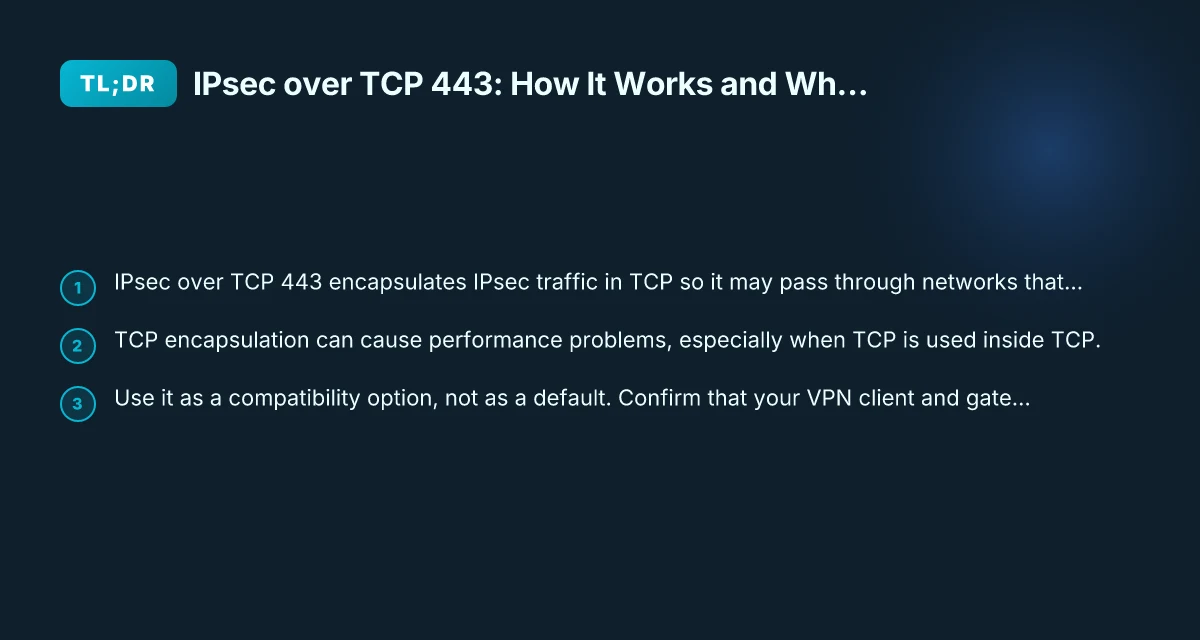
The trade-off is that TCP is not always an efficient transport for tunneled traffic. If the applications inside the VPN already use TCP, putting their traffic inside another TCP connection can lead to “TCP-over-TCP” effects. When packets are lost, both the inner and outer TCP connections may attempt retransmission and congestion control, sometimes causing delays, reduced throughput, or uneven performance.
| Option | Transport approach | Potential advantage | Main limitation |
|---|---|---|---|
| Standard IPsec | Usually UDP, such as UDP 500 and 4500 | Efficient for typical VPN use | May fail where UDP is blocked |
| IPsec over TCP 443 | IPsec traffic carried over TCP | Can work on some UDP-restricted networks | May be slower or blocked by inspection |
| TLS VPN | VPN traffic protected and transported using TLS | Often designed for operation through web-friendly networks | Requires a compatible TLS VPN service |
The best option depends on the network, the VPN product, and what the gateway administrator allows. TCP 443 is a fallback possibility, not a guarantee of better speed or broader access.
When to use it
Consider IPsec over TCP 443 when a standard IPsec connection cannot be established because UDP traffic is blocked or restricted. It may also be useful when a managed VPN product provides it as a supported fallback for users on hotels, guest Wi-Fi, or tightly controlled corporate networks. Best Free VPN That Lets You Pick Locations: Top Options and Limits
Before enabling it, check the following:
- The VPN client and gateway both support the same TCP encapsulation mode.
- The gateway is configured to listen on the required TCP port.
- The network allows a direct connection to that gateway and does not require an incompatible proxy.
- Your organization permits VPN use on the network.
- You have compared connection stability and speed with the standard UDP mode.
If you administer the VPN, test the mode under realistic conditions. Confirm authentication, routing, DNS behavior, and access controls, not just whether the client reports a successful connection.
Troubleshoot IPsec over TCP 443 connection problems
| Symptom | Possible cause | What to verify | Practical next step |
|---|---|---|---|
| Connection times out | TCP 443 is blocked or unreachable | Firewall rules and server reachability | Test access to the VPN gateway |
| TCP connects but VPN does not | IPsec negotiation or configuration failure | Client and gateway settings | Check logs and matching configuration |
| Connection works on one network only | Different firewall or inspection policies | Network-specific filtering | Compare allowed traffic across networks |
| VPN connects but apps cannot reach resources | Routes, DNS, or access policies | Assigned routes and DNS settings | Check VPN and gateway policies |
| Connection is unusually slow | TCP-over-TCP effects or congestion | Packet loss and network load | Compare with UDP where available |
| Connection drops intermittently | Unstable path or timeout handling | NAT and firewall session behavior | Review keepalive and timeout settings |
| Port 443 appears open but VPN fails | Port access does not guarantee protocol acceptance | Deep packet inspection and gateway support | Confirm TCP encapsulation is supported end to end |
Compiled November 2026; check the provider's site for current details. FortiClient VPN 7.4.3 Download: Safe Sources and Installation Guide
Troubleshooting common connection problems
If the VPN fails to connect, first verify that TCP 443 is reachable from the client to the correct gateway. A port being open in general does not prove that the gateway is listening on it or that the network permits traffic to that specific destination.
Then confirm that TCP encapsulation is enabled at both ends and that the client is using the correct server address and configuration. Check VPN logs for negotiation errors, authentication failures, or timeouts. If the connection establishes but performs poorly, compare it with UDP mode on a network where UDP is available. The issue may be the transport rather than the VPN credentials or encryption settings.
Avoid changing firewall rules or using a VPN to bypass network controls without authorization. On corporate or regulated networks, ask the network administrator for an approved connection method.
Recommendation
Use standard UDP-based IPsec when the network supports it, because it is generally the more suitable transport for IPsec. Choose IPsec over TCP 443 when UDP is unavailable and your VPN client and gateway explicitly support the same mode. If TCP encapsulation is blocked or consistently performs poorly, ask your administrator whether an approved TLS VPN or another supported access method is available. Best VPN for Microsoft Edge Extension: How to Choose and Use One